
Teksti
Tausta
Näytä
Lisäasetukset
Kieli
Urantia Opas
Kysy kirjan sisällöstä. Opas vastaa Book Enginen omien lähdekohtien perusteella ja ohjaa sinut lukemaan ne.
Hei! 🙏
Olen sinun Urantia-oppaasi. Tehtäväni on auttaa sinua löytämään oikeat kohdat Urantia-kirjasta ja ymmärtämään sen opetuksia syvemmin. 😊❤️
Kun sangik-perheen värillisten jälkeläisten lukumäärä alkoi moninkertaistua ja kun he etsivät sopivaa tilaisuutta levittäytyä naapurialueille, viides – geologisten laskelmien mukaan kolmas – jäätikkö oli edennyt Euroopassa ja Aasiassa hyvin pitkälle etelään. Värillisten rotujen ilmaantumisen aikana vallinneen jääkauden ankaruus ja siitä johtuneet vaikeudet koettelivat näitä rotuja tavattomasti. Tämä jäätikkö levittäytyi Aasiassa niin laajalle, että vaellus Itä-Aasiaan estyi tuhansien vuosien ajaksi. Ja vasta kun Välimeri Arabian kohoamisen seurauksena myöhemmin väistyi, näiden rotujen oli mahdollista päästä Afrikkaan.
Siksi nämä sangik-kansat levittäytyivät lähes sadaksituhanneksi vuodeksi vuoriston eduskukkuloiden ympärille, ja ne joutuivat toistensa kanssa enemmän tai vähemmän kosketuksiin siitäkin huolimatta, että eri rotujen välillä ilmeni jo varhain omalaatuista mutta luonnollista antipatiaa.
Planeettaprinssin ja Aatamin aikojen välillä Intiasta tuli kosmopoliittisimman maan päällä koskaan eläneen väestön kotimaa. Mutta oli valitettavaa, että tämä sekoitus tuli sisältäneeksi niin paljon vihreää, oranssia ja indigonväristä rotua. Näistä toissijaisista sangik-kansanheimoista elämä oli etelämaissa helpompaa ja miellyttävämpää, ja myöhemmin monet niistä vaelsivatkin Afrikkaan. Ensisijaiset sangik-kansat, etevämmät rodut, karttoivat tropiikkia. Niinpä punainen ihminen siirtyi koillisen suuntaan eli Aasiaan, ja keltainen ihminen seurasi tiiviisti hänen kannoillaan, kun siniset ihmiset puolestaan siirtyivät luoteeseen eli Eurooppaan.
Punaiset ihmiset alkoivat jo varhain vaeltaa koillista kohti, heti perääntyvän jäätikön kannoilla. He kiersivät Intian ylämaat ja ottivat haltuunsa koko Koillis-Aasian. Keltaiset heimokunnat, jotka sittemmin ajoivat heidät Pohjois-Amerikkaan pois Aasiasta, seurasivat tiiviisti heidän perässään.
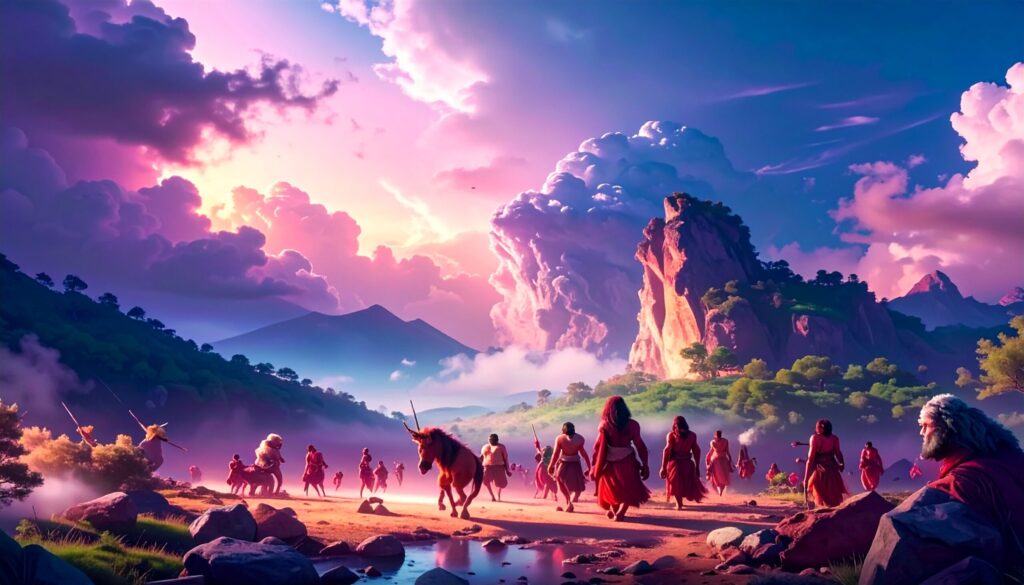
Kun punaisen rodun suhteellisen puhdassukuiset jäänteet jättivät Aasian, niitä oli yksitoista heimoa, joihin kuului vähän yli seitsemäntuhatta miestä, naista ja lasta. Näiden heimojen mukana kulki kolme pientä sekoittunutta alkuperää olevaa ryhmää, joista suurin edusti oranssin ja sinisen rodun sekoitusta. Nämä kolme ryhmää eivät koskaan täysin ystävystyneet punaisen ihmisen kanssa, ja jo varhain ne matkasivat etelään – Meksikoon ja Väli-Amerikkaan –, jossa niihin myöhemmin liittyi pieni keskenään sekoittuneiden keltaisten ja punaisten ryhmä. Kaikki nämä kansat solmivat parisuhteita yli roturajojen ja perustivat uuden, monikoosteisen rodun, joka ei ollut läheskään yhtä sotaisa kuin puhdasrotuiset punaiset ihmiset. Viidentuhannen vuoden kuluessa tämä yhteen sulautunut rotu jakautui kolmeksi ryhmäksi, jotka perustivat vastaavasti Meksikon, Väli-Amerikan ja Etelä-Amerikan sivilisaatiot. Eteläamerikkalainen haara sai aavistuksen verran Aatamin verenperintöä.
Aasiassa tapahtui punaisen ja keltaisen alkurodun sekoittumista tiettyyn määrään asti, ja tästä yhdistymisestä tuloksena ollut jälkeläistö vaelsi kauemmas itään ja pitkin eteläistä merenrannikkoa, ja nopeasti runsastunut keltainen rotu ajoi sen lopulta niemimaille ja läheisille meren saarille. He ovat nykyajan ruskeita ihmisiä.
Keltainen rotu on pitänyt yhtäjaksoisesti hallussaan Itä-Aasian keskiosia. Kaikista kuudesta värillisestä rodusta juuri tätä rotua on säilynyt nykyaikaan asti eniten. Vaikka keltaiset ihmiset silloin tällöin ryhtyivätkin rotusotaan, he eivät kuitenkaan käyneet niin loputtomia ja säälimättömiä hävityssotia kuin punaiset, vihreät ja oranssinväriset ihmiset. Nämä kolme rotua käytännöllisesti katsoen tuhosivat itsensä, ennen kuin niiden toisrotuiset viholliset ne lopulta lähes kokonaan hävittivät.
Kun viides jäätikkö ei Euroopassa ulottunut kovin kauas etelään, tie oli osittain avoinna näiden sangik-kansanheimojen siirtyä luoteeseen, ja jään vetäydyttyä siniset ihmiset vaelsivat muutamien muiden pienten roturyhmien seurassa Andonin heimokunnan muinaisia jalanjälkiä länteen. He tunkeutuivat Eurooppaan toinen toistaan seuranneina aaltoina ja ottivat haltuunsa suurimman osan tästä mantereesta.
Pian he kohtasivat Euroopassa varhaisen ja yhteisen esi-isänsä, Andonin, neandertalijälkeläiset. Jäätikkö oli ajanut nämä vanhemmat Euroopan neandertalit etelään ja itään, ja näin he saattoivat nopeasti käydä alueelle tunkeutuneita sangik-heimoihin kuuluvia serkkujaan vastaan ja sulattaa ne omaan kansaansa.
Sangik-heimot olivat yleensä ja etupäässä älykkäämpiä ja useimmissa suhteissa paljon korkeammalla kuin varhaisten andonilais-tasankolaisten heikentyneet jälkeläiset; ja näiden sangik-heimojen sekoittuminen neandertalilaiskansoihin johti vanhemman rodun välittömään kohenemiseen. Juuri tämä sangik-rotuperimän – aivan erityisesti sinisen perintöaineksen – muodossa saatu verenlisäys tuotti tuloksena sen huomattavan kohenemisen Neandertalin kansoissa, joka tuli esille idästä tulleiden, yhä älykkäämpien heimojen vyörymisenä peräkkäisinä aaltoina Euroopan yli.
Seuraavan jääkausien välisen jakson aikana tämä uusi neandertalirotu levisi Englannin ja Intian väliselle alueelle. Muinaiselle Persian niemimaalle jäänyt sinisen rodun sirpale sulautui myöhemmin muutamiin muihin, pääasiassa keltaisiin rotuaineksiin, ja tämän tuloksena ollut sekoitus, jota Aatamin violetti rotu myöhemmin jossain määrin kohensi, on säilynyt nykyisten arabien tummaihoisena nomadiheimona.
Kaikissa yrityksissä nykyajan kansojen sangik-syntyperän tunnistamiseksi on otettava huomioon se rotukantojen koheneminen, joka oli tuloksena siitä, että niihin sekoittui myöhemmin Aatamin verenperintöä.
Korkeammalla tasolla olleet rodut hakeutuivat pohjoiseen eli lauhkeaan ilmanalaan, kun sen sijaan oranssit, vihreät ja indigonväriset rodut toinen toisensa perään hankkiutuivat Afrikkaan sen merestä äskettäin kohonneen kannaksen kautta, joka erotti länteen vetäytymässä olleen Välimeren Intian valtamerestä.
Indigonvärinen ihminen muutti sangik-kansoista viimeisenä pois rotunsa alkukeskuksesta. Jokseenkin niihin aikoihin, kun vihreä rotu oli hävittämässä oranssia rotua Egyptistä ja niin tehdessään suuresti heikensi itseään, alkoi mustien suuri exodus Palestiinan kautta merenrannikkoa pitkin etelään. Ja myöhemmin, kun nämä fyysisesti väkivahvat indigokansat tulivat Egyptiin, ne pelkän lukumääränsä voimalla pyyhkäisivät vihreän ihmisrodun olemattomiin. Nämä indigonväriset rodut sulattivat itseensä sen, mitä oranssista rodusta oli jäljellä, sekä suuren osan vihreästä rotuaineksesta, ja tietyt indigoheimot kohenivat tämän rotujen yhteensulautumisen kautta melkoisesti.
Ja näin käy selville, että Egyptiä hallitsi ensin oranssi ihminen, sitten vihreä, jota seurasi indigo (musta) ihminen ja vieläkin myöhemmin indigosta, sinisestä ja muuntuneesta vihreästä aineksesta koostunut sekarotu. Mutta jo kauan ennen Aatamin saapumista Euroopan siniset ihmiset ja Arabian sekoittuneet rodut olivat ajaneet indigonvärisen rodun pois Egyptistä pitkälle etelään, Afrikan mantereen sisäosiin.
Sangikien vaellusten lähetessä loppuaan vihreä ja oranssi rotu ovat sammuneet, punainen ihminen pitää hallussaan Pohjois-Amerikkaa, keltainen ihminen Itä-Aasiaa, sininen ihminen Eurooppaa, ja indigonvärinen rotu on ajautunut Afrikkaan. Intia on toissijaisten sangik-rotujen sekoituksen tyyssija, ja ruskean ihmisen, joka on punaisen ja keltaisen sekoitus, hallussa ovat Aasian rannikolla olevat saaret. Kokolailla oivalliset potentiaalit omaava sulautumarotu pitää hallussaan Etelä-Amerikan ylämaita. Vähemmän sekoittuneet andoniitit elävät Euroopan pohjoisilla äärialueilla sekä Islannissa, Grönlannissa ja koillisessa Pohjois-Amerikassa.
Niiden jaksojen aikana, jolloin jäätiköt etenivät kauimmaksi, läntisimmät Andonin heimot olivat vähällä ajautua mereen. Vuosikausia ne elivät nykyisen Englannin saaren kapealla eteläkaistaleella. Ja nimenomaan näistä toistuvista jäätikön etenemisistä kertova perimätieto kannusti heitä etsimään turvaa mereltä, kun kuudes ja viimeinen jäätikkö lopulta ilmaantui. He olivat ensimmäiset merten tutkimusretkeilijät. He rakensivat veneitä ja lähtivät etsimään uusia maita, joista he toivoivat, että kauhistuttavat jäiset hyökkäykset eivät niihin ulottuisi. Ja toiset heistä pääsivätkin Islantiin, toiset Grönlantiin, mutta valtava enemmistö menehtyi valtameren ulapalla nälkään ja janoon.
Vähän yli kahdeksankymmentätuhatta vuotta sitten, pian punaisen ihmisen Pohjois-Amerikan luoteisosaan saapumisen jälkeen, pohjoisten merenselkien jäätyminen ja Grönlannissa tapahtunut paikallisten jääkenttien eteenpäintyöntyminen ajoivat nämä Urantian kanta-asukkaiden eskimojälkeläiset etsimään parempia maita, uusia kotikontuja; ja tässä he onnistuivatkin ylitettyään turvallisesti kapeat salmet, jotka tuohon aikaan erottivat Grönlannin Pohjois-Amerikan koillisista maamassoista. He tulivat tälle mantereelle noin kaksituhattasata vuotta sen jälkeen, kun punainen ihminen oli saapunut Alaskaan. Sittemmin jotkut sinisen rodun sekoittuneen sukuhaaran jäsenet matkasivat länteen ja sulautuivat myöhempien aikojen eskimoihin, ja tämä yhdistymä koitui jonkinmääräiseksi hyödyksi eskimoheimoille.
Noin viisituhatta vuotta sitten muuan intiaaniheimo ja yksikseen elellyt eskimoryhmä kohtasivat sattumalta toisensa Hudsoninlahden kaakkoisrannalla. Kumpikin heimokunta havaitsi keskinäisen ajatustenvaihdon vaikeaksi, mutta varsin pian syntyi kuitenkin rotujen välisiä parisuhteita, mikä johti siihen, että nämä eskimot lopulta sulautuivat luvultaan suurempaan punaiseen rotuun. Ja kysymyksessä oli se ainoa kosketus, joka Pohjois-Amerikan punaisella ihmisellä oli mihinkään muuhun ihmisen sukuhaaraan aina siihen asti, kun valkoinen ihminen noin tuhat vuotta sitten ensimmäistä kertaa nousi sattumalta maihin Atlantin rannikolla.
Näiden varhaisten aikakausien kamppailuille oli ominaista rohkeus, urheus ja jopa sankaruus. Ja me kaikki pahoittelemme sitä, että myöhempien aikojen rotunne ovat kadottaneet niin monia noista varhaisten esi-isienne väärentämättömistä ja karuista ominaispiirteistä. Vaikka annammekin arvoa monille edistyvän sivilisaation hienouksille, kaipaamme silti sitä varhaisten esi-isienne suurenmoista kestävyyttä ja verratonta uhrautuvaisuutta, jotka monet kerrat lähenivät jaloutta ja ylevyyttä.
[Esittänyt muuan Urantialla asuva Elämänkantaja.]
When the colored descendants of the Sangik family began to multiply, and as they sought opportunity for expansion into adjacent territory, the fifth glacier, the third of geologic count, was well advanced on its southern drift over Europe and Asia. These early colored races were extraordinarily tested by the rigors and hardships of the glacial age of their origin. This glacier was so extensive in Asia that for thousands of years migration to eastern Asia was cut off. And not until the later retreat of the Mediterranean Sea, consequent upon the elevation of Arabia, was it possible for them to reach Africa.
Thus it was that for almost one hundred thousand years these Sangik peoples spread out around the foothills and mingled together more or less, notwithstanding the peculiar but natural antipathy which early manifested itself between the different races.
Between the times of the Planetary Prince and Adam, India became the home of the most cosmopolitan population ever to be found on the face of the earth. But it was unfortunate that this mixture came to contain so much of the green, orange, and indigo races. These secondary Sangik peoples found existence more easy and agreeable in the southlands, and many of them subsequently migrated to Africa. The primary Sangik peoples, the superior races, avoided the tropics, the red man going northeast to Asia, closely followed by the yellow man, while the blue race moved northwest into Europe.
The red men early began to migrate to the northeast, on the heels of the retreating ice, passing around the highlands of India and occupying all of northeastern Asia. They were closely followed by the yellow tribes, who subsequently drove them out of Asia into North America.
When the relatively pure-line remnants of the red race forsook Asia, there were eleven tribes, and they numbered a little over seven thousand men, women, and children. These tribes were accompanied by three small groups of mixed ancestry, the largest of these being a combination of the orange and blue races. These three groups never fully fraternized with the red man and early journeyed southward to Mexico and Central America, where they were later joined by a small group of mixed yellows and reds. These peoples all intermarried and founded a new and amalgamated race, one which was much less warlike than the pure-line red men. Within five thousand years this amalgamated race broke up into three groups, establishing the civilizations respectively of Mexico, Central America, and South America. The South American offshoot did receive a faint touch of the blood of Adam.
To a certain extent the early red and yellow men mingled in Asia, and the offspring of this union journeyed on to the east and along the southern seacoast and, eventually, were driven by the rapidly increasing yellow race onto the peninsulas and near-by islands of the sea. They are the present-day brown men.
The yellow race has continued to occupy the central regions of eastern Asia. Of all the six colored races they have survived in greatest numbers. While the yellow men now and then engaged in racial war, they did not carry on such incessant and relentless wars of extermination as were waged by the red, green, and orange men. These three races virtually destroyed themselves before they were finally all but annihilated by their enemies of other races.
Since the fifth glacier did not extend so far south in Europe, the way was partially open for these Sangik peoples to migrate to the northwest; and upon the retreat of the ice the blue men, together with a few other small racial groups, migrated westward along the old trails of the Andon tribes. They invaded Europe in successive waves, occupying most of the continent.
In Europe they soon encountered the Neanderthal descendants of their early and common ancestor, Andon. These older European Neanderthalers had been driven south and east by the glacier and thus were in position quickly to encounter and absorb their invading cousins of the Sangik tribes.
In general and to start with, the Sangik tribes were more intelligent than, and in most ways far superior to, the deteriorated descendants of the early Andonic plainsmen; and the mingling of these Sangik tribes with the Neanderthal peoples led to the immediate improvement of the older race. It was this infusion of Sangik blood, more especially that of the blue man, which produced that marked improvement in the Neanderthal peoples exhibited by the successive waves of increasingly intelligent tribes that swept over Europe from the east.
During the following interglacial period this new Neanderthal race extended from England to India. The remnant of the blue race left in the old Persian peninsula later amalgamated with certain others, primarily the yellow; and the resultant blend, subsequently somewhat upstepped by the violet race of Adam, has persisted as the swarthy nomadic tribes of modern Arabs.
All efforts to identify the Sangik ancestry of modern peoples must take into account the later improvement of the racial strains by the subsequent admixture of Adamic blood.
The superior races sought the northern or temperate climes, while the orange, green, and indigo races successively gravitated to Africa over the newly elevated land bridge which separated the westward retreating Mediterranean from the Indian Ocean.
The last of the Sangik peoples to migrate from their center of race origin was the indigo man. About the time the green man was killing off the orange race in Egypt and greatly weakening himself in so doing, the great black exodus started south through Palestine along the coast; and later, when these physically strong indigo peoples overran Egypt, they wiped the green man out of existence by sheer force of numbers. These indigo races absorbed the remnants of the orange man and much of the stock of the green man, and certain of the indigo tribes were considerably improved by this racial amalgamation.
And so it appears that Egypt was first dominated by the orange man, then by the green, followed by the indigo (black) man, and still later by a mongrel race of indigo, blue, and modified green men. But long before Adam arrived, the blue men of Europe and the mixed races of Arabia had driven the indigo race out of Egypt and far south on the African continent.
As the Sangik migrations draw to a close, the green and orange races are gone, the red man holds North America, the yellow man eastern Asia, the blue man Europe, and the indigo race has gravitated to Africa. India harbors a blend of the secondary Sangik races, and the brown man, a blend of the red and yellow, holds the islands off the Asiatic coast. An amalgamated race of rather superior potential occupies the highlands of South America. The purer Andonites live in the extreme northern regions of Europe and in Iceland, Greenland, and northeastern North America.
During the periods of farthest glacial advance the westernmost of the Andon tribes came very near being driven into the sea. They lived for years on a narrow southern strip of the present island of England. And it was the tradition of these repeated glacial advances that drove them to take to the sea when the sixth and last glacier finally appeared. They were the first marine adventurers. They built boats and started in search of new lands which they hoped might be free from the terrifying ice invasions. And some of them reached Iceland, others Greenland, but the vast majority perished from hunger and thirst on the open sea.
A little more than eighty thousand years ago, shortly after the red man entered northwestern North America, the freezing over of the north seas and the advance of local ice fields on Greenland drove these Eskimo descendants of the Urantia aborigines to seek a better land, a new home; and they were successful, safely crossing the narrow straits which then separated Greenland from the northeastern land masses of North America. They reached the continent about twenty-one hundred years after the red man arrived in Alaska. Subsequently some of the mixed stock of the blue man journeyed westward and amalgamated with the later-day Eskimos, and this union was slightly beneficial to the Eskimo tribes.
About five thousand years ago a chance meeting occurred between an Indian tribe and a lone Eskimo group on the southeastern shores of Hudson Bay. These two tribes found it difficult to communicate with each other, but very soon they intermarried with the result that these Eskimos were eventually absorbed by the more numerous red men. And this represents the only contact of the North American red man with any other human stock down to about one thousand years ago, when the white man first chanced to land on the Atlantic coast.
The struggles of these early ages were characterized by courage, bravery, and even heroism. And we all regret that so many of those sterling and rugged traits of your early ancestors have been lost to the later-day races. While we appreciate the value of many of the refinements of advancing civilization, we miss the magnificent persistency and superb devotion of your early ancestors, which oftentimes bordered on grandeur and sublimity.
[Presented by a Life Carrier resident on Urantia.]
SuomiEnglish
Kun sangik-perheen värillisten jälkeläisten lukumäärä alkoi moninkertaistua ja kun he etsivät sopivaa tilaisuutta levittäytyä naapurialueille, viides – geologisten laskelmien mukaan kolmas – jäätikkö oli edennyt Euroopassa ja Aasiassa hyvin pitkälle etelään. Värillisten rotujen ilmaantumisen aikana vallinneen jääkauden ankaruus ja siitä johtuneet vaikeudet koettelivat näitä rotuja tavattomasti. Tämä jäätikkö levittäytyi Aasiassa niin laajalle, että vaellus Itä-Aasiaan estyi tuhansien vuosien ajaksi. Ja vasta kun Välimeri Arabian kohoamisen seurauksena myöhemmin väistyi, näiden rotujen oli mahdollista päästä Afrikkaan.
When the colored descendants of the Sangik family began to multiply, and as they sought opportunity for expansion into adjacent territory, the fifth glacier, the third of geologic count, was well advanced on its southern drift over Europe and Asia. These early colored races were extraordinarily tested by the rigors and hardships of the glacial age of their origin. This glacier was so extensive in Asia that for thousands of years migration to eastern Asia was cut off. And not until the later retreat of the Mediterranean Sea, consequent upon the elevation of Arabia, was it possible for them to reach Africa.
Siksi nämä sangik-kansat levittäytyivät lähes sadaksituhanneksi vuodeksi vuoriston eduskukkuloiden ympärille, ja ne joutuivat toistensa kanssa enemmän tai vähemmän kosketuksiin siitäkin huolimatta, että eri rotujen välillä ilmeni jo varhain omalaatuista mutta luonnollista antipatiaa.
Thus it was that for almost one hundred thousand years these Sangik peoples spread out around the foothills and mingled together more or less, notwithstanding the peculiar but natural antipathy which early manifested itself between the different races.
Planeettaprinssin ja Aatamin aikojen välillä Intiasta tuli kosmopoliittisimman maan päällä koskaan eläneen väestön kotimaa. Mutta oli valitettavaa, että tämä sekoitus tuli sisältäneeksi niin paljon vihreää, oranssia ja indigonväristä rotua. Näistä toissijaisista sangik-kansanheimoista elämä oli etelämaissa helpompaa ja miellyttävämpää, ja myöhemmin monet niistä vaelsivatkin Afrikkaan. Ensisijaiset sangik-kansat, etevämmät rodut, karttoivat tropiikkia. Niinpä punainen ihminen siirtyi koillisen suuntaan eli Aasiaan, ja keltainen ihminen seurasi tiiviisti hänen kannoillaan, kun siniset ihmiset puolestaan siirtyivät luoteeseen eli Eurooppaan.
Between the times of the Planetary Prince and Adam, India became the home of the most cosmopolitan population ever to be found on the face of the earth. But it was unfortunate that this mixture came to contain so much of the green, orange, and indigo races. These secondary Sangik peoples found existence more easy and agreeable in the southlands, and many of them subsequently migrated to Africa. The primary Sangik peoples, the superior races, avoided the tropics, the red man going northeast to Asia, closely followed by the yellow man, while the blue race moved northwest into Europe.
Punaiset ihmiset alkoivat jo varhain vaeltaa koillista kohti, heti perääntyvän jäätikön kannoilla. He kiersivät Intian ylämaat ja ottivat haltuunsa koko Koillis-Aasian. Keltaiset heimokunnat, jotka sittemmin ajoivat heidät Pohjois-Amerikkaan pois Aasiasta, seurasivat tiiviisti heidän perässään.
The red men early began to migrate to the northeast, on the heels of the retreating ice, passing around the highlands of India and occupying all of northeastern Asia. They were closely followed by the yellow tribes, who subsequently drove them out of Asia into North America.
Kun punaisen rodun suhteellisen puhdassukuiset jäänteet jättivät Aasian, niitä oli yksitoista heimoa, joihin kuului vähän yli seitsemäntuhatta miestä, naista ja lasta. Näiden heimojen mukana kulki kolme pientä sekoittunutta alkuperää olevaa ryhmää, joista suurin edusti oranssin ja sinisen rodun sekoitusta. Nämä kolme ryhmää eivät koskaan täysin ystävystyneet punaisen ihmisen kanssa, ja jo varhain ne matkasivat etelään – Meksikoon ja Väli-Amerikkaan –, jossa niihin myöhemmin liittyi pieni keskenään sekoittuneiden keltaisten ja punaisten ryhmä. Kaikki nämä kansat solmivat parisuhteita yli roturajojen ja perustivat uuden, monikoosteisen rodun, joka ei ollut läheskään yhtä sotaisa kuin puhdasrotuiset punaiset ihmiset. Viidentuhannen vuoden kuluessa tämä yhteen sulautunut rotu jakautui kolmeksi ryhmäksi, jotka perustivat vastaavasti Meksikon, Väli-Amerikan ja Etelä-Amerikan sivilisaatiot. Eteläamerikkalainen haara sai aavistuksen verran Aatamin verenperintöä.
When the relatively pure-line remnants of the red race forsook Asia, there were eleven tribes, and they numbered a little over seven thousand men, women, and children. These tribes were accompanied by three small groups of mixed ancestry, the largest of these being a combination of the orange and blue races. These three groups never fully fraternized with the red man and early journeyed southward to Mexico and Central America, where they were later joined by a small group of mixed yellows and reds. These peoples all intermarried and founded a new and amalgamated race, one which was much less warlike than the pure-line red men. Within five thousand years this amalgamated race broke up into three groups, establishing the civilizations respectively of Mexico, Central America, and South America. The South American offshoot did receive a faint touch of the blood of Adam.
Aasiassa tapahtui punaisen ja keltaisen alkurodun sekoittumista tiettyyn määrään asti, ja tästä yhdistymisestä tuloksena ollut jälkeläistö vaelsi kauemmas itään ja pitkin eteläistä merenrannikkoa, ja nopeasti runsastunut keltainen rotu ajoi sen lopulta niemimaille ja läheisille meren saarille. He ovat nykyajan ruskeita ihmisiä.
To a certain extent the early red and yellow men mingled in Asia, and the offspring of this union journeyed on to the east and along the southern seacoast and, eventually, were driven by the rapidly increasing yellow race onto the peninsulas and near-by islands of the sea. They are the present-day brown men.
Keltainen rotu on pitänyt yhtäjaksoisesti hallussaan Itä-Aasian keskiosia. Kaikista kuudesta värillisestä rodusta juuri tätä rotua on säilynyt nykyaikaan asti eniten. Vaikka keltaiset ihmiset silloin tällöin ryhtyivätkin rotusotaan, he eivät kuitenkaan käyneet niin loputtomia ja säälimättömiä hävityssotia kuin punaiset, vihreät ja oranssinväriset ihmiset. Nämä kolme rotua käytännöllisesti katsoen tuhosivat itsensä, ennen kuin niiden toisrotuiset viholliset ne lopulta lähes kokonaan hävittivät.
The yellow race has continued to occupy the central regions of eastern Asia. Of all the six colored races they have survived in greatest numbers. While the yellow men now and then engaged in racial war, they did not carry on such incessant and relentless wars of extermination as were waged by the red, green, and orange men. These three races virtually destroyed themselves before they were finally all but annihilated by their enemies of other races.
Kun viides jäätikkö ei Euroopassa ulottunut kovin kauas etelään, tie oli osittain avoinna näiden sangik-kansanheimojen siirtyä luoteeseen, ja jään vetäydyttyä siniset ihmiset vaelsivat muutamien muiden pienten roturyhmien seurassa Andonin heimokunnan muinaisia jalanjälkiä länteen. He tunkeutuivat Eurooppaan toinen toistaan seuranneina aaltoina ja ottivat haltuunsa suurimman osan tästä mantereesta.
Since the fifth glacier did not extend so far south in Europe, the way was partially open for these Sangik peoples to migrate to the northwest; and upon the retreat of the ice the blue men, together with a few other small racial groups, migrated westward along the old trails of the Andon tribes. They invaded Europe in successive waves, occupying most of the continent.
Pian he kohtasivat Euroopassa varhaisen ja yhteisen esi-isänsä, Andonin, neandertalijälkeläiset. Jäätikkö oli ajanut nämä vanhemmat Euroopan neandertalit etelään ja itään, ja näin he saattoivat nopeasti käydä alueelle tunkeutuneita sangik-heimoihin kuuluvia serkkujaan vastaan ja sulattaa ne omaan kansaansa.
In Europe they soon encountered the Neanderthal descendants of their early and common ancestor, Andon. These older European Neanderthalers had been driven south and east by the glacier and thus were in position quickly to encounter and absorb their invading cousins of the Sangik tribes.
Sangik-heimot olivat yleensä ja etupäässä älykkäämpiä ja useimmissa suhteissa paljon korkeammalla kuin varhaisten andonilais-tasankolaisten heikentyneet jälkeläiset; ja näiden sangik-heimojen sekoittuminen neandertalilaiskansoihin johti vanhemman rodun välittömään kohenemiseen. Juuri tämä sangik-rotuperimän – aivan erityisesti sinisen perintöaineksen – muodossa saatu verenlisäys tuotti tuloksena sen huomattavan kohenemisen Neandertalin kansoissa, joka tuli esille idästä tulleiden, yhä älykkäämpien heimojen vyörymisenä peräkkäisinä aaltoina Euroopan yli.
In general and to start with, the Sangik tribes were more intelligent than, and in most ways far superior to, the deteriorated descendants of the early Andonic plainsmen; and the mingling of these Sangik tribes with the Neanderthal peoples led to the immediate improvement of the older race. It was this infusion of Sangik blood, more especially that of the blue man, which produced that marked improvement in the Neanderthal peoples exhibited by the successive waves of increasingly intelligent tribes that swept over Europe from the east.
Seuraavan jääkausien välisen jakson aikana tämä uusi neandertalirotu levisi Englannin ja Intian väliselle alueelle. Muinaiselle Persian niemimaalle jäänyt sinisen rodun sirpale sulautui myöhemmin muutamiin muihin, pääasiassa keltaisiin rotuaineksiin, ja tämän tuloksena ollut sekoitus, jota Aatamin violetti rotu myöhemmin jossain määrin kohensi, on säilynyt nykyisten arabien tummaihoisena nomadiheimona.
During the following interglacial period this new Neanderthal race extended from England to India. The remnant of the blue race left in the old Persian peninsula later amalgamated with certain others, primarily the yellow; and the resultant blend, subsequently somewhat upstepped by the violet race of Adam, has persisted as the swarthy nomadic tribes of modern Arabs.
Kaikissa yrityksissä nykyajan kansojen sangik-syntyperän tunnistamiseksi on otettava huomioon se rotukantojen koheneminen, joka oli tuloksena siitä, että niihin sekoittui myöhemmin Aatamin verenperintöä.
All efforts to identify the Sangik ancestry of modern peoples must take into account the later improvement of the racial strains by the subsequent admixture of Adamic blood.
Korkeammalla tasolla olleet rodut hakeutuivat pohjoiseen eli lauhkeaan ilmanalaan, kun sen sijaan oranssit, vihreät ja indigonväriset rodut toinen toisensa perään hankkiutuivat Afrikkaan sen merestä äskettäin kohonneen kannaksen kautta, joka erotti länteen vetäytymässä olleen Välimeren Intian valtamerestä.
The superior races sought the northern or temperate climes, while the orange, green, and indigo races successively gravitated to Africa over the newly elevated land bridge which separated the westward retreating Mediterranean from the Indian Ocean.
Indigonvärinen ihminen muutti sangik-kansoista viimeisenä pois rotunsa alkukeskuksesta. Jokseenkin niihin aikoihin, kun vihreä rotu oli hävittämässä oranssia rotua Egyptistä ja niin tehdessään suuresti heikensi itseään, alkoi mustien suuri exodus Palestiinan kautta merenrannikkoa pitkin etelään. Ja myöhemmin, kun nämä fyysisesti väkivahvat indigokansat tulivat Egyptiin, ne pelkän lukumääränsä voimalla pyyhkäisivät vihreän ihmisrodun olemattomiin. Nämä indigonväriset rodut sulattivat itseensä sen, mitä oranssista rodusta oli jäljellä, sekä suuren osan vihreästä rotuaineksesta, ja tietyt indigoheimot kohenivat tämän rotujen yhteensulautumisen kautta melkoisesti.
The last of the Sangik peoples to migrate from their center of race origin was the indigo man. About the time the green man was killing off the orange race in Egypt and greatly weakening himself in so doing, the great black exodus started south through Palestine along the coast; and later, when these physically strong indigo peoples overran Egypt, they wiped the green man out of existence by sheer force of numbers. These indigo races absorbed the remnants of the orange man and much of the stock of the green man, and certain of the indigo tribes were considerably improved by this racial amalgamation.
Ja näin käy selville, että Egyptiä hallitsi ensin oranssi ihminen, sitten vihreä, jota seurasi indigo (musta) ihminen ja vieläkin myöhemmin indigosta, sinisestä ja muuntuneesta vihreästä aineksesta koostunut sekarotu. Mutta jo kauan ennen Aatamin saapumista Euroopan siniset ihmiset ja Arabian sekoittuneet rodut olivat ajaneet indigonvärisen rodun pois Egyptistä pitkälle etelään, Afrikan mantereen sisäosiin.
And so it appears that Egypt was first dominated by the orange man, then by the green, followed by the indigo (black) man, and still later by a mongrel race of indigo, blue, and modified green men. But long before Adam arrived, the blue men of Europe and the mixed races of Arabia had driven the indigo race out of Egypt and far south on the African continent.
Sangikien vaellusten lähetessä loppuaan vihreä ja oranssi rotu ovat sammuneet, punainen ihminen pitää hallussaan Pohjois-Amerikkaa, keltainen ihminen Itä-Aasiaa, sininen ihminen Eurooppaa, ja indigonvärinen rotu on ajautunut Afrikkaan. Intia on toissijaisten sangik-rotujen sekoituksen tyyssija, ja ruskean ihmisen, joka on punaisen ja keltaisen sekoitus, hallussa ovat Aasian rannikolla olevat saaret. Kokolailla oivalliset potentiaalit omaava sulautumarotu pitää hallussaan Etelä-Amerikan ylämaita. Vähemmän sekoittuneet andoniitit elävät Euroopan pohjoisilla äärialueilla sekä Islannissa, Grönlannissa ja koillisessa Pohjois-Amerikassa.
As the Sangik migrations draw to a close, the green and orange races are gone, the red man holds North America, the yellow man eastern Asia, the blue man Europe, and the indigo race has gravitated to Africa. India harbors a blend of the secondary Sangik races, and the brown man, a blend of the red and yellow, holds the islands off the Asiatic coast. An amalgamated race of rather superior potential occupies the highlands of South America. The purer Andonites live in the extreme northern regions of Europe and in Iceland, Greenland, and northeastern North America.
Niiden jaksojen aikana, jolloin jäätiköt etenivät kauimmaksi, läntisimmät Andonin heimot olivat vähällä ajautua mereen. Vuosikausia ne elivät nykyisen Englannin saaren kapealla eteläkaistaleella. Ja nimenomaan näistä toistuvista jäätikön etenemisistä kertova perimätieto kannusti heitä etsimään turvaa mereltä, kun kuudes ja viimeinen jäätikkö lopulta ilmaantui. He olivat ensimmäiset merten tutkimusretkeilijät. He rakensivat veneitä ja lähtivät etsimään uusia maita, joista he toivoivat, että kauhistuttavat jäiset hyökkäykset eivät niihin ulottuisi. Ja toiset heistä pääsivätkin Islantiin, toiset Grönlantiin, mutta valtava enemmistö menehtyi valtameren ulapalla nälkään ja janoon.
During the periods of farthest glacial advance the westernmost of the Andon tribes came very near being driven into the sea. They lived for years on a narrow southern strip of the present island of England. And it was the tradition of these repeated glacial advances that drove them to take to the sea when the sixth and last glacier finally appeared. They were the first marine adventurers. They built boats and started in search of new lands which they hoped might be free from the terrifying ice invasions. And some of them reached Iceland, others Greenland, but the vast majority perished from hunger and thirst on the open sea.
Vähän yli kahdeksankymmentätuhatta vuotta sitten, pian punaisen ihmisen Pohjois-Amerikan luoteisosaan saapumisen jälkeen, pohjoisten merenselkien jäätyminen ja Grönlannissa tapahtunut paikallisten jääkenttien eteenpäintyöntyminen ajoivat nämä Urantian kanta-asukkaiden eskimojälkeläiset etsimään parempia maita, uusia kotikontuja; ja tässä he onnistuivatkin ylitettyään turvallisesti kapeat salmet, jotka tuohon aikaan erottivat Grönlannin Pohjois-Amerikan koillisista maamassoista. He tulivat tälle mantereelle noin kaksituhattasata vuotta sen jälkeen, kun punainen ihminen oli saapunut Alaskaan. Sittemmin jotkut sinisen rodun sekoittuneen sukuhaaran jäsenet matkasivat länteen ja sulautuivat myöhempien aikojen eskimoihin, ja tämä yhdistymä koitui jonkinmääräiseksi hyödyksi eskimoheimoille.
A little more than eighty thousand years ago, shortly after the red man entered northwestern North America, the freezing over of the north seas and the advance of local ice fields on Greenland drove these Eskimo descendants of the Urantia aborigines to seek a better land, a new home; and they were successful, safely crossing the narrow straits which then separated Greenland from the northeastern land masses of North America. They reached the continent about twenty-one hundred years after the red man arrived in Alaska. Subsequently some of the mixed stock of the blue man journeyed westward and amalgamated with the later-day Eskimos, and this union was slightly beneficial to the Eskimo tribes.
Noin viisituhatta vuotta sitten muuan intiaaniheimo ja yksikseen elellyt eskimoryhmä kohtasivat sattumalta toisensa Hudsoninlahden kaakkoisrannalla. Kumpikin heimokunta havaitsi keskinäisen ajatustenvaihdon vaikeaksi, mutta varsin pian syntyi kuitenkin rotujen välisiä parisuhteita, mikä johti siihen, että nämä eskimot lopulta sulautuivat luvultaan suurempaan punaiseen rotuun. Ja kysymyksessä oli se ainoa kosketus, joka Pohjois-Amerikan punaisella ihmisellä oli mihinkään muuhun ihmisen sukuhaaraan aina siihen asti, kun valkoinen ihminen noin tuhat vuotta sitten ensimmäistä kertaa nousi sattumalta maihin Atlantin rannikolla.
About five thousand years ago a chance meeting occurred between an Indian tribe and a lone Eskimo group on the southeastern shores of Hudson Bay. These two tribes found it difficult to communicate with each other, but very soon they intermarried with the result that these Eskimos were eventually absorbed by the more numerous red men. And this represents the only contact of the North American red man with any other human stock down to about one thousand years ago, when the white man first chanced to land on the Atlantic coast.
Näiden varhaisten aikakausien kamppailuille oli ominaista rohkeus, urheus ja jopa sankaruus. Ja me kaikki pahoittelemme sitä, että myöhempien aikojen rotunne ovat kadottaneet niin monia noista varhaisten esi-isienne väärentämättömistä ja karuista ominaispiirteistä. Vaikka annammekin arvoa monille edistyvän sivilisaation hienouksille, kaipaamme silti sitä varhaisten esi-isienne suurenmoista kestävyyttä ja verratonta uhrautuvaisuutta, jotka monet kerrat lähenivät jaloutta ja ylevyyttä.
The struggles of these early ages were characterized by courage, bravery, and even heroism. And we all regret that so many of those sterling and rugged traits of your early ancestors have been lost to the later-day races. While we appreciate the value of many of the refinements of advancing civilization, we miss the magnificent persistency and superb devotion of your early ancestors, which oftentimes bordered on grandeur and sublimity.
[Esittänyt muuan Urantialla asuva Elämänkantaja.]
[Presented by a Life Carrier resident on Urantia.]