
Teksti
Tausta
Näytä
Lisäasetukset
Kieli
Urantia Opas
Kysy kirjan sisällöstä. Opas vastaa Book Enginen omien lähdekohtien perusteella ja ohjaa sinut lukemaan ne.
Hei! 🙏
Olen sinun Urantia-oppaasi. Tehtäväni on auttaa sinua löytämään oikeat kohdat Urantia-kirjasta ja ymmärtämään sen opetuksia syvemmin. 😊❤️
Kuolleista nousseen Jeesuksen keskustellessa Satanian seitsemästä mansiomaailmasta paikalle kerääntyneiden morontiapersoonallisuuksien kanssa arkkienkeleiden – kuolleistaheräämisen enkelien – päällikkö kääntyi kello kymmentä yli kolme Gabrielin puoleen ja pyysi saada Jeesukselle kuolevaisena kuuluneen ruumiin. Arkkienkelien päällikkö sanoi: ”Emme saa olla mukana hallitsijamme Mikaelin lahjoittautumiskokemukseen kuuluvassa morontianousemuksessa, mutta haluaisimme välittömästi toimeenpantavaa hajottamista varten saada huostaamme hänen kuolevaisen jäännöksensä. Tarkoituksemme ei ole käyttää dematerialisointimenetelmäämme, vaan haluamme vain panna liikkeelle prosessin, joka perustuu ajan kulumisen nopeuttamiseen. Meille riittää, että olemme nähneet Hallitsijamme elävän ja kuolevan Urantialla; taivaan armeijakunnat tahtoisivat säästyä siltä muistolta, että heidän pitäisi asiaan puuttumatta katsella, kun universumin Luojan ja Ylläpitäjän ihmishahmo hitaasti mätänee. Koko Nebadonin taivaallisten älyllisolentojen nimissä pyydän saada määräyksen, jolla Jeesus Nasaretilaiselle kuolevaisena kuulunut ruumis annetaan huostaani ja joka valtuuttaa meidät ryhtymään sen välittömään hajottamiseen.”
Gabrielin keskusteltua asiasta Edentian vanhemman Kaikkein Korkeimman kanssa taivaallisten olentojoukkojen arkkienkeliedusmiehelle annettiin lupa ryhtyä toimenpiteisiin Jeesuksen fyysisten jäännösten hävittämiseksi tavalla, josta hän tekisi itse päätöksensä.
Sen jälkeen kun tähän arkkienkelien päällikön pyyntöön oli suostuttu, hän kutsui avukseen useita tovereitaan sekä suurilukuisen joukon kaikkien taivaallisten persoonallisuusluokkien edustajia, ja sitten nämä ryhtyivät Urantian keskiväliolentojen avustamina toimenpiteisiin ottaakseen huostaansa Jeesuksen fyysisen ruumiin. Tämä kuollut ruumis oli puhtaasti aineellinen luomus; se oli fyysinen ja konkreettinen; sitä ei voinut siirtää pois haudasta samalla tavoin kuin kuolleistanousun morontiahahmo oli kyennyt pääsemään pois sinetöidystä hautakammiosta. Joidenkuiden avustavien morontiapersoonallisuuksien avun turvin morontiahahmo voidaan tiettynä hetkenä tehdä sellaiseksi ikään kuin se olisi henkeä, niin että tavallinen aine ei sen suhteen merkitse mitään, kun jonakin toisena hetkenä siitä taas voi tulla sellaista, että maailman kuolevaisten kaltaiset aineelliset olennot voivat sen havaita ja olla siihen kosketuksissa.
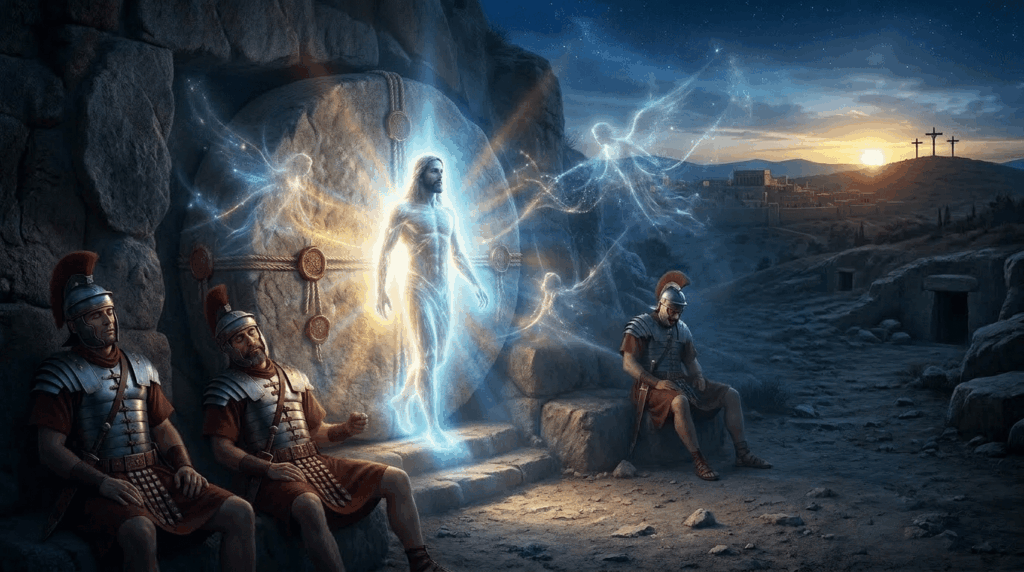
Kun he valmistautuivat siirtämään Jeesuksen ruumiin pois haudasta esivaiheena sille, että he arvokkaasti ja kunnioittavasti hävittäisivät sen miltei silmänräpäyksessä tapahtuvalla hajottamisella, Urantian toisasteisille keskiväliolennoille annettiin tehtäväksi vierittää kivet pois haudan oviaukolta. Suurempi kivi oli valtavan kookas ja pyöreä möhkäle, paljolti myllynkiven kaltainen, ja se liikkui kallioon hakatussa urassa, joten sitä voitiin vierittää edestakaisin sen mukaan, haluttiinko hautakammio avata vai sulkea. Kun vartiossa seisovat juutalaiset vartijat ja roomalaiset sotilaat aamuhämärän valossa näkivät, miten tämä valtaisa kivi alkoi, niin kuin näytti, omia aikojaan vieriä pois haudan suuaukolta – ilman mitään näkyvää syytä, joka olisi selittänyt tämän liikkumisen – heidät valtasi pelko ja pakokauhu, ja he pakenivat kiireesti tapahtumapaikalta. Juutalaiset pakenivat kotiinsa ja menivät myöhemmin temppelille tekemään kapteenilleen selkoa näistä tapahtumista. Roomalaiset pakenivat Antonian linnoitukseen ja antoivat näkemästään selvityksen sadanpäämiehelle heti tämän saavuttua palvelukseen.
Juutalaisjohtajat aloittivat tämän surkean jutun, jolla he muka pääsisivät Jeesuksesta, tarjoamalla lahjuksia kavalalle Juudakselle, ja nyt kun he joutuivat tässä kuvattuun kiusalliseen tilanteeseen, he sen sijaan, että olisivat ajatelleet rangaista vartiopaikaltaan poistuneita vartiomiehiä, ryhtyivätkin näiden vartijoiden ja roomalaissotilaiden lahjomiseen. He maksoivat näille kahdellekymmenelle miehelle kullekin rahasumman ja neuvoivat heitä sanomaan kaikille: ”Kun me yöllä nukuimme, hänen opetuslapsensa kävivät kimppuumme ja veivät ruumiin pois.” Ja juutalaisjohtajat antoivat sotilaille juhlalliset lupaukset puolustaa heitä Pilatuksen edessä, mikäli maaherra joskus saisi tietää heidän ottaneen vastaan lahjuksen.
Kristillinen usko Jeesuksen kuolleistanousuun on pohjautunut ”tyhjän haudan” tosiasiaan. Oli todellakin tosiasia se, että hauta oli tyhjä, mutta tämä ei ole kuolleistanousun totuus. Hauta oli eittämättä tyhjä, kun ensimmäiset uskovat saapuivat, ja tämä tosiasia yhdessä Mestarin epäilyksettömän kuolleistanousun kanssa johti sellaisen uskomuksen muotoutumiseen, joka ei ollut tosi, eli opetukseen, jonka mukaan Jeesuksen aineellinen ja kuolevaisen ruumis nousi haudasta. Totuutta, koska siinä on kysymys hengellisistä realiteeteista ja ikuisista arvoista, ei voi aina rakentaa havaittavia tosiasioita yhdistelemällä. Vaikka yksittäiset tosiasiat saattavat olla aineellisessa mielessä tosia, siitä ei seuraa, että muutaman tosiasian yhdistämisen välttämättä täytyy johtaa totuudellisiin hengellisiin johtopäätöksiin.
Joosefin hautakammio oli tyhjä, mutta ei sen vuoksi, että Jeesuksen ruumis oli saatettu entiselleen tai noussut kuolleista, vaan siksi, että oli suostuttu taivaallisten olentojoukkojen pyyntöön suoda sille erityinen ja ainutlaatuinen hajoaminen, palauttaa ”tomu tomuksi” ilman, että asiaan pääsivät vaikuttamaan ajalliset viivytykset ja ilman, että tavanomaiset ja kuolevaisen ruumiin näkyvät mätänemis- ja aineellisen kappaleen maatumisprosessit pääsivät vaikuttamaan.
Jeesukselle kuolevaisena kuuluneet jäännökset kävivät läpi saman luonnonmukaisen alkuosiinsa hajoamisen, joka maan päällä kohtaa kaikkia ihmisruumiita, ellei lukuun oteta sitä, että tässä tapauksessa tätä luonnollista hajoamisprosessia ajan kulumisen osalta suuresti nopeutettiin, kiirehdittiin niin pitkälle, että se tapahtui jotakuinkin silmänräpäyksessä.
Mikaelin kuolleistanousun oikeat todisteet ovat luonteeltaan hengellisiä, olkoonkin että tämän opetuksen vahvistaa niiden monien tämän maailman kuolevaisten todistus, jotka tapasivat ja tunnistivat kuolleista nousseen morontia-Mestarin ja keskustelivat hänen kanssaan. Hän tuli kuulumaan lähes tuhannen ihmisolennon henkilökohtaiseen kokemukseen, ennen kuin hän lopullisesti jätti jäähyväiset Urantialle.
At ten minutes past three o’clock, as the resurrected Jesus fraternized with the assembled morontia personalities from the seven mansion worlds of Satania, the chief of archangels—the angels of the resurrection—approached Gabriel and asked for the mortal body of Jesus. Said the chief of the archangels: “We may not participate in the morontia resurrection of the bestowal experience of Michael our sovereign, but we would have his mortal remains put in our custody for immediate dissolution. We do not propose to employ our technique of dematerialization; we merely wish to invoke the process of accelerated time. It is enough that we have seen the Sovereign live and die on Urantia; the hosts of heaven would be spared the memory of enduring the sight of the slow decay of the human form of the Creator and Upholder of a universe. In the name of the celestial intelligences of all Nebadon, I ask for a mandate giving me the custody of the mortal body of Jesus of Nazareth and empowering us to proceed with its immediate dissolution.”
And when Gabriel had conferred with the senior Most High of Edentia, the archangel spokesman for the celestial hosts was given permission to make such disposition of the physical remains of Jesus as he might determine.
After the chief of archangels had been granted this request, he summoned to his assistance many of his fellows, together with a numerous host of the representatives of all orders of celestial personalities, and then, with the aid of the Urantia midwayers, proceeded to take possession of Jesus’ physical body. This body of death was a purely material creation; it was physical and literal; it could not be removed from the tomb as the morontia form of the resurrection had been able to escape the sealed sepulchre. By the aid of certain morontia auxiliary personalities, the morontia form can be made at one time as of the spirit so that it can become indifferent to ordinary matter, while at another time it can become discernible and contactable to material beings, such as the mortals of the realm.
As they made ready to remove the body of Jesus from the tomb preparatory to according it the dignified and reverent disposal of near-instantaneous dissolution, it was assigned the secondary Urantia midwayers to roll away the stones from the entrance of the tomb. The larger of these two stones was a huge circular affair, much like a millstone, and it moved in a groove chiseled out of the rock, so that it could be rolled back and forth to open or close the tomb. When the watching Jewish guards and the Roman soldiers, in the dim light of the morning, saw this huge stone begin to roll away from the entrance of the tomb, apparently of its own accord—without any visible means to account for such motion—they were seized with fear and panic, and they fled in haste from the scene. The Jews fled to their homes, afterward going back to report these doings to their captain at the temple. The Romans fled to the fortress of Antonia and reported what they had seen to the centurion as soon as he arrived on duty.
The Jewish leaders began the sordid business of supposedly getting rid of Jesus by offering bribes to the traitorous Judas, and now, when confronted with this embarrassing situation, instead of thinking of punishing the guards who deserted their post, they resorted to bribing these guards and the Roman soldiers. They paid each of these twenty men a sum of money and instructed them to say to all: “While we slept during the nighttime, his disciples came upon us and took away the body.” And the Jewish leaders made solemn promises to the soldiers to defend them before Pilate in case it should ever come to the governor’s knowledge that they had accepted a bribe.
The Christian belief in the resurrection of Jesus has been based on the fact of the “empty tomb.” It was indeed a fact that the tomb was empty, but this is not the truth of the resurrection. The tomb was truly empty when the first believers arrived, and this fact, associated with that of the undoubted resurrection of the Master, led to the formulation of a belief which was not true: the teaching that the material and mortal body of Jesus was raised from the grave. Truth having to do with spiritual realities and eternal values cannot always be built up by a combination of apparent facts. Although individual facts may be materially true, it does not follow that the association of a group of facts must necessarily lead to truthful spiritual conclusions.
The tomb of Joseph was empty, not because the body of Jesus had been rehabilitated or resurrected, but because the celestial hosts had been granted their request to afford it a special and unique dissolution, a return of the “dust to dust,” without the intervention of the delays of time and without the operation of the ordinary and visible processes of mortal decay and material corruption.
The mortal remains of Jesus underwent the same natural process of elemental disintegration as characterizes all human bodies on earth except that, in point of time, this natural mode of dissolution was greatly accelerated, hastened to that point where it became well-nigh instantaneous.
The true evidences of the resurrection of Michael are spiritual in nature, albeit this teaching is corroborated by the testimony of many mortals of the realm who met, recognized, and communed with the resurrected morontia Master. He became a part of the personal experience of almost one thousand human beings before he finally took leave of Urantia.
SuomiEnglish
Kuolleista nousseen Jeesuksen keskustellessa Satanian seitsemästä mansiomaailmasta paikalle kerääntyneiden morontiapersoonallisuuksien kanssa arkkienkeleiden – kuolleistaheräämisen enkelien – päällikkö kääntyi kello kymmentä yli kolme Gabrielin puoleen ja pyysi saada Jeesukselle kuolevaisena kuuluneen ruumiin. Arkkienkelien päällikkö sanoi: ”Emme saa olla mukana hallitsijamme Mikaelin lahjoittautumiskokemukseen kuuluvassa morontianousemuksessa, mutta haluaisimme välittömästi toimeenpantavaa hajottamista varten saada huostaamme hänen kuolevaisen jäännöksensä. Tarkoituksemme ei ole käyttää dematerialisointimenetelmäämme, vaan haluamme vain panna liikkeelle prosessin, joka perustuu ajan kulumisen nopeuttamiseen. Meille riittää, että olemme nähneet Hallitsijamme elävän ja kuolevan Urantialla; taivaan armeijakunnat tahtoisivat säästyä siltä muistolta, että heidän pitäisi asiaan puuttumatta katsella, kun universumin Luojan ja Ylläpitäjän ihmishahmo hitaasti mätänee. Koko Nebadonin taivaallisten älyllisolentojen nimissä pyydän saada määräyksen, jolla Jeesus Nasaretilaiselle kuolevaisena kuulunut ruumis annetaan huostaani ja joka valtuuttaa meidät ryhtymään sen välittömään hajottamiseen.”
At ten minutes past three o’clock, as the resurrected Jesus fraternized with the assembled morontia personalities from the seven mansion worlds of Satania, the chief of archangels—the angels of the resurrection—approached Gabriel and asked for the mortal body of Jesus. Said the chief of the archangels: “We may not participate in the morontia resurrection of the bestowal experience of Michael our sovereign, but we would have his mortal remains put in our custody for immediate dissolution. We do not propose to employ our technique of dematerialization; we merely wish to invoke the process of accelerated time. It is enough that we have seen the Sovereign live and die on Urantia; the hosts of heaven would be spared the memory of enduring the sight of the slow decay of the human form of the Creator and Upholder of a universe. In the name of the celestial intelligences of all Nebadon, I ask for a mandate giving me the custody of the mortal body of Jesus of Nazareth and empowering us to proceed with its immediate dissolution.”
Gabrielin keskusteltua asiasta Edentian vanhemman Kaikkein Korkeimman kanssa taivaallisten olentojoukkojen arkkienkeliedusmiehelle annettiin lupa ryhtyä toimenpiteisiin Jeesuksen fyysisten jäännösten hävittämiseksi tavalla, josta hän tekisi itse päätöksensä.
And when Gabriel had conferred with the senior Most High of Edentia, the archangel spokesman for the celestial hosts was given permission to make such disposition of the physical remains of Jesus as he might determine.
Sen jälkeen kun tähän arkkienkelien päällikön pyyntöön oli suostuttu, hän kutsui avukseen useita tovereitaan sekä suurilukuisen joukon kaikkien taivaallisten persoonallisuusluokkien edustajia, ja sitten nämä ryhtyivät Urantian keskiväliolentojen avustamina toimenpiteisiin ottaakseen huostaansa Jeesuksen fyysisen ruumiin. Tämä kuollut ruumis oli puhtaasti aineellinen luomus; se oli fyysinen ja konkreettinen; sitä ei voinut siirtää pois haudasta samalla tavoin kuin kuolleistanousun morontiahahmo oli kyennyt pääsemään pois sinetöidystä hautakammiosta. Joidenkuiden avustavien morontiapersoonallisuuksien avun turvin morontiahahmo voidaan tiettynä hetkenä tehdä sellaiseksi ikään kuin se olisi henkeä, niin että tavallinen aine ei sen suhteen merkitse mitään, kun jonakin toisena hetkenä siitä taas voi tulla sellaista, että maailman kuolevaisten kaltaiset aineelliset olennot voivat sen havaita ja olla siihen kosketuksissa.
After the chief of archangels had been granted this request, he summoned to his assistance many of his fellows, together with a numerous host of the representatives of all orders of celestial personalities, and then, with the aid of the Urantia midwayers, proceeded to take possession of Jesus’ physical body. This body of death was a purely material creation; it was physical and literal; it could not be removed from the tomb as the morontia form of the resurrection had been able to escape the sealed sepulchre. By the aid of certain morontia auxiliary personalities, the morontia form can be made at one time as of the spirit so that it can become indifferent to ordinary matter, while at another time it can become discernible and contactable to material beings, such as the mortals of the realm.
Kun he valmistautuivat siirtämään Jeesuksen ruumiin pois haudasta esivaiheena sille, että he arvokkaasti ja kunnioittavasti hävittäisivät sen miltei silmänräpäyksessä tapahtuvalla hajottamisella, Urantian toisasteisille keskiväliolennoille annettiin tehtäväksi vierittää kivet pois haudan oviaukolta. Suurempi kivi oli valtavan kookas ja pyöreä möhkäle, paljolti myllynkiven kaltainen, ja se liikkui kallioon hakatussa urassa, joten sitä voitiin vierittää edestakaisin sen mukaan, haluttiinko hautakammio avata vai sulkea. Kun vartiossa seisovat juutalaiset vartijat ja roomalaiset sotilaat aamuhämärän valossa näkivät, miten tämä valtaisa kivi alkoi, niin kuin näytti, omia aikojaan vieriä pois haudan suuaukolta – ilman mitään näkyvää syytä, joka olisi selittänyt tämän liikkumisen – heidät valtasi pelko ja pakokauhu, ja he pakenivat kiireesti tapahtumapaikalta. Juutalaiset pakenivat kotiinsa ja menivät myöhemmin temppelille tekemään kapteenilleen selkoa näistä tapahtumista. Roomalaiset pakenivat Antonian linnoitukseen ja antoivat näkemästään selvityksen sadanpäämiehelle heti tämän saavuttua palvelukseen.
As they made ready to remove the body of Jesus from the tomb preparatory to according it the dignified and reverent disposal of near-instantaneous dissolution, it was assigned the secondary Urantia midwayers to roll away the stones from the entrance of the tomb. The larger of these two stones was a huge circular affair, much like a millstone, and it moved in a groove chiseled out of the rock, so that it could be rolled back and forth to open or close the tomb. When the watching Jewish guards and the Roman soldiers, in the dim light of the morning, saw this huge stone begin to roll away from the entrance of the tomb, apparently of its own accord—without any visible means to account for such motion—they were seized with fear and panic, and they fled in haste from the scene. The Jews fled to their homes, afterward going back to report these doings to their captain at the temple. The Romans fled to the fortress of Antonia and reported what they had seen to the centurion as soon as he arrived on duty.
Juutalaisjohtajat aloittivat tämän surkean jutun, jolla he muka pääsisivät Jeesuksesta, tarjoamalla lahjuksia kavalalle Juudakselle, ja nyt kun he joutuivat tässä kuvattuun kiusalliseen tilanteeseen, he sen sijaan, että olisivat ajatelleet rangaista vartiopaikaltaan poistuneita vartiomiehiä, ryhtyivätkin näiden vartijoiden ja roomalaissotilaiden lahjomiseen. He maksoivat näille kahdellekymmenelle miehelle kullekin rahasumman ja neuvoivat heitä sanomaan kaikille: ”Kun me yöllä nukuimme, hänen opetuslapsensa kävivät kimppuumme ja veivät ruumiin pois.” Ja juutalaisjohtajat antoivat sotilaille juhlalliset lupaukset puolustaa heitä Pilatuksen edessä, mikäli maaherra joskus saisi tietää heidän ottaneen vastaan lahjuksen.
The Jewish leaders began the sordid business of supposedly getting rid of Jesus by offering bribes to the traitorous Judas, and now, when confronted with this embarrassing situation, instead of thinking of punishing the guards who deserted their post, they resorted to bribing these guards and the Roman soldiers. They paid each of these twenty men a sum of money and instructed them to say to all: “While we slept during the nighttime, his disciples came upon us and took away the body.” And the Jewish leaders made solemn promises to the soldiers to defend them before Pilate in case it should ever come to the governor’s knowledge that they had accepted a bribe.
Kristillinen usko Jeesuksen kuolleistanousuun on pohjautunut ”tyhjän haudan” tosiasiaan. Oli todellakin tosiasia se, että hauta oli tyhjä, mutta tämä ei ole kuolleistanousun totuus. Hauta oli eittämättä tyhjä, kun ensimmäiset uskovat saapuivat, ja tämä tosiasia yhdessä Mestarin epäilyksettömän kuolleistanousun kanssa johti sellaisen uskomuksen muotoutumiseen, joka ei ollut tosi, eli opetukseen, jonka mukaan Jeesuksen aineellinen ja kuolevaisen ruumis nousi haudasta. Totuutta, koska siinä on kysymys hengellisistä realiteeteista ja ikuisista arvoista, ei voi aina rakentaa havaittavia tosiasioita yhdistelemällä. Vaikka yksittäiset tosiasiat saattavat olla aineellisessa mielessä tosia, siitä ei seuraa, että muutaman tosiasian yhdistämisen välttämättä täytyy johtaa totuudellisiin hengellisiin johtopäätöksiin.
The Christian belief in the resurrection of Jesus has been based on the fact of the “empty tomb.” It was indeed a fact that the tomb was empty, but this is not the truth of the resurrection. The tomb was truly empty when the first believers arrived, and this fact, associated with that of the undoubted resurrection of the Master, led to the formulation of a belief which was not true: the teaching that the material and mortal body of Jesus was raised from the grave. Truth having to do with spiritual realities and eternal values cannot always be built up by a combination of apparent facts. Although individual facts may be materially true, it does not follow that the association of a group of facts must necessarily lead to truthful spiritual conclusions.
Joosefin hautakammio oli tyhjä, mutta ei sen vuoksi, että Jeesuksen ruumis oli saatettu entiselleen tai noussut kuolleista, vaan siksi, että oli suostuttu taivaallisten olentojoukkojen pyyntöön suoda sille erityinen ja ainutlaatuinen hajoaminen, palauttaa ”tomu tomuksi” ilman, että asiaan pääsivät vaikuttamaan ajalliset viivytykset ja ilman, että tavanomaiset ja kuolevaisen ruumiin näkyvät mätänemis- ja aineellisen kappaleen maatumisprosessit pääsivät vaikuttamaan.
The tomb of Joseph was empty, not because the body of Jesus had been rehabilitated or resurrected, but because the celestial hosts had been granted their request to afford it a special and unique dissolution, a return of the “dust to dust,” without the intervention of the delays of time and without the operation of the ordinary and visible processes of mortal decay and material corruption.
Jeesukselle kuolevaisena kuuluneet jäännökset kävivät läpi saman luonnonmukaisen alkuosiinsa hajoamisen, joka maan päällä kohtaa kaikkia ihmisruumiita, ellei lukuun oteta sitä, että tässä tapauksessa tätä luonnollista hajoamisprosessia ajan kulumisen osalta suuresti nopeutettiin, kiirehdittiin niin pitkälle, että se tapahtui jotakuinkin silmänräpäyksessä.
The mortal remains of Jesus underwent the same natural process of elemental disintegration as characterizes all human bodies on earth except that, in point of time, this natural mode of dissolution was greatly accelerated, hastened to that point where it became well-nigh instantaneous.
Mikaelin kuolleistanousun oikeat todisteet ovat luonteeltaan hengellisiä, olkoonkin että tämän opetuksen vahvistaa niiden monien tämän maailman kuolevaisten todistus, jotka tapasivat ja tunnistivat kuolleista nousseen morontia-Mestarin ja keskustelivat hänen kanssaan. Hän tuli kuulumaan lähes tuhannen ihmisolennon henkilökohtaiseen kokemukseen, ennen kuin hän lopullisesti jätti jäähyväiset Urantialle.
The true evidences of the resurrection of Michael are spiritual in nature, albeit this teaching is corroborated by the testimony of many mortals of the realm who met, recognized, and communed with the resurrected morontia Master. He became a part of the personal experience of almost one thousand human beings before he finally took leave of Urantia.