
Teksti
Tausta
Näytä
Lisäasetukset
Kieli
Urantia Opas
Kysy kirjan sisällöstä. Opas vastaa Book Enginen omien lähdekohtien perusteella ja ohjaa sinut lukemaan ne.
Hei! 🙏
Olen sinun Urantia-oppaasi. Tehtäväni on auttaa sinua löytämään oikeat kohdat Urantia-kirjasta ja ymmärtämään sen opetuksia syvemmin. 😊❤️
Betania sijaitsi runsaan kolmen kilometrin päässä temppelistä, ja puoli kahdelta tuona sunnuntai-iltapäivänä Jeesus sonnustautui lähtemään Jerusalemiin. Hän tunsi syvää kiintymystä Betaniaa ja sen korutonta väkeä kohtaan. Nasaret, Kapernaum ja Jerusalem olivat torjuneet hänet, mutta Betania oli hänet hyväksynyt, oli uskonut häneen. Ja juuri tässä pikkukylässä, jossa jotakuinkin jokainen mies, nainen ja lapsi oli uskova, hän päätti toteuttaa maisen lahjoittautumisensa voimallisimman teon: Lasaruksen kuolleistaherättämisen. Hän ei nostanut Lasarusta kuolleista, jotta kyläläiset uskoisivat, vaan paremminkin siksi, että nämä jo uskoivat.
Jeesus oli koko aamun ajatellut Jerusalemiin-menoaan. Tähän saakka hän oli aina koettanut tukahduttaa kaikki hänelle Messiaana osoitetut yleisön suosionosoitukset, mutta nyt tilanne oli toisenlainen. Hän oli lähestymässä lihallishahmoisen elämänvaiheensa päätöstä, sanhedrin oli antanut määräyksen hänen tappamisestaan, eikä mitään vahinkoa voisi koitua, vaikka hänen opetuslastensa sallittaisiinkin tuoda esteettä julki tunteensa, kuten saattaisi käydä, jos hän päättäisi suorittaa julkisen ja muodollisen sisääntulon kaupunkiin.
Jeesus ei päättänyt suorittaa tätä julkista Jerusalemiin-tuloa siinä mielessä, että se olisi ollut hänen viimeinen eleensä kansansuosion saavuttamiseksi tai lopullinen kurottautumisensa kohti vallankahvaa. Hän ei myöskään tehnyt sitä siinä mielessä, että hän olisi sillä kaikin puolin tyydyttänyt opetuslastensa ja apostoliensa inhimilliset kaipaukset. Jeesuksella ei ollut mitään haaveilevan uneksijan harhakuvia, vaan hän tiesi hyvin, mihin tämä vierailu lopulta johtaisi.
Päätettyään suorittaa julkisen sisääntulon Jerusalemiin Mestarin oli välttämättä myös tehtävä päätös siitä, miten hän tämän ratkaisunsa toteuttaisi. Jeesus pohti kaikkia niin kutsuttuja messiasprofetioita, jotka olivat keskenään enemmän tai vähemmän ristiriitaisia, mutta vain yksi niistä tuntui edes jossakin määrin sopivalta hänen seurata. Useimmat näistä profeetallisista näkemyksistä loivat kuvan kuninkaasta, Daavidin pojasta ja jälkeläisestä, uhmakkaasta ja aggressiivisesta ajallisesta vapahtajasta, joka vapauttaisi koko Israelin vieraan herruuden ikeestä. Mutta oli olemassa muuan kirjoitus, jonka lähempänä hengellistä käsitystä Messiaan tehtävästä olevat olivat joskus yhdistäneet Messiaaseen, ja tästä kirjoituksesta Jeesus ajatteli, että sitä olisi mahdollista todellista tilannetta vastaavalla tavalla käyttää ohjenuorana siinä, mitä hän tekisi hankkeissa olevan Jerusalemiin-menonsa osalta. Tämä tekstikohta oli Sakarjan kirjasta ja kuului: ”Iloitse suuresti, oi tytär Siionin; huuda ääneesi oi tytär Jerusalemin. Katso, sinun kuninkaasi tulee sinulle. Hän on oikeudenmukainen ja hän tuo pelastuksen. Hän tulee kuin alhainen ja ratsastaa aasilla, varsalla, aasinvarsalla.”
Sotilaskuningas tuli kaupunkiin aina hevosella ratsastaen; rauhan ja ystävyyden asialla oleva kuningas saapui aina aasilla ratsastaen. Jeesus ei halunnut suorittaa Jerusalemiin-tuloaan ihmisenä hevosen selässä ratsastaen, vaan hän tahtoi tulla rauhanomaisesti ja hyvän tahdon merkeissä Ihmisen Poikana aasilla ratsastaen.
Jeesus oli jo pitkään koettanut selkeäsanaisesti opettamalla juurruttaa apostoliensa ja opetuslastensa mieleen, ettei hänen valtakuntansa ollut tästä maailmasta, vaan että se oli puhtaasti hengellinen asia; mutta hän ei ollut tässä pyrkimyksessään onnistunut. Näin ollen, mitä hän ei selkeäsanaisella ja henkilökohtaisella opettamisella ollut onnistunut tekemään, sen hän yrittäisi saavuttaa symboliikkaan turvautumalla. Niinpä Jeesus heti keskipäivän ateriahetken jälkeen pyysi luokseen Pietarin ja Johanneksen ja annettuaan heille ohjeen mennä Betfageen, joka oli naapurikylä vähän matkan päässä päätieltä ja hieman Betaniasta luoteeseen, hän sanoi heille lisäksi: ”Menkää Betfageen, ja tullessanne tienristeykseen löydätte sieltä liekaan kytketyn aasinvarsan. Päästäkää varsa lieasta ja tuokaa se mukananne tänne. Jos joku kysyy teiltä, miksi tämän teette, sanokaa vain: ’Mestari tarvitsee sitä.’” Ja mentyään Mestarin ohjeen mukaisesti Betfageen nämä kaksi apostolia löysivät aasin lieasta emonsa läheltä, ja se oli avoimella kadulla ja lähellä yhtä kadunkulman taloa. Kun Pietari ryhtyi irrottamaan varsaa kytkyestä, sen omistaja tuli paikalle ja kysyi, miksi he tämän tekivät, ja Pietarin vastattua hänelle kuten Jeesus oli käskenyt mies sanoi: ”Jos Mestarisi on Jeesus Galileasta, niin viekää varsa hänelle.” Ja niin he palasivat tuoden varsan mukanaan.
Tähän hetkeen mennessä Jeesuksen ja hänen apostoliensa ympärille oli kerääntynyt useita satoja pyhiinvaeltajia. Paikalle oli aamupäivän puolivälistä saakka jäänyt vierailijoita, jotka kulkivat paikan ohi matkallaan pääsiäisjuhlille. Sillä välin Daavid Sebedeus ja muutamat hänen entisistä viestinviejätovereistaan ottivat asiakseen kiiruhtaa Jerusalemiin, jossa he temppelin ympärillä levittivät vierailulle saapuneiden pyhiinvaeltajajoukkojen keskuudessa tehokkaasti tietoa siitä, että Jeesus Nasaretilainen olisi kohta suorittava riemusaattomaisen sisääntulon kaupunkiin. Niinpä näiden vierailijoiden joukosta useat tuhannet lähtivät yhtenä laumana tervehtimään tätä profeettaa ja ihmeidentekijää, josta niin paljon puhuttiin ja josta jotkut uskoivat, että hän olisi Messias. Tämä Jerusalemista purkautuva väenpaljous kohtasi Jeesuksen ja kaupunkiin matkalla olevan väkijoukon heti sen jälkeen, kun nämä olivat ohittaneet Öljymäen harjan ja aloittaneet laskeutumisensa kaupunkiin.
Kun kulkue lähti liikkeelle Betaniasta, tämän juhlivan väkijoukon keskuudessa vallitsi suuri innostus. Siinä oli opetuslapsia, uskovia ja vierailevia pyhiinvaeltajia, joista monet olivat kotoisin Galileasta ja Pereasta. Hetkeä ennen heidän liikkeellelähtöään näyttämölle saapuivat alkuperäisen naisryhmän kaksitoista naista, joiden seurassa oli muutamia heidän työtovereitaan, ja nämä liittyivät tähän ainutlaatuiseen kulkueeseen sen edetessä riemuiten kohti kaupunkia.
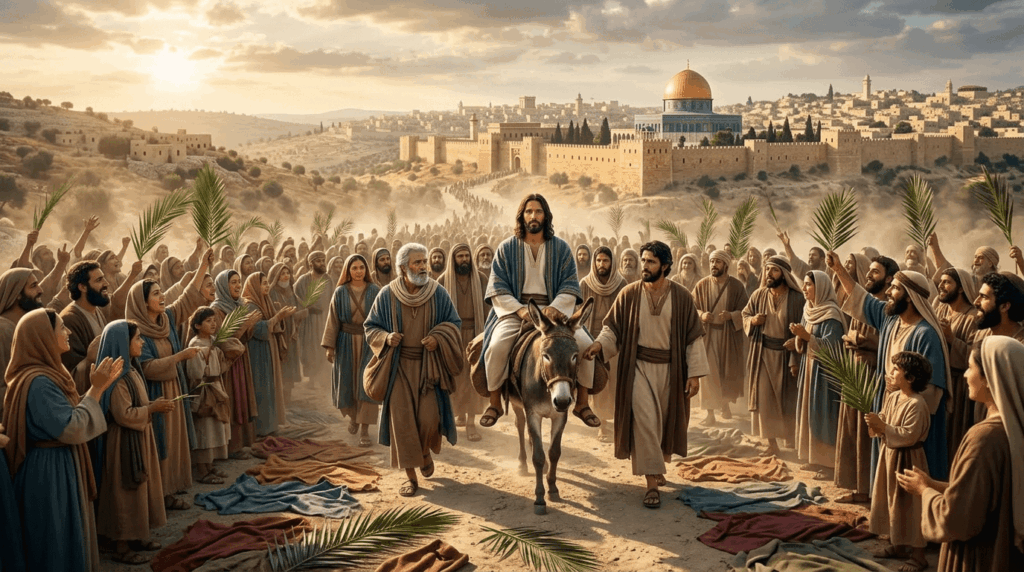
Ennen kuin he lähtivät liikkeelle, Alfeuksen kaksoset laskivat viittansa aasin päälle ja pitelivät sitä paikallaan, sillä aikaa kun Mestari asettui sen selkään. Kulkueen edetessä kohti Öljymäen lakea juhlaväki viskeli vaatteitaan maahan ja toi lähistön puista oksia kunniamatoksi aasille, joka kantoi kuninkaallista Poikaa, luvattua Messiasta. Siirtyessään eteenpäin, kohti Jerusalemia, riemuitseva kansanjoukko alkoi laulaa tai pikemminkin huutaa yhteen ääneen psalmia: ”Hoosianna Daavidin pojalle; siunattu on hän, joka tulee Herran nimessä. Hoosianna korkeuksissa. Siunattu olkoon valtakunta, joka laskeutuu alas taivaasta.”
Kulkueen astellessa eteenpäin Jeesus oli hilpeällä ja iloisella mielellä kunnes hän tuli Öljymäen harjalle, jossa kaupunki ja temppelitornit tulivat kokonaan näkyviin. Siellä Mestari pysäytti kulkueen, ja suuri hiljaisuus laskeutui kaiken ylle, kun he näkivät, että hän itki. Katsellessaan valtavaa kansanpaljoutta, joka oli tulossa kaupungista tervehtimään häntä, Mestari lausui syvästi liikuttuneena ja kyyneleisellä äänellä: ”Oi Jerusalem, jospa sinä – sinäpä juuri – vain olisit tiennyt edes tänä sinun päivänäsi ne asiat, jotka kuuluvat rauhaasi ja jotka niin auliisti olisit saanut! Mutta nyt nämä ihanuudet kohta kätketään silmiesi edestä. Kohta sinä torjut Rauhan Pojan ja käännät selkäsi pelastuksen evankeliumille. Ne päivät koittavat sinulle kohta, jolloin vihollisesi kaivavat taisteluhaudan ympärillesi ja piirittävät sinua joka puolelta; niin perinpohjaisesti he sinut hävittävät, ettei kiveäkään jää kiven päälle. Ja tämä kaikki on osasi siksi, ettet tiennyt jumalallisen vierailusi ajankohtaa. Kohta sinä hylkäät Jumalan lahjan, ja kaikki ihmiset tulevat hylkäämään sinut.”
Sen jälkeen kun Jeesus oli äskeiset sanat lausunut, kulkue alkoi laskeutua alas Öljymäkeä, ja hetken kuluttua mukaan liittyi muualta tulleiden kansanjoukko. Nämä olivat lähteneet Jerusalemista palmunlehviä liehutellen, hoosiannoja huutaen ja muutoinkin riemumieltä ja hyvää yhteishenkeä ilmoille kaiuttaen. Mestari ei ollut suunnitellut sellaista, että nämä väkijoukot tulisivat heitä vastaan Jerusalemista. Se oli joidenkuiden muiden työtä. Hän ei milloinkaan ennakolta harkinnut mitään, mikä oli dramaattista.
Mestaria tervehtimään ryöpynneen kansanpaljouden mukana tuli myös monia fariseuksia ja hänen muita vihamiehiään. Tämä äkillinen ja odottamaton kansansuosion purkaus sai heidät siinä määrin pois tolaltaan, etteivät he rohjenneet pidättää häntä, jottei sellainen toimenpide mahdollisesti syöksisi väestöä avoimeen kapinaan. He olivat suuresti huolissaan siitä, miten ne lukuisat vierailijat asiaan suhtautuisivat, jotka olivat kuulleet paljon Jeesuksesta ja joista monet uskoivat häneen.
Kun he lähestyivät Jerusalemia, väkijoukko alkoi osoittaa tuntemuksiaan yhä äänekkäämmin, jopa siinä määrin, että muutamat fariseukset raivasivat tiensä Jeesuksen vierelle ja sanoivat: ”Opettaja, eiköhän sinun tulisi torua opetuslapsiasi ja kehottaa heitä käyttäytymään siivommin.” Jeesus vastasi: ”On toki paikallaan, että nämä lapset toivottavat tervetulleeksi Rauhan Pojan, jonka pääpapit ovat torjuneet. Olisi hyödytöntä pysäyttää heitä, sillä siinä tapauksessa heidän sijastaan huutaisivat ääneensä nämä tienvieren kivet.”
Fariseukset riensivät kulkueen edelle päästäkseen taas mukaan sanhedrinin kokoukseen. Kyseinen neuvosto oli nimittäin tuolloin koolla temppelissä, ja nämä fariseukset raportoivat virkatovereilleen: ”Katsokaas, teemmepä mitä hyvänsä, siitä ei ole mihinkään. Tämä galilealainen saattaa meidät häpeään. Ihmiset ovat hullaantuneet häneen. Ellemme pysäytä näitä tietämättömiä, koko maailma menee hänen perässään.”
Todellisuudessa tähän väkijoukon pinnalliseen ja spontaaniin innostuksen purkaukseen ei tulisi liittää mitään syvää merkitystä. Olkoonkin, että tämä vastaanotto oli riemukas ja vilpitön, se ei silti ollut merkki mistään todellisesta tai syvälle juurtuneesta vakuuttuneisuudesta tämän juhlaväen sydämessä. Samaiset väkijoukot olivat yhtä valmiita torjumaan Jeesuksen myöhemmin samalla viikolla, heti sen jälkeen kun sanhedrin lopulta otti lujan ja päättäväisen kannan häntä vastaan, ja kun heidän harhakuvansa haihtuivat – kun he tajusivat, ettei Jeesus aikonutkaan perustaa valtakuntaa heidän kauan hellimiensä toiveiden mukaisesti.
Mutta koko kaupunki oli suunnattoman kuohunnan tilassa niin, että jokainen kyseli: ”Kuka on tämä mies?” Ja väkijoukko vastasi: ”Tämä on Galilean profeetta, Nasaretin Jeesus.”
Bethany was about two miles from the temple, and it was half past one that Sunday afternoon when Jesus made ready to start for Jerusalem. He had feelings of profound affection for Bethany and its simple people. Nazareth, Capernaum, and Jerusalem had rejected him, but Bethany had accepted him, had believed in him. And it was in this small village, where almost every man, woman, and child were believers, that he chose to perform the mightiest work of his earth bestowal, the resurrection of Lazarus. He did not raise Lazarus that the villagers might believe, but rather because they already believed.
All morning Jesus had thought about his entry into Jerusalem. Heretofore he had always endeavored to suppress all public acclaim of him as the Messiah, but it was different now; he was nearing the end of his career in the flesh, his death had been decreed by the Sanhedrin, and no harm could come from allowing his disciples to give free expression to their feelings, just as might occur if he elected to make a formal and public entry into the city.
Jesus did not decide to make this public entrance into Jerusalem as a last bid for popular favor nor as a final grasp for power. Neither did he do it altogether to satisfy the human longings of his disciples and apostles. Jesus entertained none of the illusions of a fantastic dreamer; he well knew what was to be the outcome of this visit.
Having decided upon making a public entrance into Jerusalem, the Master was confronted with the necessity of choosing a proper method of executing such a resolve. Jesus thought over all of the many more or less contradictory so-called Messianic prophecies, but there seemed to be only one which was at all appropriate for him to follow. Most of these prophetic utterances depicted a king, the son and successor of David, a bold and aggressive temporal deliverer of all Israel from the yoke of foreign domination. But there was one Scripture that had sometimes been associated with the Messiah by those who held more to the spiritual concept of his mission, which Jesus thought might consistently be taken as a guide for his projected entry into Jerusalem. This Scripture was found in Zechariah, and it said: “Rejoice greatly, O daughter of Zion; shout, O daughter of Jerusalem. Behold, your king comes to you. He is just and he brings salvation. He comes as the lowly one, riding upon an ass, upon a colt, the foal of an ass.”
A warrior king always entered a city riding upon a horse; a king on a mission of peace and friendship always entered riding upon an ass. Jesus would not enter Jerusalem as a man on horseback, but he was willing to enter peacefully and with good will as the Son of Man on a donkey.
Jesus had long tried by direct teaching to impress upon his apostles and his disciples that his kingdom was not of this world, that it was a purely spiritual matter; but he had not succeeded in this effort. Now, what he had failed to do by plain and personal teaching, he would attempt to accomplish by a symbolic appeal. Accordingly, right after the noon lunch, Jesus called Peter and John, and after directing them to go over to Bethpage, a neighboring village a little off the main road and a short distance northwest of Bethany, he further said: “Go to Bethpage, and when you come to the junction of the roads, you will find the colt of an ass tied there. Loose the colt and bring it back with you. If anyone asks you why you do this, merely say, ‘The Master has need of him.’” And when the two apostles had gone into Bethpage as the Master had directed, they found the colt tied near his mother in the open street and close to a house on the corner. As Peter began to untie the colt, the owner came over and asked why they did this, and when Peter answered him as Jesus had directed, the man said: “If your Master is Jesus from Galilee, let him have the colt.” And so they returned bringing the colt with them.
By this time several hundred pilgrims had gathered around Jesus and his apostles. Since midforenoon the visitors passing by on their way to the Passover had tarried. Meanwhile, David Zebedee and some of his former messenger associates took it upon themselves to hasten on down to Jerusalem, where they effectively spread the report among the throngs of visiting pilgrims about the temple that Jesus of Nazareth was making a triumphal entry into the city. Accordingly, several thousand of these visitors flocked forth to greet this much-talked-of prophet and wonder-worker, whom some believed to be the Messiah. This multitude, coming out from Jerusalem, met Jesus and the crowd going into the city just after they had passed over the brow of Olivet and had begun the descent into the city.
As the procession started out from Bethany, there was great enthusiasm among the festive crowd of disciples, believers, and visiting pilgrims, many hailing from Galilee and Perea. Just before they started, the twelve women of the original women’s corps, accompanied by some of their associates, arrived on the scene and joined this unique procession as it moved on joyously toward the city.
Before they started, the Alpheus twins put their cloaks on the donkey and held him while the Master got on. As the procession moved toward the summit of Olivet, the festive crowd threw their garments on the ground and brought branches from the near-by trees in order to make a carpet of honor for the donkey bearing the royal Son, the promised Messiah. As the merry crowd moved on toward Jerusalem, they began to sing, or rather to shout in unison, the Psalm, “Hosanna to the son of David; blessed is he who comes in the name of the Lord. Hosanna in the highest. Blessed be the kingdom that comes down from heaven.”
Jesus was lighthearted and cheerful as they moved along until he came to the brow of Olivet, where the city and the temple towers came into full view; there the Master stopped the procession, and a great silence came upon all as they beheld him weeping. Looking down upon the vast multitude coming forth from the city to greet him, the Master, with much emotion and with tearful voice, said: “O Jerusalem, if you had only known, even you, at least in this your day, the things which belong to your peace, and which you could so freely have had! But now are these glories about to be hid from your eyes. You are about to reject the Son of Peace and turn your backs upon the gospel of salvation. The days will soon come upon you wherein your enemies will cast a trench around about you and lay siege to you on every side; they shall utterly destroy you, insomuch that not one stone shall be left upon another. And all this shall befall you because you knew not the time of your divine visitation. You are about to reject the gift of God, and all men will reject you.”
When he had finished speaking, they began the descent of Olivet and presently were joined by the multitude of visitors who had come from Jerusalem waving palm branches, shouting hosannas, and otherwise expressing gleefulness and good fellowship. The Master had not planned that these crowds should come out from Jerusalem to meet them; that was the work of others. He never premeditated anything which was dramatic.
Along with the multitude which poured out to welcome the Master, there came also many of the Pharisees and his other enemies. They were so much perturbed by this sudden and unexpected outburst of popular acclaim that they feared to arrest him lest such action precipitate an open revolt of the populace. They greatly feared the attitude of the large numbers of visitors, who had heard much of Jesus, and who, many of them, believed in him.
As they neared Jerusalem, the crowd became more demonstrative, so much so that some of the Pharisees made their way up alongside Jesus and said: “Teacher, you should rebuke your disciples and exhort them to behave more seemly.” Jesus answered: “It is only fitting that these children should welcome the Son of Peace, whom the chief priests have rejected. It would be useless to stop them lest in their stead these stones by the roadside cry out.”
The Pharisees hastened on ahead of the procession to rejoin the Sanhedrin, which was then in session at the temple, and they reported to their associates: “Behold, all that we do is of no avail; we are confounded by this Galilean. The people have gone mad over him; if we do not stop these ignorant ones, all the world will go after him.”
There really was no deep significance to be attached to this superficial and spontaneous outburst of popular enthusiasm. This welcome, although it was joyous and sincere, did not betoken any real or deep-seated conviction in the hearts of this festive multitude. These same crowds were equally as willing quickly to reject Jesus later on this week when the Sanhedrin once took a firm and decided stand against him, and when they became disillusioned—when they realized that Jesus was not going to establish the kingdom in accordance with their long-cherished expectations.
But the whole city was mightily stirred up, insomuch that everyone asked, “Who is this man?” And the multitude answered, “This is the prophet of Galilee, Jesus of Nazareth.”
SuomiEnglish
Betania sijaitsi runsaan kolmen kilometrin päässä temppelistä, ja puoli kahdelta tuona sunnuntai-iltapäivänä Jeesus sonnustautui lähtemään Jerusalemiin. Hän tunsi syvää kiintymystä Betaniaa ja sen korutonta väkeä kohtaan. Nasaret, Kapernaum ja Jerusalem olivat torjuneet hänet, mutta Betania oli hänet hyväksynyt, oli uskonut häneen. Ja juuri tässä pikkukylässä, jossa jotakuinkin jokainen mies, nainen ja lapsi oli uskova, hän päätti toteuttaa maisen lahjoittautumisensa voimallisimman teon: Lasaruksen kuolleistaherättämisen. Hän ei nostanut Lasarusta kuolleista, jotta kyläläiset uskoisivat, vaan paremminkin siksi, että nämä jo uskoivat.
Bethany was about two miles from the temple, and it was half past one that Sunday afternoon when Jesus made ready to start for Jerusalem. He had feelings of profound affection for Bethany and its simple people. Nazareth, Capernaum, and Jerusalem had rejected him, but Bethany had accepted him, had believed in him. And it was in this small village, where almost every man, woman, and child were believers, that he chose to perform the mightiest work of his earth bestowal, the resurrection of Lazarus. He did not raise Lazarus that the villagers might believe, but rather because they already believed.
Jeesus oli koko aamun ajatellut Jerusalemiin-menoaan. Tähän saakka hän oli aina koettanut tukahduttaa kaikki hänelle Messiaana osoitetut yleisön suosionosoitukset, mutta nyt tilanne oli toisenlainen. Hän oli lähestymässä lihallishahmoisen elämänvaiheensa päätöstä, sanhedrin oli antanut määräyksen hänen tappamisestaan, eikä mitään vahinkoa voisi koitua, vaikka hänen opetuslastensa sallittaisiinkin tuoda esteettä julki tunteensa, kuten saattaisi käydä, jos hän päättäisi suorittaa julkisen ja muodollisen sisääntulon kaupunkiin.
All morning Jesus had thought about his entry into Jerusalem. Heretofore he had always endeavored to suppress all public acclaim of him as the Messiah, but it was different now; he was nearing the end of his career in the flesh, his death had been decreed by the Sanhedrin, and no harm could come from allowing his disciples to give free expression to their feelings, just as might occur if he elected to make a formal and public entry into the city.
Jeesus ei päättänyt suorittaa tätä julkista Jerusalemiin-tuloa siinä mielessä, että se olisi ollut hänen viimeinen eleensä kansansuosion saavuttamiseksi tai lopullinen kurottautumisensa kohti vallankahvaa. Hän ei myöskään tehnyt sitä siinä mielessä, että hän olisi sillä kaikin puolin tyydyttänyt opetuslastensa ja apostoliensa inhimilliset kaipaukset. Jeesuksella ei ollut mitään haaveilevan uneksijan harhakuvia, vaan hän tiesi hyvin, mihin tämä vierailu lopulta johtaisi.
Jesus did not decide to make this public entrance into Jerusalem as a last bid for popular favor nor as a final grasp for power. Neither did he do it altogether to satisfy the human longings of his disciples and apostles. Jesus entertained none of the illusions of a fantastic dreamer; he well knew what was to be the outcome of this visit.
Päätettyään suorittaa julkisen sisääntulon Jerusalemiin Mestarin oli välttämättä myös tehtävä päätös siitä, miten hän tämän ratkaisunsa toteuttaisi. Jeesus pohti kaikkia niin kutsuttuja messiasprofetioita, jotka olivat keskenään enemmän tai vähemmän ristiriitaisia, mutta vain yksi niistä tuntui edes jossakin määrin sopivalta hänen seurata. Useimmat näistä profeetallisista näkemyksistä loivat kuvan kuninkaasta, Daavidin pojasta ja jälkeläisestä, uhmakkaasta ja aggressiivisesta ajallisesta vapahtajasta, joka vapauttaisi koko Israelin vieraan herruuden ikeestä. Mutta oli olemassa muuan kirjoitus, jonka lähempänä hengellistä käsitystä Messiaan tehtävästä olevat olivat joskus yhdistäneet Messiaaseen, ja tästä kirjoituksesta Jeesus ajatteli, että sitä olisi mahdollista todellista tilannetta vastaavalla tavalla käyttää ohjenuorana siinä, mitä hän tekisi hankkeissa olevan Jerusalemiin-menonsa osalta. Tämä tekstikohta oli Sakarjan kirjasta ja kuului: ”Iloitse suuresti, oi tytär Siionin; huuda ääneesi oi tytär Jerusalemin. Katso, sinun kuninkaasi tulee sinulle. Hän on oikeudenmukainen ja hän tuo pelastuksen. Hän tulee kuin alhainen ja ratsastaa aasilla, varsalla, aasinvarsalla.”
Having decided upon making a public entrance into Jerusalem, the Master was confronted with the necessity of choosing a proper method of executing such a resolve. Jesus thought over all of the many more or less contradictory so-called Messianic prophecies, but there seemed to be only one which was at all appropriate for him to follow. Most of these prophetic utterances depicted a king, the son and successor of David, a bold and aggressive temporal deliverer of all Israel from the yoke of foreign domination. But there was one Scripture that had sometimes been associated with the Messiah by those who held more to the spiritual concept of his mission, which Jesus thought might consistently be taken as a guide for his projected entry into Jerusalem. This Scripture was found in Zechariah, and it said: “Rejoice greatly, O daughter of Zion; shout, O daughter of Jerusalem. Behold, your king comes to you. He is just and he brings salvation. He comes as the lowly one, riding upon an ass, upon a colt, the foal of an ass.”
Sotilaskuningas tuli kaupunkiin aina hevosella ratsastaen; rauhan ja ystävyyden asialla oleva kuningas saapui aina aasilla ratsastaen. Jeesus ei halunnut suorittaa Jerusalemiin-tuloaan ihmisenä hevosen selässä ratsastaen, vaan hän tahtoi tulla rauhanomaisesti ja hyvän tahdon merkeissä Ihmisen Poikana aasilla ratsastaen.
A warrior king always entered a city riding upon a horse; a king on a mission of peace and friendship always entered riding upon an ass. Jesus would not enter Jerusalem as a man on horseback, but he was willing to enter peacefully and with good will as the Son of Man on a donkey.
Jeesus oli jo pitkään koettanut selkeäsanaisesti opettamalla juurruttaa apostoliensa ja opetuslastensa mieleen, ettei hänen valtakuntansa ollut tästä maailmasta, vaan että se oli puhtaasti hengellinen asia; mutta hän ei ollut tässä pyrkimyksessään onnistunut. Näin ollen, mitä hän ei selkeäsanaisella ja henkilökohtaisella opettamisella ollut onnistunut tekemään, sen hän yrittäisi saavuttaa symboliikkaan turvautumalla. Niinpä Jeesus heti keskipäivän ateriahetken jälkeen pyysi luokseen Pietarin ja Johanneksen ja annettuaan heille ohjeen mennä Betfageen, joka oli naapurikylä vähän matkan päässä päätieltä ja hieman Betaniasta luoteeseen, hän sanoi heille lisäksi: ”Menkää Betfageen, ja tullessanne tienristeykseen löydätte sieltä liekaan kytketyn aasinvarsan. Päästäkää varsa lieasta ja tuokaa se mukananne tänne. Jos joku kysyy teiltä, miksi tämän teette, sanokaa vain: ’Mestari tarvitsee sitä.’” Ja mentyään Mestarin ohjeen mukaisesti Betfageen nämä kaksi apostolia löysivät aasin lieasta emonsa läheltä, ja se oli avoimella kadulla ja lähellä yhtä kadunkulman taloa. Kun Pietari ryhtyi irrottamaan varsaa kytkyestä, sen omistaja tuli paikalle ja kysyi, miksi he tämän tekivät, ja Pietarin vastattua hänelle kuten Jeesus oli käskenyt mies sanoi: ”Jos Mestarisi on Jeesus Galileasta, niin viekää varsa hänelle.” Ja niin he palasivat tuoden varsan mukanaan.
Jesus had long tried by direct teaching to impress upon his apostles and his disciples that his kingdom was not of this world, that it was a purely spiritual matter; but he had not succeeded in this effort. Now, what he had failed to do by plain and personal teaching, he would attempt to accomplish by a symbolic appeal. Accordingly, right after the noon lunch, Jesus called Peter and John, and after directing them to go over to Bethpage, a neighboring village a little off the main road and a short distance northwest of Bethany, he further said: “Go to Bethpage, and when you come to the junction of the roads, you will find the colt of an ass tied there. Loose the colt and bring it back with you. If anyone asks you why you do this, merely say, ‘The Master has need of him.’” And when the two apostles had gone into Bethpage as the Master had directed, they found the colt tied near his mother in the open street and close to a house on the corner. As Peter began to untie the colt, the owner came over and asked why they did this, and when Peter answered him as Jesus had directed, the man said: “If your Master is Jesus from Galilee, let him have the colt.” And so they returned bringing the colt with them.
Tähän hetkeen mennessä Jeesuksen ja hänen apostoliensa ympärille oli kerääntynyt useita satoja pyhiinvaeltajia. Paikalle oli aamupäivän puolivälistä saakka jäänyt vierailijoita, jotka kulkivat paikan ohi matkallaan pääsiäisjuhlille. Sillä välin Daavid Sebedeus ja muutamat hänen entisistä viestinviejätovereistaan ottivat asiakseen kiiruhtaa Jerusalemiin, jossa he temppelin ympärillä levittivät vierailulle saapuneiden pyhiinvaeltajajoukkojen keskuudessa tehokkaasti tietoa siitä, että Jeesus Nasaretilainen olisi kohta suorittava riemusaattomaisen sisääntulon kaupunkiin. Niinpä näiden vierailijoiden joukosta useat tuhannet lähtivät yhtenä laumana tervehtimään tätä profeettaa ja ihmeidentekijää, josta niin paljon puhuttiin ja josta jotkut uskoivat, että hän olisi Messias. Tämä Jerusalemista purkautuva väenpaljous kohtasi Jeesuksen ja kaupunkiin matkalla olevan väkijoukon heti sen jälkeen, kun nämä olivat ohittaneet Öljymäen harjan ja aloittaneet laskeutumisensa kaupunkiin.
By this time several hundred pilgrims had gathered around Jesus and his apostles. Since midforenoon the visitors passing by on their way to the Passover had tarried. Meanwhile, David Zebedee and some of his former messenger associates took it upon themselves to hasten on down to Jerusalem, where they effectively spread the report among the throngs of visiting pilgrims about the temple that Jesus of Nazareth was making a triumphal entry into the city. Accordingly, several thousand of these visitors flocked forth to greet this much-talked-of prophet and wonder-worker, whom some believed to be the Messiah. This multitude, coming out from Jerusalem, met Jesus and the crowd going into the city just after they had passed over the brow of Olivet and had begun the descent into the city.
Kun kulkue lähti liikkeelle Betaniasta, tämän juhlivan väkijoukon keskuudessa vallitsi suuri innostus. Siinä oli opetuslapsia, uskovia ja vierailevia pyhiinvaeltajia, joista monet olivat kotoisin Galileasta ja Pereasta. Hetkeä ennen heidän liikkeellelähtöään näyttämölle saapuivat alkuperäisen naisryhmän kaksitoista naista, joiden seurassa oli muutamia heidän työtovereitaan, ja nämä liittyivät tähän ainutlaatuiseen kulkueeseen sen edetessä riemuiten kohti kaupunkia.
As the procession started out from Bethany, there was great enthusiasm among the festive crowd of disciples, believers, and visiting pilgrims, many hailing from Galilee and Perea. Just before they started, the twelve women of the original women’s corps, accompanied by some of their associates, arrived on the scene and joined this unique procession as it moved on joyously toward the city.
Ennen kuin he lähtivät liikkeelle, Alfeuksen kaksoset laskivat viittansa aasin päälle ja pitelivät sitä paikallaan, sillä aikaa kun Mestari asettui sen selkään. Kulkueen edetessä kohti Öljymäen lakea juhlaväki viskeli vaatteitaan maahan ja toi lähistön puista oksia kunniamatoksi aasille, joka kantoi kuninkaallista Poikaa, luvattua Messiasta. Siirtyessään eteenpäin, kohti Jerusalemia, riemuitseva kansanjoukko alkoi laulaa tai pikemminkin huutaa yhteen ääneen psalmia: ”Hoosianna Daavidin pojalle; siunattu on hän, joka tulee Herran nimessä. Hoosianna korkeuksissa. Siunattu olkoon valtakunta, joka laskeutuu alas taivaasta.”
Before they started, the Alpheus twins put their cloaks on the donkey and held him while the Master got on. As the procession moved toward the summit of Olivet, the festive crowd threw their garments on the ground and brought branches from the near-by trees in order to make a carpet of honor for the donkey bearing the royal Son, the promised Messiah. As the merry crowd moved on toward Jerusalem, they began to sing, or rather to shout in unison, the Psalm, “Hosanna to the son of David; blessed is he who comes in the name of the Lord. Hosanna in the highest. Blessed be the kingdom that comes down from heaven.”
Kulkueen astellessa eteenpäin Jeesus oli hilpeällä ja iloisella mielellä kunnes hän tuli Öljymäen harjalle, jossa kaupunki ja temppelitornit tulivat kokonaan näkyviin. Siellä Mestari pysäytti kulkueen, ja suuri hiljaisuus laskeutui kaiken ylle, kun he näkivät, että hän itki. Katsellessaan valtavaa kansanpaljoutta, joka oli tulossa kaupungista tervehtimään häntä, Mestari lausui syvästi liikuttuneena ja kyyneleisellä äänellä: ”Oi Jerusalem, jospa sinä – sinäpä juuri – vain olisit tiennyt edes tänä sinun päivänäsi ne asiat, jotka kuuluvat rauhaasi ja jotka niin auliisti olisit saanut! Mutta nyt nämä ihanuudet kohta kätketään silmiesi edestä. Kohta sinä torjut Rauhan Pojan ja käännät selkäsi pelastuksen evankeliumille. Ne päivät koittavat sinulle kohta, jolloin vihollisesi kaivavat taisteluhaudan ympärillesi ja piirittävät sinua joka puolelta; niin perinpohjaisesti he sinut hävittävät, ettei kiveäkään jää kiven päälle. Ja tämä kaikki on osasi siksi, ettet tiennyt jumalallisen vierailusi ajankohtaa. Kohta sinä hylkäät Jumalan lahjan, ja kaikki ihmiset tulevat hylkäämään sinut.”
Jesus was lighthearted and cheerful as they moved along until he came to the brow of Olivet, where the city and the temple towers came into full view; there the Master stopped the procession, and a great silence came upon all as they beheld him weeping. Looking down upon the vast multitude coming forth from the city to greet him, the Master, with much emotion and with tearful voice, said: “O Jerusalem, if you had only known, even you, at least in this your day, the things which belong to your peace, and which you could so freely have had! But now are these glories about to be hid from your eyes. You are about to reject the Son of Peace and turn your backs upon the gospel of salvation. The days will soon come upon you wherein your enemies will cast a trench around about you and lay siege to you on every side; they shall utterly destroy you, insomuch that not one stone shall be left upon another. And all this shall befall you because you knew not the time of your divine visitation. You are about to reject the gift of God, and all men will reject you.”
Sen jälkeen kun Jeesus oli äskeiset sanat lausunut, kulkue alkoi laskeutua alas Öljymäkeä, ja hetken kuluttua mukaan liittyi muualta tulleiden kansanjoukko. Nämä olivat lähteneet Jerusalemista palmunlehviä liehutellen, hoosiannoja huutaen ja muutoinkin riemumieltä ja hyvää yhteishenkeä ilmoille kaiuttaen. Mestari ei ollut suunnitellut sellaista, että nämä väkijoukot tulisivat heitä vastaan Jerusalemista. Se oli joidenkuiden muiden työtä. Hän ei milloinkaan ennakolta harkinnut mitään, mikä oli dramaattista.
When he had finished speaking, they began the descent of Olivet and presently were joined by the multitude of visitors who had come from Jerusalem waving palm branches, shouting hosannas, and otherwise expressing gleefulness and good fellowship. The Master had not planned that these crowds should come out from Jerusalem to meet them; that was the work of others. He never premeditated anything which was dramatic.
Mestaria tervehtimään ryöpynneen kansanpaljouden mukana tuli myös monia fariseuksia ja hänen muita vihamiehiään. Tämä äkillinen ja odottamaton kansansuosion purkaus sai heidät siinä määrin pois tolaltaan, etteivät he rohjenneet pidättää häntä, jottei sellainen toimenpide mahdollisesti syöksisi väestöä avoimeen kapinaan. He olivat suuresti huolissaan siitä, miten ne lukuisat vierailijat asiaan suhtautuisivat, jotka olivat kuulleet paljon Jeesuksesta ja joista monet uskoivat häneen.
Along with the multitude which poured out to welcome the Master, there came also many of the Pharisees and his other enemies. They were so much perturbed by this sudden and unexpected outburst of popular acclaim that they feared to arrest him lest such action precipitate an open revolt of the populace. They greatly feared the attitude of the large numbers of visitors, who had heard much of Jesus, and who, many of them, believed in him.
Kun he lähestyivät Jerusalemia, väkijoukko alkoi osoittaa tuntemuksiaan yhä äänekkäämmin, jopa siinä määrin, että muutamat fariseukset raivasivat tiensä Jeesuksen vierelle ja sanoivat: ”Opettaja, eiköhän sinun tulisi torua opetuslapsiasi ja kehottaa heitä käyttäytymään siivommin.” Jeesus vastasi: ”On toki paikallaan, että nämä lapset toivottavat tervetulleeksi Rauhan Pojan, jonka pääpapit ovat torjuneet. Olisi hyödytöntä pysäyttää heitä, sillä siinä tapauksessa heidän sijastaan huutaisivat ääneensä nämä tienvieren kivet.”
As they neared Jerusalem, the crowd became more demonstrative, so much so that some of the Pharisees made their way up alongside Jesus and said: “Teacher, you should rebuke your disciples and exhort them to behave more seemly.” Jesus answered: “It is only fitting that these children should welcome the Son of Peace, whom the chief priests have rejected. It would be useless to stop them lest in their stead these stones by the roadside cry out.”
Fariseukset riensivät kulkueen edelle päästäkseen taas mukaan sanhedrinin kokoukseen. Kyseinen neuvosto oli nimittäin tuolloin koolla temppelissä, ja nämä fariseukset raportoivat virkatovereilleen: ”Katsokaas, teemmepä mitä hyvänsä, siitä ei ole mihinkään. Tämä galilealainen saattaa meidät häpeään. Ihmiset ovat hullaantuneet häneen. Ellemme pysäytä näitä tietämättömiä, koko maailma menee hänen perässään.”
The Pharisees hastened on ahead of the procession to rejoin the Sanhedrin, which was then in session at the temple, and they reported to their associates: “Behold, all that we do is of no avail; we are confounded by this Galilean. The people have gone mad over him; if we do not stop these ignorant ones, all the world will go after him.”
Todellisuudessa tähän väkijoukon pinnalliseen ja spontaaniin innostuksen purkaukseen ei tulisi liittää mitään syvää merkitystä. Olkoonkin, että tämä vastaanotto oli riemukas ja vilpitön, se ei silti ollut merkki mistään todellisesta tai syvälle juurtuneesta vakuuttuneisuudesta tämän juhlaväen sydämessä. Samaiset väkijoukot olivat yhtä valmiita torjumaan Jeesuksen myöhemmin samalla viikolla, heti sen jälkeen kun sanhedrin lopulta otti lujan ja päättäväisen kannan häntä vastaan, ja kun heidän harhakuvansa haihtuivat – kun he tajusivat, ettei Jeesus aikonutkaan perustaa valtakuntaa heidän kauan hellimiensä toiveiden mukaisesti.
There really was no deep significance to be attached to this superficial and spontaneous outburst of popular enthusiasm. This welcome, although it was joyous and sincere, did not betoken any real or deep-seated conviction in the hearts of this festive multitude. These same crowds were equally as willing quickly to reject Jesus later on this week when the Sanhedrin once took a firm and decided stand against him, and when they became disillusioned—when they realized that Jesus was not going to establish the kingdom in accordance with their long-cherished expectations.
Mutta koko kaupunki oli suunnattoman kuohunnan tilassa niin, että jokainen kyseli: ”Kuka on tämä mies?” Ja väkijoukko vastasi: ”Tämä on Galilean profeetta, Nasaretin Jeesus.”
But the whole city was mightily stirred up, insomuch that everyone asked, “Who is this man?” And the multitude answered, “This is the prophet of Galilee, Jesus of Nazareth.”