
Teksti
Tausta
Näytä
Lisäasetukset
Kieli
Urantia Opas
Kysy kirjan sisällöstä. Opas vastaa Book Enginen omien lähdekohtien perusteella ja ohjaa sinut lukemaan ne.
Hei! 🙏
Olen sinun Urantia-oppaasi. Tehtäväni on auttaa sinua löytämään oikeat kohdat Urantia-kirjasta ja ymmärtämään sen opetuksia syvemmin. 😊❤️
Kello oli noin puoli yhdeksän tänä perjantaiaamuna, kun Pilatuksen edessä toimitettu Jeesuksen kuulustelu päättyi ja Mestari jätettiin niiden roomalaissotilaiden huostaan, joiden oli määrä hänet ristiinnaulita. Kohta sen jälkeen kun roomalaiset ottivat Jeesuksen huostaansa, juutalaisvartijoiden kapteeni marssi miehineen takaisin heidän temppelipäämajaansa. Pääpappi ja tämän sanhedristitoverit seurasivat vartijoiden kintereillä ja menivät suoraa tietä tavanomaiseen kokoontumispaikkaansa, veistetyistä kivistä rakennettuun temppelisaliin. Siellä he tapasivat monia muita sanhedrinin jäseniä, jotka odottelivat tietoa siitä, mitä Jeesuksen suhteen oli tehty. Kaiafaan ollessa esittämässä sanhedrinille selostustaan Jeesuksen oikeudenkäynnistä ja tuomiosta Juudas ilmestyi heidän eteensä vaatimaan palkkiotaan osasta, jota oli esittänyt Mestarin kiinniottamisessa ja kuolemaan tuomitsemisessa.
Kaikki nämä juutalaiset inhosivat Juudasta; he suhtautuivat kavaltajaan tuntein, joiden sisältönä oli vain äärimmäinen halveksunta. Koko sen ajan, jonka Jeesus oli kuultavana Kaiafaan edessä, ja silloin kun hän esiintyi Pilatuksen edessä, Juudas oli tuntenut petollisesta menettelystään omantunnonpistoksia. Ja vähitellen alkoivat haihtua myös hänen harhakuvitelmansa siitä palkkiosta, joka hänen oli määrä saada maksuksi palveluksistaan Jeesuksen kavaltajana. Hän ei pitänyt juutalaisviranomaisten osoittamasta viileydestä ja kylmäkiskoisuudesta; siitä huolimatta hän odotti saavansa raukkamaisesta menettelystään avokätisen palkkion. Hän odotti tulevansa kutsutuksi täysilukuisen sanhedrinin kokouksen eteen kuulemaan, kun hänelle pidettäisiin siellä ylistyspuheita, samalla kun hänelle osoitettaisiin soveliaita kunnianosoituksia sen suuren palveluksen johdosta, jonka hän itseään imarrellen luuli kansakunnalleen tehneensä. Kuvitelkaapa sen vuoksi tämän itsekeskeisen kavaltajan suurta ällistystä, kun muuan ylipapin palvelija häntä olalle napauttaen pyysi hänet vähän matkan päähän salin ulkopuolelle ja sanoi: ”Juudas, minulle on annettu tehtäväksi maksaa sinulle Jeesuksen kavaltamisesta. Tässä on palkkiosi.” Ja näin sanoessaan Kaiafaan palvelija ojensi Juudakselle kukkaron, jossa oli kolmekymmentä hopearahaa – käypä hinta hyvästä, terveestä orjasta.
Juudas oli ällikällä lyöty, hän ei saanut sanaa suustaan. Hän syöksähti takaisin mennäkseen saliin, mutta ovenvartija esti hänen sisäänpääsynsä. Hän halusi vedota sanhedriniin, mutta häntä ei päästetty sisälle. Juudas ei voinut uskoa, että nämä juutalaiset vallanpitäjät antaisivat hänen pettää ystävänsä ja Mestarinsa ja sitten tarjoaisivat hänelle palkkiona kolmekymmentä hopearahaa. Hän tunsi itsensä nöyryytetyksi, pettyneeksi ja läpikotaisen muserretuksi. Hän käveli pois temppeliltä ikään kuin olisi ollut transsissa. Mitään ajattelematta hän pudotti rahakukkaron syvään taskuunsa, samaan taskuun, jossa hän niin kauan aikaa oli kantanut apostolien rahavarat sisältävää kukkaroa. Ja hän vaelsi kaupungin läpi niiden väkijoukkojen perässä, jotka olivat menossa katsomaan ristiinnaulitsemisia.
Matkan päästä Juudas näki, kun nostettiin paikalleen poikkipuu, johon Jeesus oli naulittu, ja tämän nähtyään hän ryntäsi takaisin temppeliin, tunkeutui väkisin ovenvartijan ohitse ja huomasi seisovansa istuntoaan edelleen jatkavan sanhedrinin edessä. Kavaltajan henki oli miltei salpaantunut, ja hän oli perin suunniltaan, mutta hän onnistui kakistamaan seuraavat sanat: ”Olen tehnyt syntiä viattoman veren kavaltamalla. Olette loukanneet minua. Olette palkaksi palveluksestani tarjonneet minulle rahaa – orjan hinnan. Kadun, että olen tämän tehnyt; tässä on rahanne. En halua niskoilleni syyllisyyttä tästä teosta.”
Kun juutalaisten vallanpitäjät kuulivat, mitä Juudaksella oli sanottavanaan, nämä pilkkasivat häntä. Muuan heistä, joka istui lähellä paikkaa, jossa Juudas seisoi, viittasi häntä poistumaan salista ja sanoi: ”Roomalaiset ovat jo ottaneet Mestarisi hengiltä, ja syyllisyydestäsi puheen ollen, mitä se meitä liikuttaa? Se on sinun huolesi – painu tiehesi!”
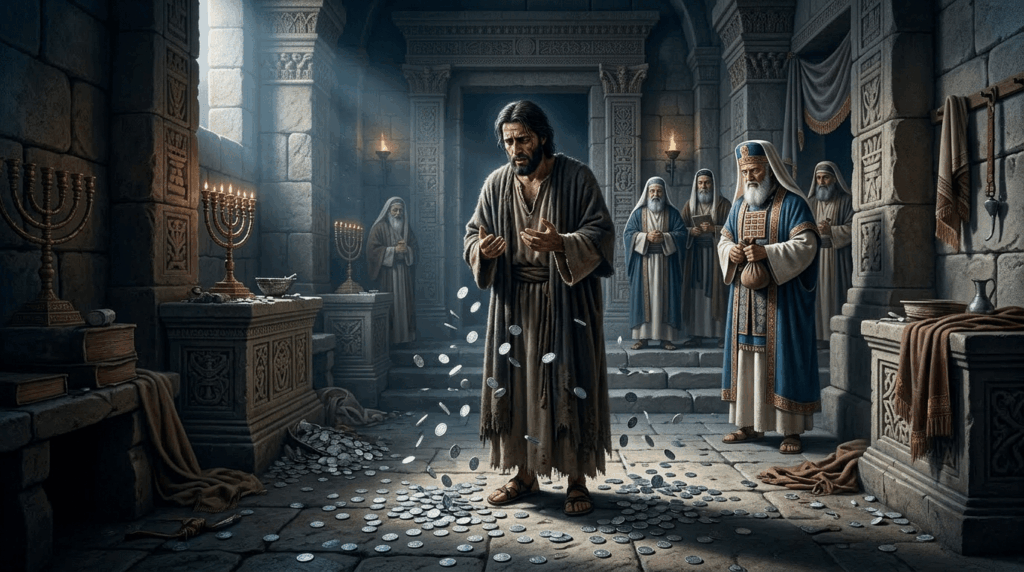
Sanhedrinin kamarista lähtiessään Juudas otti kukkarosta nuo kolmekymmentä hopearahaa ja viskasi ne pitkin temppelin lattiaa. Temppelistä poistuessaan kavaltaja oli melkein järjiltään. Juudas kävi nyt läpi kokemusta, jossa hän tajusi synnin todellisen olemuksen. Väärintekemisen koko hohto, tenho ja hurma olivat kaikonneet. Pahantekijä seisoi nyt yksin ja kasvotusten harhakuvitelmansa menettäneen ja pettyneen sielunsa esittämän langettavan tuomion kanssa. Synti oli sitä tehtäessä lumoavaa ja jännittävää, mutta nyt oli kohdattava alastomina ja epäromanttisina tosiasioina se, mikä oli synnin sato.
Tämä maanpäällisen taivaanvaltakunnan entinen suurlähettiläs käveli nyt Jerusalemin katuja, hylättynä ja yksinäisenä. Hänen epätoivonsa oli hirvittävää ja jokseenkin ehdotonta. Hän vaelsi eteenpäin, kaupungin läpi ja muurien ulkopuolelle, ja edelleen alas Hinnominlaakson kauheaan yksinäisyyteen. Siellä hän kiipesi ylös jyrkät kalliot, otti vaipastaan vyön, sitoi sen toisen pään puunkäkkärään ja toisen pään kaulansa ympäri ja heittäytyi alas jyrkänteeltä. Ennen kuin hän kuoli, hänen hermostunein käsin sitomansa solmu antoi myöten, ja kavaltajan ruumis repesi mätkähtäessään sahanteräville kiville.
It was about half past eight o’clock this Friday morning when the hearing of Jesus before Pilate was ended and the Master was placed in the custody of the Roman soldiers who were to crucify him. As soon as the Romans took possession of Jesus, the captain of the Jewish guards marched with his men back to their temple headquarters. The chief priest and his Sanhedrist associates followed close behind the guards, going directly to their usual meeting place in the hall of hewn stone in the temple. Here they found many other members of the Sanhedrin waiting to learn what had been done with Jesus. As Caiaphas was engaged in making his report to the Sanhedrin regarding the trial and condemnation of Jesus, Judas appeared before them to claim his reward for the part he had played in his Master’s arrest and sentence of death.
All of these Jews loathed Judas; they looked upon the betrayer with only feelings of utter contempt. Throughout the trial of Jesus before Caiaphas and during his appearance before Pilate, Judas was pricked in his conscience about his traitorous conduct. And he was also beginning to become somewhat disillusioned regarding the reward he was to receive as payment for his services as Jesus’ betrayer. He did not like the coolness and aloofness of the Jewish authorities; nevertheless, he expected to be liberally rewarded for his cowardly conduct. He anticipated being called before the full meeting of the Sanhedrin and there hearing himself eulogized while they conferred upon him suitable honors in token of the great service which he flattered himself he had rendered his nation. Imagine, therefore, the great surprise of this egotistic traitor when a servant of the high priest, tapping him on the shoulder, called him just outside the hall and said: “Judas, I have been appointed to pay you for the betrayal of Jesus. Here is your reward.” And thus speaking, the servant of Caiaphas handed Judas a bag containing thirty pieces of silver—the current price of a good, healthy slave.
Judas was stunned, dumfounded. He rushed back to enter the hall but was debarred by the doorkeeper. He wanted to appeal to the Sanhedrin, but they would not admit him. Judas could not believe that these rulers of the Jews would allow him to betray his friends and his Master and then offer him as a reward thirty pieces of silver. He was humiliated, disillusioned, and utterly crushed. He walked away from the temple, as it were, in a trance. He automatically dropped the money bag in his deep pocket, that same pocket wherein he had so long carried the bag containing the apostolic funds. And he wandered out through the city after the crowds who were on their way to witness the crucifixions.
From a distance Judas saw them raise the cross piece with Jesus nailed thereon, and upon sight of this he rushed back to the temple and, forcing his way past the doorkeeper, found himself standing in the presence of the Sanhedrin, which was still in session. The betrayer was well-nigh breathless and highly distraught, but he managed to stammer out these words: “I have sinned in that I have betrayed innocent blood. You have insulted me. You have offered me as a reward for my service, money—the price of a slave. I repent that I have done this; here is your money. I want to escape the guilt of this deed.”
When the rulers of the Jews heard Judas, they scoffed at him. One of them sitting near where Judas stood, motioned that he should leave the hall and said: “Your Master has already been put to death by the Romans, and as for your guilt, what is that to us? See you to that—and begone!”
As Judas left the Sanhedrin chamber, he removed the thirty pieces of silver from the bag and threw them broadcast over the temple floor. When the betrayer left the temple, he was almost beside himself. Judas was now passing through the experience of the realization of the true nature of sin. All the glamor, fascination, and intoxication of wrongdoing had vanished. Now the evildoer stood alone and face to face with the judgment verdict of his disillusioned and disappointed soul. Sin was bewitching and adventurous in the committing, but now must the harvest of the naked and unromantic facts be faced.
This onetime ambassador of the kingdom of heaven on earth now walked through the streets of Jerusalem, forsaken and alone. His despair was desperate and well-nigh absolute. On he journeyed through the city and outside the walls, on down into the terrible solitude of the valley of Hinnom, where he climbed up the steep rocks and, taking the girdle of his cloak, fastened one end to a small tree, tied the other about his neck, and cast himself over the precipice. Ere he was dead, the knot which his nervous hands had tied gave way, and the betrayer’s body was dashed to pieces as it fell on the jagged rocks below.
SuomiEnglish
Kello oli noin puoli yhdeksän tänä perjantaiaamuna, kun Pilatuksen edessä toimitettu Jeesuksen kuulustelu päättyi ja Mestari jätettiin niiden roomalaissotilaiden huostaan, joiden oli määrä hänet ristiinnaulita. Kohta sen jälkeen kun roomalaiset ottivat Jeesuksen huostaansa, juutalaisvartijoiden kapteeni marssi miehineen takaisin heidän temppelipäämajaansa. Pääpappi ja tämän sanhedristitoverit seurasivat vartijoiden kintereillä ja menivät suoraa tietä tavanomaiseen kokoontumispaikkaansa, veistetyistä kivistä rakennettuun temppelisaliin. Siellä he tapasivat monia muita sanhedrinin jäseniä, jotka odottelivat tietoa siitä, mitä Jeesuksen suhteen oli tehty. Kaiafaan ollessa esittämässä sanhedrinille selostustaan Jeesuksen oikeudenkäynnistä ja tuomiosta Juudas ilmestyi heidän eteensä vaatimaan palkkiotaan osasta, jota oli esittänyt Mestarin kiinniottamisessa ja kuolemaan tuomitsemisessa.
It was about half past eight o’clock this Friday morning when the hearing of Jesus before Pilate was ended and the Master was placed in the custody of the Roman soldiers who were to crucify him. As soon as the Romans took possession of Jesus, the captain of the Jewish guards marched with his men back to their temple headquarters. The chief priest and his Sanhedrist associates followed close behind the guards, going directly to their usual meeting place in the hall of hewn stone in the temple. Here they found many other members of the Sanhedrin waiting to learn what had been done with Jesus. As Caiaphas was engaged in making his report to the Sanhedrin regarding the trial and condemnation of Jesus, Judas appeared before them to claim his reward for the part he had played in his Master’s arrest and sentence of death.
Kaikki nämä juutalaiset inhosivat Juudasta; he suhtautuivat kavaltajaan tuntein, joiden sisältönä oli vain äärimmäinen halveksunta. Koko sen ajan, jonka Jeesus oli kuultavana Kaiafaan edessä, ja silloin kun hän esiintyi Pilatuksen edessä, Juudas oli tuntenut petollisesta menettelystään omantunnonpistoksia. Ja vähitellen alkoivat haihtua myös hänen harhakuvitelmansa siitä palkkiosta, joka hänen oli määrä saada maksuksi palveluksistaan Jeesuksen kavaltajana. Hän ei pitänyt juutalaisviranomaisten osoittamasta viileydestä ja kylmäkiskoisuudesta; siitä huolimatta hän odotti saavansa raukkamaisesta menettelystään avokätisen palkkion. Hän odotti tulevansa kutsutuksi täysilukuisen sanhedrinin kokouksen eteen kuulemaan, kun hänelle pidettäisiin siellä ylistyspuheita, samalla kun hänelle osoitettaisiin soveliaita kunnianosoituksia sen suuren palveluksen johdosta, jonka hän itseään imarrellen luuli kansakunnalleen tehneensä. Kuvitelkaapa sen vuoksi tämän itsekeskeisen kavaltajan suurta ällistystä, kun muuan ylipapin palvelija häntä olalle napauttaen pyysi hänet vähän matkan päähän salin ulkopuolelle ja sanoi: ”Juudas, minulle on annettu tehtäväksi maksaa sinulle Jeesuksen kavaltamisesta. Tässä on palkkiosi.” Ja näin sanoessaan Kaiafaan palvelija ojensi Juudakselle kukkaron, jossa oli kolmekymmentä hopearahaa – käypä hinta hyvästä, terveestä orjasta.
All of these Jews loathed Judas; they looked upon the betrayer with only feelings of utter contempt. Throughout the trial of Jesus before Caiaphas and during his appearance before Pilate, Judas was pricked in his conscience about his traitorous conduct. And he was also beginning to become somewhat disillusioned regarding the reward he was to receive as payment for his services as Jesus’ betrayer. He did not like the coolness and aloofness of the Jewish authorities; nevertheless, he expected to be liberally rewarded for his cowardly conduct. He anticipated being called before the full meeting of the Sanhedrin and there hearing himself eulogized while they conferred upon him suitable honors in token of the great service which he flattered himself he had rendered his nation. Imagine, therefore, the great surprise of this egotistic traitor when a servant of the high priest, tapping him on the shoulder, called him just outside the hall and said: “Judas, I have been appointed to pay you for the betrayal of Jesus. Here is your reward.” And thus speaking, the servant of Caiaphas handed Judas a bag containing thirty pieces of silver—the current price of a good, healthy slave.
Juudas oli ällikällä lyöty, hän ei saanut sanaa suustaan. Hän syöksähti takaisin mennäkseen saliin, mutta ovenvartija esti hänen sisäänpääsynsä. Hän halusi vedota sanhedriniin, mutta häntä ei päästetty sisälle. Juudas ei voinut uskoa, että nämä juutalaiset vallanpitäjät antaisivat hänen pettää ystävänsä ja Mestarinsa ja sitten tarjoaisivat hänelle palkkiona kolmekymmentä hopearahaa. Hän tunsi itsensä nöyryytetyksi, pettyneeksi ja läpikotaisen muserretuksi. Hän käveli pois temppeliltä ikään kuin olisi ollut transsissa. Mitään ajattelematta hän pudotti rahakukkaron syvään taskuunsa, samaan taskuun, jossa hän niin kauan aikaa oli kantanut apostolien rahavarat sisältävää kukkaroa. Ja hän vaelsi kaupungin läpi niiden väkijoukkojen perässä, jotka olivat menossa katsomaan ristiinnaulitsemisia.
Judas was stunned, dumfounded. He rushed back to enter the hall but was debarred by the doorkeeper. He wanted to appeal to the Sanhedrin, but they would not admit him. Judas could not believe that these rulers of the Jews would allow him to betray his friends and his Master and then offer him as a reward thirty pieces of silver. He was humiliated, disillusioned, and utterly crushed. He walked away from the temple, as it were, in a trance. He automatically dropped the money bag in his deep pocket, that same pocket wherein he had so long carried the bag containing the apostolic funds. And he wandered out through the city after the crowds who were on their way to witness the crucifixions.
Matkan päästä Juudas näki, kun nostettiin paikalleen poikkipuu, johon Jeesus oli naulittu, ja tämän nähtyään hän ryntäsi takaisin temppeliin, tunkeutui väkisin ovenvartijan ohitse ja huomasi seisovansa istuntoaan edelleen jatkavan sanhedrinin edessä. Kavaltajan henki oli miltei salpaantunut, ja hän oli perin suunniltaan, mutta hän onnistui kakistamaan seuraavat sanat: ”Olen tehnyt syntiä viattoman veren kavaltamalla. Olette loukanneet minua. Olette palkaksi palveluksestani tarjonneet minulle rahaa – orjan hinnan. Kadun, että olen tämän tehnyt; tässä on rahanne. En halua niskoilleni syyllisyyttä tästä teosta.”
From a distance Judas saw them raise the cross piece with Jesus nailed thereon, and upon sight of this he rushed back to the temple and, forcing his way past the doorkeeper, found himself standing in the presence of the Sanhedrin, which was still in session. The betrayer was well-nigh breathless and highly distraught, but he managed to stammer out these words: “I have sinned in that I have betrayed innocent blood. You have insulted me. You have offered me as a reward for my service, money—the price of a slave. I repent that I have done this; here is your money. I want to escape the guilt of this deed.”
Kun juutalaisten vallanpitäjät kuulivat, mitä Juudaksella oli sanottavanaan, nämä pilkkasivat häntä. Muuan heistä, joka istui lähellä paikkaa, jossa Juudas seisoi, viittasi häntä poistumaan salista ja sanoi: ”Roomalaiset ovat jo ottaneet Mestarisi hengiltä, ja syyllisyydestäsi puheen ollen, mitä se meitä liikuttaa? Se on sinun huolesi – painu tiehesi!”
When the rulers of the Jews heard Judas, they scoffed at him. One of them sitting near where Judas stood, motioned that he should leave the hall and said: “Your Master has already been put to death by the Romans, and as for your guilt, what is that to us? See you to that—and begone!”
Sanhedrinin kamarista lähtiessään Juudas otti kukkarosta nuo kolmekymmentä hopearahaa ja viskasi ne pitkin temppelin lattiaa. Temppelistä poistuessaan kavaltaja oli melkein järjiltään. Juudas kävi nyt läpi kokemusta, jossa hän tajusi synnin todellisen olemuksen. Väärintekemisen koko hohto, tenho ja hurma olivat kaikonneet. Pahantekijä seisoi nyt yksin ja kasvotusten harhakuvitelmansa menettäneen ja pettyneen sielunsa esittämän langettavan tuomion kanssa. Synti oli sitä tehtäessä lumoavaa ja jännittävää, mutta nyt oli kohdattava alastomina ja epäromanttisina tosiasioina se, mikä oli synnin sato.
As Judas left the Sanhedrin chamber, he removed the thirty pieces of silver from the bag and threw them broadcast over the temple floor. When the betrayer left the temple, he was almost beside himself. Judas was now passing through the experience of the realization of the true nature of sin. All the glamor, fascination, and intoxication of wrongdoing had vanished. Now the evildoer stood alone and face to face with the judgment verdict of his disillusioned and disappointed soul. Sin was bewitching and adventurous in the committing, but now must the harvest of the naked and unromantic facts be faced.
Tämä maanpäällisen taivaanvaltakunnan entinen suurlähettiläs käveli nyt Jerusalemin katuja, hylättynä ja yksinäisenä. Hänen epätoivonsa oli hirvittävää ja jokseenkin ehdotonta. Hän vaelsi eteenpäin, kaupungin läpi ja muurien ulkopuolelle, ja edelleen alas Hinnominlaakson kauheaan yksinäisyyteen. Siellä hän kiipesi ylös jyrkät kalliot, otti vaipastaan vyön, sitoi sen toisen pään puunkäkkärään ja toisen pään kaulansa ympäri ja heittäytyi alas jyrkänteeltä. Ennen kuin hän kuoli, hänen hermostunein käsin sitomansa solmu antoi myöten, ja kavaltajan ruumis repesi mätkähtäessään sahanteräville kiville.
This onetime ambassador of the kingdom of heaven on earth now walked through the streets of Jerusalem, forsaken and alone. His despair was desperate and well-nigh absolute. On he journeyed through the city and outside the walls, on down into the terrible solitude of the valley of Hinnom, where he climbed up the steep rocks and, taking the girdle of his cloak, fastened one end to a small tree, tied the other about his neck, and cast himself over the precipice. Ere he was dead, the knot which his nervous hands had tied gave way, and the betrayer’s body was dashed to pieces as it fell on the jagged rocks below.