
Teksti
Tausta
Näytä
Lisäasetukset
Kieli
Urantia Opas
Kysy kirjan sisällöstä. Opas vastaa Book Enginen omien lähdekohtien perusteella ja ohjaa sinut lukemaan ne.
Hei! 🙏
Olen sinun Urantia-oppaasi. Tehtäväni on auttaa sinua löytämään oikeat kohdat Urantia-kirjasta ja ymmärtämään sen opetuksia syvemmin. 😊❤️
Tuona sapattina oli kaunis sää, ja kaikki nasaretilaiset – niin ystävät kuin vihollisetkin – ilmestyivät kuuntelemaan, kun tämä heidän kaupunkinsa entinen asukas puhuisi synagogassa. Useat apostoliseurueen jäsenet joutuivat jäämään synagogan ulkopuolelle, sillä tila ei riittänyt kaikille, jotka olivat tulleet häntä kuulemaan. Nuorena miehenä Jeesus oli monet kerrat puhunut tässä palvontapaikassa, ja kun synagogan esimies tuona aamuna ojensi Jeesukselle sen pyhien kirjoitusten kirjakäärön, josta tämä lukisi päivän tekstin, kukaan läsnäolevista ei tuntunut muistavan, että tämä oli sama käsikirjoitus, jonka hän oli tuolle synagogalle lahjoittanut.
Tuon päivän palvelukset toimitettiin täsmälleen samalla tavalla kuin ne oli toimitettu Jeesuksen niihin pikkupoikana osallistuessa. Hän nousi puhujakorokkeelle synagogan esimiehen seurassa, ja palvelus aloitettiin lausumalla ääneen kaksi rukousta: ”Siunattu on Herra, maailman Kuningas, joka muovaelee valkeuden ja luo pimeyden; joka tekee rauhan ja joka luo kaiken; joka armossaan antaa valon maailmaan ja niille, jotka siellä asuvat, ja joka hyvyydessään päivästä päivään ja joka päivä uudistaa ne, jotka hän on luonut. Siunattu on Herra, meidän Jumalamme, kättensä töitten suurenmoisuuden ja valoa antavien valkeuksiensa tähden, jotka hän on tehnyt ylistyksekseen. Sela. Siunattu on Herra, meidän Jumalamme, joka on muovaellut valkeudet.”
Hetken tauon jälkeen he esittivät toisen rukouksen: ”Suurella rakkaudella on Herra, meidän Jumalamme, meitä rakastanut ja paljolla ja ylitsevuotavalla säälillä on hän, Isämme ja Kuninkaamme, meitä säälinyt isiemme tähden, jotka luottivat häneen. Sinä opetit heille elämän lakisäädökset; ole meille armollinen ja opeta meitä. Valaise meidän silmämme, niin että ymmärtäisimme lain; pane sydämemme pitämään kiinni käskyistäsi; yhdistä sydämemme rakastamaan ja pelkäämään nimeäsi, eikä meitä silloin saateta häpeään niin kauan kuin maailma pysyy. Sillä sinä olet Jumala, joka valmistaa pelastuksen, ja meidät sinä olet kaikkien kansakuntien ja kielikuntien joukosta valinnut ja totuudessa olet sinä meidät tuonut lähelle suurta nimeäsi – sela –, jotta me saattaisimme rakkaudessa ylistää sinun ykseyttäsi. Siunattu on Herra, joka rakkaudessaan valitsi kansansa Israelin.”
Sitten seurakunta lausui sheeman, juutalaisen uskontunnustuksen. Tässä rituaalissa oli kysymys lukuisten lainkohtien toistamisesta, ja se oli osoitus siitä, että palvojat ottivat kantaakseen taivaan valtakunnan ikeen kuin myös käskyjen ikeen, niin kuin niitä sovellettiin päivän ja yön tapahtumiin.
Ja sitten seurasi kolmas rukous: ”Totisesti sinä olet Jahve, meidän Jumalamme ja meidän isiemme Jumala; Kuninkaamme ja isiemme Kuningas; Pelastajamme ja isiemme Pelastaja; Luojamme ja pelastuksemme kallio; apumme ja vapahtajamme. Sinun nimesi on iankaikkisuudesta, eikä ole muuta Jumalaa kuin sinä. Vapahdetut lauloivat merenrannalla uuden laulun sinun nimellesi; yhdessä he kaikki ylistivät sinua ja tunnustivat sinut Kuninkaaksi ja sanoivat: Jahve on hallitseva niin kauan kuin maailma pysyy. Siunattu on Herra, joka pelastaa Israelin.”
Tämän jälkeen synagogan esimies asettui paikalleen arkin eli pyhät kirjoitukset sisältävän kirstun eteen ja alkoi lukea ääneen yhdeksäätoista ylistysrukousta eli siunausta. Mutta tämänkertaisessa tilanteessa palvelusta haluttiin lyhentää, jotta arvovieraalle jäisi enemmän aikaa omaa puhettaan varten. Niinpä siunauksista esitettiin vain ensimmäinen ja viimeinen. Ensimmäinen kuului: ”Siunattu on Herra, meidän Jumalamme, ja meidän isiemme Jumala, Abrahamin Jumala ja Iisakin Jumala ja Jaakobin Jumala; suuri, mahtava ja kauhistuttava Jumala, joka osoittaa armoa ja laupeutta, joka luo kaikki olevaiset, joka muistaa isille antamansa armolliset lupaukset ja joka rakkaudessaan tuo pelastajan heidän lastenlapsilleen oman nimensä tähden. Oi Kuningas, auttaja, pelastaja ja kilpemme! Siunattu olet sinä, oi Jahve, Abrahamin kilpi.”
Sitten seurasi viimeinen siunaus: ”Oi, tuo kansallesi Israelille ikiajoiksi suurenmoinen rauha, sillä sinä olet Kuningas ja kaiken rauhan Herra. Ja sinun silmissäsi on hyvä siunata rauhalla Israelia kaikkina aikoina ja joka hetki. Siunattu olet sinä, Jahve, joka siunaa rauhalla kansaansa Israelia.” Seurakunta ei katsonut esimiestä tämän lausuessa siunaukset. Siunaustenluvun jälkeen hän esitti tilanteeseen sopivan epämuodollisen rukouksen, ja kun hän sai sen päätökseen, koko seurakunta lausui yhdessä aamenen.
Sitten hashen meni arkille ja otti sieltä esille käärön, jonka hän ojensi Jeesukselle, jotta tämä lukisi siitä kirjoitusten tekstikohdan. Tapana oli, että seitsemän eri henkilöä kutsuttiin lukemaan vähintään kolme lain säettä, mutta tällä kertaa tästä tavasta luovuttiin, jotta vieras saisi lukea itse valitsemansa tekstikohdan. Jeesus tarttui kääröön, nousi seisomaan ja alkoi lukea viidennestä Mooseksen kirjasta: ”Sillä tätä käskyä, jonka minä tänä päivänä sinulle annan, ei ole sinulta kätketty, eikä se ole kaukana. Se ei ole taivaassa, jotta sinä sanoisit: Kuka nousisi meidän puolestamme taivaaseen noutamaan sen meille ja julistaisi sen meille, että me sen täyttäisimme? Se ei myöskään ole meren takana, jotta sinä sanoisit: Kuka menisi meidän puolestamme meren taakse noutamaan tämän käskyn meille ja julistaisi sen meille, että me sen täyttäisimme? Ei, vaan elämän sana on sinua aivan lähellä, siellä missä sinäkin olet, ja sinun sydämessäsi, niin että sinä sen tuntisit ja täyttäisit.”
Ja kun hän oli lukenut lain tekstikohdan loppuun, hän siirtyi Jesajan kirjaan ja ryhtyi lukemaan: ”Herran henki on minun päälläni, sillä hän on voidellut minut julistamaan ilosanomaa köyhille. Hän on lähettänyt minut julistamaan vangituille vapautusta ja sokeille näön saamista, päästämään pahoinpidellyt vapauteen ja julistamaan Herran otollista vuotta.”
Jeesus sulki kirjan, ja ojennettuaan sen takaisin synagogan esimiehelle hän istuutui ja ryhtyi pitämään puhetta kansalle. Hän aloitti sanomalla: ”Tänään ovat nämä kirjoitusten kohdat täytetyt.” Ja sitten Jeesus puhui lähes viidentoista minuutin ajan aiheesta ”Jumalan pojat ja tyttäret”. Monia tämä puhe miellytti, ja he ihmettelivät ja ihailivat hänen rakastettavuuttaan ja viisauttaan.
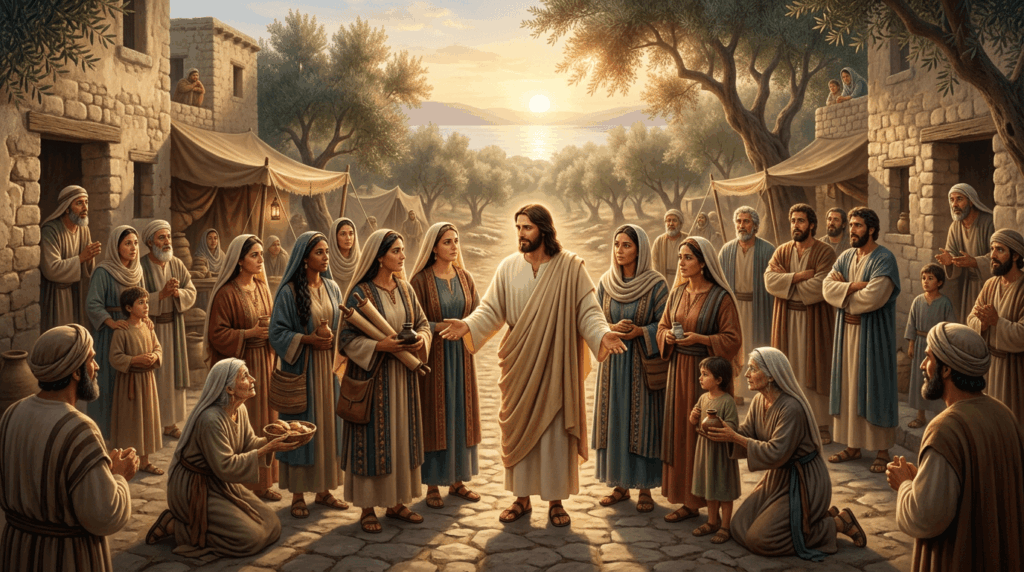
Synagogassa oli tapana, että puhuja jäi virallisen palveluksen päätyttyä vielä paikalle, jotta mahdolliset kiinnostuneet voisivat esittää hänelle kysymyksiä. Niinpä Jeesus tuona sapattiaamuna astui alas kansanjoukon keskuuteen, joka työntyi eteenpäin esittämään kysymyksiä. Tämän ryhmän mukana tuli monia levottomia yksilöitä, joiden mieli oli taipuvainen pahantekoon, samalla kun tämän väkijoukon laitamilla kiertelivät ne alhaiset miehet, jotka oli palkattu aiheuttamaan Jeesukselle ikävyyksiä. Monet ulkopuolelle jääneistä opetuslapsista ja evankelistoista työntyivät nyt sisälle synagogaan, ja he huomasivat heti, että tulossa oli rettelö. He koettivat johdattaa Mestarin pois, mutta hän ei suostunut lähtemään heidän mukaansa.
This Sabbath was a beautiful day, and all Nazareth, friends and foes, turned out to hear this former citizen of their town discourse in the synagogue. Many of the apostolic retinue had to remain without the synagogue; there was not room for all who had come to hear him. As a young man Jesus had often spoken in this place of worship, and this morning, when the ruler of the synagogue handed him the roll of sacred writings from which to read the Scripture lesson, none present seemed to recall that this was the very manuscript which he had presented to this synagogue.
The services on this day were conducted just as when Jesus had attended them as a boy. He ascended the speaking platform with the ruler of the synagogue, and the service was begun by the recital of two prayers: “Blessed is the Lord, King of the world, who forms the light and creates the darkness, who makes peace and creates everything; who, in mercy, gives light to the earth and to those who dwell upon it and in goodness, day by day and every day, renews the works of creation. Blessed is the Lord our God for the glory of his handiworks and for the light-giving lights which he has made for his praise. Selah. Blessed is the Lord our God, who has formed the lights.”
After a moment’s pause they again prayed: “With great love has the Lord our God loved us, and with much overflowing pity has he pitied us, our Father and our King, for the sake of our fathers who trusted in him. You taught them the statutes of life; have mercy upon us and teach us. Enlighten our eyes in the law; cause our hearts to cleave to your commandments; unite our hearts to love and fear your name, and we shall not be put to shame, world without end. For you are a God who prepares salvation, and us have you chosen from among all nations and tongues, and in truth have you brought us near your great name—selah—that we may lovingly praise your unity. Blessed is the Lord, who in love chose his people Israel.”
The congregation then recited the Shema, the Jewish creed of faith. This ritual consisted in repeating numerous passages from the law and indicated that the worshipers took upon themselves the yoke of the kingdom of heaven, also the yoke of the commandments as applied to the day and the night.
And then followed the third prayer: “True it is that you are Yahweh, our God and the God of our fathers; our King and the King of our fathers; our Savior and the Savior of our fathers; our Creator and the rock of our salvation; our help and our deliverer. Your name is from everlasting, and there is no God beside you. A new song did they that were delivered sing to your name by the seashore; together did all praise and own you King and say, Yahweh shall reign, world without end. Blessed is the Lord who saves Israel.”
The ruler of the synagogue then took his place before the ark, or chest, containing the sacred writings and began the recitation of the nineteen prayer eulogies, or benedictions. But on this occasion it was desirable to shorten the service in order that the distinguished guest might have more time for his discourse; accordingly, only the first and last of the benedictions were recited. The first was: “Blessed is the Lord our God, and the God of our fathers, the God of Abraham, and the God of Isaac, and the God of Jacob; the great, the mighty, and the terrible God, who shows mercy and kindness, who creates all things, who remembers the gracious promises to the fathers and brings a savior to their children’s children for his own name’s sake, in love. O King, helper, savior, and shield! Blessed are you, O Yahweh, the shield of Abraham.”
Then followed the last benediction: “O bestow on your people Israel great peace forever, for you are King and the Lord of all peace. And it is good in your eyes to bless Israel at all times and at every hour with peace. Blessed are you, Yahweh, who blesses his people Israel with peace.” The congregation looked not at the ruler as he recited the benedictions. Following the benedictions he offered an informal prayer suitable for the occasion, and when this was concluded, all the congregation joined in saying amen.
Then the chazan went over to the ark and brought out a roll, which he presented to Jesus that he might read the Scripture lesson. It was customary to call upon seven persons to read not less than three verses of the law, but this practice was waived on this occasion that the visitor might read the lesson of his own selection. Jesus, taking the roll, stood up and began to read from Deuteronomy: “For this commandment which I give you this day is not hidden from you, neither is it far off. It is not in heaven, that you should say, who shall go up for us to heaven and bring it down to us that we may hear and do it? Neither is it beyond the sea, that you should say, who will go over the sea for us to bring the commandment to us that we may hear and do it? No, the word of life is very near to you, even in your presence and in your heart, that you may know and obey it.”
And when he had ceased reading from the law, he turned to Isaiah and began to read: “The spirit of the Lord is upon me because he has anointed me to preach good tidings to the poor. He has sent me to proclaim release to the captives and the recovering of sight to the blind, to set at liberty those who are bruised and to proclaim the acceptable year of the Lord.”
Jesus closed the book and, after handing it back to the ruler of the synagogue, sat down and began to discourse to the people. He began by saying: “Today are these Scriptures fulfilled.” And then Jesus spoke for almost fifteen minutes on “The Sons and Daughters of God.” Many of the people were pleased with the discourse, and they marveled at his graciousness and wisdom.
It was customary in the synagogue, after the conclusion of the formal service, for the speaker to remain so that those who might be interested could ask him questions. Accordingly, on this Sabbath morning Jesus stepped down into the crowd which pressed forward to ask questions. In this group were many turbulent individuals whose minds were bent on mischief, while about the fringe of this crowd there circulated those debased men who had been hired to make trouble for Jesus. Many of the disciples and evangelists who had remained without now pressed into the synagogue and were not slow to recognize that trouble was brewing. They sought to lead the Master away, but he would not go with them.
SuomiEnglish
Tuona sapattina oli kaunis sää, ja kaikki nasaretilaiset – niin ystävät kuin vihollisetkin – ilmestyivät kuuntelemaan, kun tämä heidän kaupunkinsa entinen asukas puhuisi synagogassa. Useat apostoliseurueen jäsenet joutuivat jäämään synagogan ulkopuolelle, sillä tila ei riittänyt kaikille, jotka olivat tulleet häntä kuulemaan. Nuorena miehenä Jeesus oli monet kerrat puhunut tässä palvontapaikassa, ja kun synagogan esimies tuona aamuna ojensi Jeesukselle sen pyhien kirjoitusten kirjakäärön, josta tämä lukisi päivän tekstin, kukaan läsnäolevista ei tuntunut muistavan, että tämä oli sama käsikirjoitus, jonka hän oli tuolle synagogalle lahjoittanut.
This Sabbath was a beautiful day, and all Nazareth, friends and foes, turned out to hear this former citizen of their town discourse in the synagogue. Many of the apostolic retinue had to remain without the synagogue; there was not room for all who had come to hear him. As a young man Jesus had often spoken in this place of worship, and this morning, when the ruler of the synagogue handed him the roll of sacred writings from which to read the Scripture lesson, none present seemed to recall that this was the very manuscript which he had presented to this synagogue.
Tuon päivän palvelukset toimitettiin täsmälleen samalla tavalla kuin ne oli toimitettu Jeesuksen niihin pikkupoikana osallistuessa. Hän nousi puhujakorokkeelle synagogan esimiehen seurassa, ja palvelus aloitettiin lausumalla ääneen kaksi rukousta: ”Siunattu on Herra, maailman Kuningas, joka muovaelee valkeuden ja luo pimeyden; joka tekee rauhan ja joka luo kaiken; joka armossaan antaa valon maailmaan ja niille, jotka siellä asuvat, ja joka hyvyydessään päivästä päivään ja joka päivä uudistaa ne, jotka hän on luonut. Siunattu on Herra, meidän Jumalamme, kättensä töitten suurenmoisuuden ja valoa antavien valkeuksiensa tähden, jotka hän on tehnyt ylistyksekseen. Sela. Siunattu on Herra, meidän Jumalamme, joka on muovaellut valkeudet.”
The services on this day were conducted just as when Jesus had attended them as a boy. He ascended the speaking platform with the ruler of the synagogue, and the service was begun by the recital of two prayers: “Blessed is the Lord, King of the world, who forms the light and creates the darkness, who makes peace and creates everything; who, in mercy, gives light to the earth and to those who dwell upon it and in goodness, day by day and every day, renews the works of creation. Blessed is the Lord our God for the glory of his handiworks and for the light-giving lights which he has made for his praise. Selah. Blessed is the Lord our God, who has formed the lights.”
Hetken tauon jälkeen he esittivät toisen rukouksen: ”Suurella rakkaudella on Herra, meidän Jumalamme, meitä rakastanut ja paljolla ja ylitsevuotavalla säälillä on hän, Isämme ja Kuninkaamme, meitä säälinyt isiemme tähden, jotka luottivat häneen. Sinä opetit heille elämän lakisäädökset; ole meille armollinen ja opeta meitä. Valaise meidän silmämme, niin että ymmärtäisimme lain; pane sydämemme pitämään kiinni käskyistäsi; yhdistä sydämemme rakastamaan ja pelkäämään nimeäsi, eikä meitä silloin saateta häpeään niin kauan kuin maailma pysyy. Sillä sinä olet Jumala, joka valmistaa pelastuksen, ja meidät sinä olet kaikkien kansakuntien ja kielikuntien joukosta valinnut ja totuudessa olet sinä meidät tuonut lähelle suurta nimeäsi – sela –, jotta me saattaisimme rakkaudessa ylistää sinun ykseyttäsi. Siunattu on Herra, joka rakkaudessaan valitsi kansansa Israelin.”
After a moment’s pause they again prayed: “With great love has the Lord our God loved us, and with much overflowing pity has he pitied us, our Father and our King, for the sake of our fathers who trusted in him. You taught them the statutes of life; have mercy upon us and teach us. Enlighten our eyes in the law; cause our hearts to cleave to your commandments; unite our hearts to love and fear your name, and we shall not be put to shame, world without end. For you are a God who prepares salvation, and us have you chosen from among all nations and tongues, and in truth have you brought us near your great name—selah—that we may lovingly praise your unity. Blessed is the Lord, who in love chose his people Israel.”
Sitten seurakunta lausui sheeman, juutalaisen uskontunnustuksen. Tässä rituaalissa oli kysymys lukuisten lainkohtien toistamisesta, ja se oli osoitus siitä, että palvojat ottivat kantaakseen taivaan valtakunnan ikeen kuin myös käskyjen ikeen, niin kuin niitä sovellettiin päivän ja yön tapahtumiin.
The congregation then recited the Shema, the Jewish creed of faith. This ritual consisted in repeating numerous passages from the law and indicated that the worshipers took upon themselves the yoke of the kingdom of heaven, also the yoke of the commandments as applied to the day and the night.
Ja sitten seurasi kolmas rukous: ”Totisesti sinä olet Jahve, meidän Jumalamme ja meidän isiemme Jumala; Kuninkaamme ja isiemme Kuningas; Pelastajamme ja isiemme Pelastaja; Luojamme ja pelastuksemme kallio; apumme ja vapahtajamme. Sinun nimesi on iankaikkisuudesta, eikä ole muuta Jumalaa kuin sinä. Vapahdetut lauloivat merenrannalla uuden laulun sinun nimellesi; yhdessä he kaikki ylistivät sinua ja tunnustivat sinut Kuninkaaksi ja sanoivat: Jahve on hallitseva niin kauan kuin maailma pysyy. Siunattu on Herra, joka pelastaa Israelin.”
And then followed the third prayer: “True it is that you are Yahweh, our God and the God of our fathers; our King and the King of our fathers; our Savior and the Savior of our fathers; our Creator and the rock of our salvation; our help and our deliverer. Your name is from everlasting, and there is no God beside you. A new song did they that were delivered sing to your name by the seashore; together did all praise and own you King and say, Yahweh shall reign, world without end. Blessed is the Lord who saves Israel.”
Tämän jälkeen synagogan esimies asettui paikalleen arkin eli pyhät kirjoitukset sisältävän kirstun eteen ja alkoi lukea ääneen yhdeksäätoista ylistysrukousta eli siunausta. Mutta tämänkertaisessa tilanteessa palvelusta haluttiin lyhentää, jotta arvovieraalle jäisi enemmän aikaa omaa puhettaan varten. Niinpä siunauksista esitettiin vain ensimmäinen ja viimeinen. Ensimmäinen kuului: ”Siunattu on Herra, meidän Jumalamme, ja meidän isiemme Jumala, Abrahamin Jumala ja Iisakin Jumala ja Jaakobin Jumala; suuri, mahtava ja kauhistuttava Jumala, joka osoittaa armoa ja laupeutta, joka luo kaikki olevaiset, joka muistaa isille antamansa armolliset lupaukset ja joka rakkaudessaan tuo pelastajan heidän lastenlapsilleen oman nimensä tähden. Oi Kuningas, auttaja, pelastaja ja kilpemme! Siunattu olet sinä, oi Jahve, Abrahamin kilpi.”
The ruler of the synagogue then took his place before the ark, or chest, containing the sacred writings and began the recitation of the nineteen prayer eulogies, or benedictions. But on this occasion it was desirable to shorten the service in order that the distinguished guest might have more time for his discourse; accordingly, only the first and last of the benedictions were recited. The first was: “Blessed is the Lord our God, and the God of our fathers, the God of Abraham, and the God of Isaac, and the God of Jacob; the great, the mighty, and the terrible God, who shows mercy and kindness, who creates all things, who remembers the gracious promises to the fathers and brings a savior to their children’s children for his own name’s sake, in love. O King, helper, savior, and shield! Blessed are you, O Yahweh, the shield of Abraham.”
Sitten seurasi viimeinen siunaus: ”Oi, tuo kansallesi Israelille ikiajoiksi suurenmoinen rauha, sillä sinä olet Kuningas ja kaiken rauhan Herra. Ja sinun silmissäsi on hyvä siunata rauhalla Israelia kaikkina aikoina ja joka hetki. Siunattu olet sinä, Jahve, joka siunaa rauhalla kansaansa Israelia.” Seurakunta ei katsonut esimiestä tämän lausuessa siunaukset. Siunaustenluvun jälkeen hän esitti tilanteeseen sopivan epämuodollisen rukouksen, ja kun hän sai sen päätökseen, koko seurakunta lausui yhdessä aamenen.
Then followed the last benediction: “O bestow on your people Israel great peace forever, for you are King and the Lord of all peace. And it is good in your eyes to bless Israel at all times and at every hour with peace. Blessed are you, Yahweh, who blesses his people Israel with peace.” The congregation looked not at the ruler as he recited the benedictions. Following the benedictions he offered an informal prayer suitable for the occasion, and when this was concluded, all the congregation joined in saying amen.
Sitten hashen meni arkille ja otti sieltä esille käärön, jonka hän ojensi Jeesukselle, jotta tämä lukisi siitä kirjoitusten tekstikohdan. Tapana oli, että seitsemän eri henkilöä kutsuttiin lukemaan vähintään kolme lain säettä, mutta tällä kertaa tästä tavasta luovuttiin, jotta vieras saisi lukea itse valitsemansa tekstikohdan. Jeesus tarttui kääröön, nousi seisomaan ja alkoi lukea viidennestä Mooseksen kirjasta: ”Sillä tätä käskyä, jonka minä tänä päivänä sinulle annan, ei ole sinulta kätketty, eikä se ole kaukana. Se ei ole taivaassa, jotta sinä sanoisit: Kuka nousisi meidän puolestamme taivaaseen noutamaan sen meille ja julistaisi sen meille, että me sen täyttäisimme? Se ei myöskään ole meren takana, jotta sinä sanoisit: Kuka menisi meidän puolestamme meren taakse noutamaan tämän käskyn meille ja julistaisi sen meille, että me sen täyttäisimme? Ei, vaan elämän sana on sinua aivan lähellä, siellä missä sinäkin olet, ja sinun sydämessäsi, niin että sinä sen tuntisit ja täyttäisit.”
Then the chazan went over to the ark and brought out a roll, which he presented to Jesus that he might read the Scripture lesson. It was customary to call upon seven persons to read not less than three verses of the law, but this practice was waived on this occasion that the visitor might read the lesson of his own selection. Jesus, taking the roll, stood up and began to read from Deuteronomy: “For this commandment which I give you this day is not hidden from you, neither is it far off. It is not in heaven, that you should say, who shall go up for us to heaven and bring it down to us that we may hear and do it? Neither is it beyond the sea, that you should say, who will go over the sea for us to bring the commandment to us that we may hear and do it? No, the word of life is very near to you, even in your presence and in your heart, that you may know and obey it.”
Ja kun hän oli lukenut lain tekstikohdan loppuun, hän siirtyi Jesajan kirjaan ja ryhtyi lukemaan: ”Herran henki on minun päälläni, sillä hän on voidellut minut julistamaan ilosanomaa köyhille. Hän on lähettänyt minut julistamaan vangituille vapautusta ja sokeille näön saamista, päästämään pahoinpidellyt vapauteen ja julistamaan Herran otollista vuotta.”
And when he had ceased reading from the law, he turned to Isaiah and began to read: “The spirit of the Lord is upon me because he has anointed me to preach good tidings to the poor. He has sent me to proclaim release to the captives and the recovering of sight to the blind, to set at liberty those who are bruised and to proclaim the acceptable year of the Lord.”
Jeesus sulki kirjan, ja ojennettuaan sen takaisin synagogan esimiehelle hän istuutui ja ryhtyi pitämään puhetta kansalle. Hän aloitti sanomalla: ”Tänään ovat nämä kirjoitusten kohdat täytetyt.” Ja sitten Jeesus puhui lähes viidentoista minuutin ajan aiheesta ”Jumalan pojat ja tyttäret”. Monia tämä puhe miellytti, ja he ihmettelivät ja ihailivat hänen rakastettavuuttaan ja viisauttaan.
Jesus closed the book and, after handing it back to the ruler of the synagogue, sat down and began to discourse to the people. He began by saying: “Today are these Scriptures fulfilled.” And then Jesus spoke for almost fifteen minutes on “The Sons and Daughters of God.” Many of the people were pleased with the discourse, and they marveled at his graciousness and wisdom.
Synagogassa oli tapana, että puhuja jäi virallisen palveluksen päätyttyä vielä paikalle, jotta mahdolliset kiinnostuneet voisivat esittää hänelle kysymyksiä. Niinpä Jeesus tuona sapattiaamuna astui alas kansanjoukon keskuuteen, joka työntyi eteenpäin esittämään kysymyksiä. Tämän ryhmän mukana tuli monia levottomia yksilöitä, joiden mieli oli taipuvainen pahantekoon, samalla kun tämän väkijoukon laitamilla kiertelivät ne alhaiset miehet, jotka oli palkattu aiheuttamaan Jeesukselle ikävyyksiä. Monet ulkopuolelle jääneistä opetuslapsista ja evankelistoista työntyivät nyt sisälle synagogaan, ja he huomasivat heti, että tulossa oli rettelö. He koettivat johdattaa Mestarin pois, mutta hän ei suostunut lähtemään heidän mukaansa.
It was customary in the synagogue, after the conclusion of the formal service, for the speaker to remain so that those who might be interested could ask him questions. Accordingly, on this Sabbath morning Jesus stepped down into the crowd which pressed forward to ask questions. In this group were many turbulent individuals whose minds were bent on mischief, while about the fringe of this crowd there circulated those debased men who had been hired to make trouble for Jesus. Many of the disciples and evangelists who had remained without now pressed into the synagogue and were not slow to recognize that trouble was brewing. They sought to lead the Master away, but he would not go with them.