
Teksti
Tausta
Näytä
Lisäasetukset
Kieli
Urantia Opas
Kysy kirjan sisällöstä. Opas vastaa Book Enginen omien lähdekohtien perusteella ja ohjaa sinut lukemaan ne.
Hei! 🙏
Olen sinun Urantia-oppaasi. Tehtäväni on auttaa sinua löytämään oikeat kohdat Urantia-kirjasta ja ymmärtämään sen opetuksia syvemmin. 😊❤️
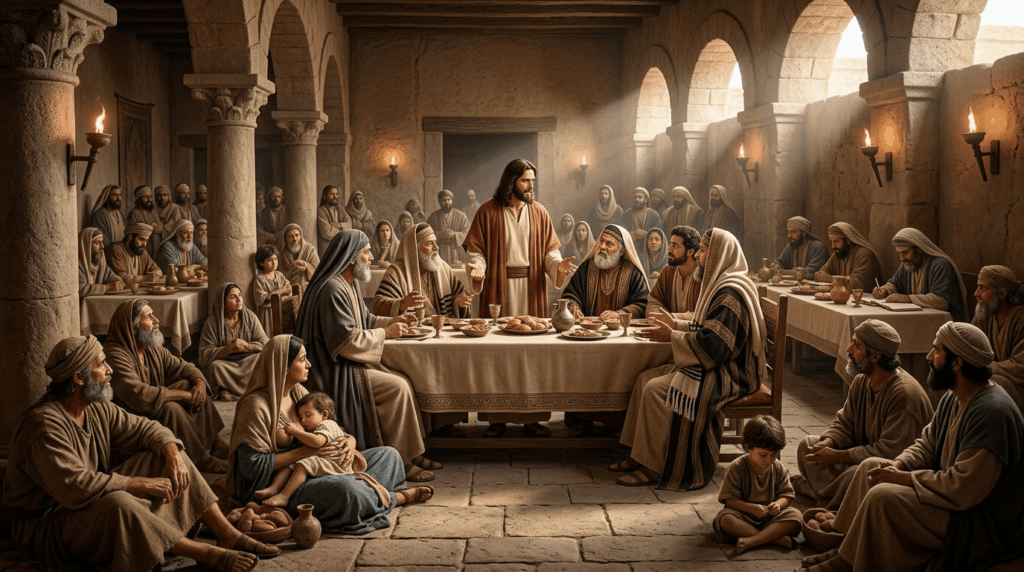
Filadelfiassa asui muuan varsin varakas ja vaikutusvaltainen fariseus, joka oli omaksunut Abnerin opetukset, ja hän kutsui Jeesuksen sapattiaamuna taloonsa aamiaiselle. Oli tiedossa, että Jeesusta odotettiin tuona ajankohtana Filadelfiaan, ja niin sinne oli saapunut Jerusalemista ja muualta suuri joukko kyläilijöitä, joiden joukossa oli useita fariseuksia. Niinpä näitä johtomiehiä oli kutsuttu nelisenkymmentä muutaman lainoppineen lisäksi tälle Mestarin kunniaksi järjestetylle aamiaiselle.
Jeesuksen viipyessä ovella Abnerin kanssa keskustellen ja isännän jo istuuduttua paikalleen huoneeseen astui yksi Jerusalemin johtavista fariseuksista, sanhedrinin jäsen, ja tapansa mukaan hän suunnisti suoraan kohti kunniapaikkaa isännän vasemmalla puolella. Mutta koska tämä paikka oli varattu Mestarille ja oikeanpuoleinen paikka Abnerille, isäntä viittasi jerusalemilaisfariseusta asettumaan isännästä neljä sijaa vasemmalle, ja se, ettei hän saanut kunniapaikkaa, loukkasi syvästi tätä arvohenkilöä.
Kohta olivat kaikki kuitenkin asettuneet paikalleen, ja he nauttivat tilaisuudesta saada keskustella toistensa kanssa, olivathan useimmat läsnäolijoista Jeesuksen opetuslapsia tai muuten suopeita evankeliumille. Vain hänen vihamiehensä panivat merkille, ettei hän toimittanut seremoniallista käsienpesua ennen istuutumistaan aterialle. Abner pesi kätensä aterian alkajaisiksi, muttei tarjoilun aikana.
Aterioinnin loppupuolella kadulta astui sisälle huoneeseen mies, jota oli pitkään vaivannut muuan krooninen sairaus ja joka nyt oli pöhöttyneessä tilassa. Tämä mies oli Abnerin työtovereiden hiljattain kastama uskova. Hän ei esittänyt Jeesukselle mitään pyyntöä terveyden palauttamisesta, mutta Mestari oli täysin tietoinen siitä, että tämä sairas mies oli tullut tähän aamiaistilaisuuteen siinä toivossa, että hän pääsisi erilleen ympärillään tungeksivasta väkijoukosta ja että hän sillä keinoin todennäköisemmin kiinnittäisi Jeesuksen huomion itseensä. Tämä mies tiesi, että tuolloin tehtiin hyvin vähän ihmeitä. Hän oli siitä huolimatta laskeskellut sydämessään, että hänen surkea tilansa kenties vetoaisi Mestarin sääliväisyyteen. Eikä hän tässä erehtynytkään, sillä kun hän astui huoneeseen, sekä Jeesus että Jerusalemista saapunut omahyväinen fariseus kiinnittivät häneen huomionsa. Fariseus ei hukannut aikaa tuodessaan julki närkästyksensä siitä, että tuollainen nyt oli pitänyt päästää sisälle huoneeseen. Mutta Jeesus loi katseensa sairaaseen mieheen ja hymyili niin myötätuntoisesti, että tämä siirtyi hänen lähelleen ja istuutui lattialle. Koska ateria oli päättymässä, Mestari katsahti muita vieraita, loi sitten merkitsevän silmäyksen vesipöhöiseen mieheen ja sanoi: ”Ystäväni, Israelin opettajat ja oppineet lakimiehet, haluaisin esittää teille yhden kysymyksen: Onko laillista parantaa sairaita ja vaivattuja sapattipäivänä, vai eikö ole?” Mutta läsnäolijat tunsivat Jeesuksen liian hyvin; he pysyivät vaiti; he eivät vastanneet hänen kysymykseensä.
Sitten Jeesus siirtyi sinne, missä sairas istui, tarttui häntä kädestä ja sanoi: ”Nouse ja mene tietäsi. Et ole pyytänyt tulla parannetuksi, mutta tiedän, mitä sydämessäsi halajat ja mitä sielussasi uskot.” Ennen kuin mies poistui huoneesta, Jeesus palasi paikalleen ja osoittaessaan sanansa pöydän ääressä istuville hän virkkoi: ”Ei Isäni tee näitä tekoja houkutellakseen teitä valtakuntaan vaan tuodakseen itsensä julki valtakunnassa jo oleville. Voitte ymmärtää, että olisi Isän tapaista tehdä juuri tällaisia tekoja, sillä jos sattuisi, että suosikkieläimenne putoaisi kaivoon sapattipäivänä, kukapa teistä ei oikopäätä rientäisi kiskomaan sitä ylös?” Ja kun kukaan ei halunnut vastata hänelle, ja koska hänen isäntänsä ilmeisestikin hyväksyi, mitä oli tapahtumassa, Jeesus nousi seisomaan ja puhui kaikille läsnäoleville: ”Veljeni, kun teidät kutsutaan häihin, älkää istuutuko kunniapaikalle, koska voi sattua, että juhlille on kutsuttu joku teitä kunnioitetumpi mies, ja silloin isännän olisi tultava luoksenne pyytämään teitä antamaan paikkanne tälle toiselle ja kunnioitetulle vieraalle. Sellaisessa tapauksessa teitä pyydetään häpeäksenne asettumaan pöydässä alemmalle paikalle. Kun teidät kutsutaan juhlaan, osoittaisitte viisautta, jos juhlapöytään saapuessanne etsisitte alimman paikan ja istuutuisitte sille, jotta isäntä, kun hän luo yleissilmäyksen vieraisiinsa, voisi sanoa sinulle: ’Ystäväni, miksi istut vähäisimmän paikalla? Tule ylemmäksi.’ Ja näin kaikki läsnä olevat vieraat saavat nähdä, miten tämän henkilön osalle lankeaa kunnia. Älkää unohtako, että jokainen, joka itsensä ylentää, alennetaan, kun taas se, joka aidosti itsensä alentaa, ylennetään. Siispä, kun järjestätte päivällis- tai illalliskutsuja, älkää joka kerta kutsuko vain ystäviänne, veljiänne, sukulaisianne tai rikkaita naapureitanne, jotta nämä vuorostaan kutsuisivat teidät juhliinsa ja sillä tavoin maksaisivat teille takaisin. Pitäessänne pidot kutsukaa sinne joskus köyhiä, raajarikkoja ja sokeita. Sillä tavoin saatte siunauksen sydämessänne, sillä varsin hyvin tiedätte, etteivät rammat ja ontuvat kykene palkitsemaan teitä rakastavasta huolenpidostanne.”
There lived in Philadelphia a very wealthy and influential Pharisee who had accepted the teachings of Abner, and who invited Jesus to his house Sabbath morning for breakfast. It was known that Jesus was expected in Philadelphia at this time; so a large number of visitors, among them many Pharisees, had come over from Jerusalem and from elsewhere. Accordingly, about forty of these leading men and a few lawyers were bidden to this breakfast, which had been arranged in honor of the Master.
As Jesus lingered by the door, speaking with Abner, and after the host had seated himself, there came into the room one of the leading Pharisees of Jerusalem, a member of the Sanhedrin, and as was his habit, he made straight for the seat of honor at the left of the host. But since this place had been reserved for the Master and that on the right for Abner, the host beckoned the Jerusalem Pharisee to sit four seats to the left, and this dignitary was much offended because he did not receive the seat of honor.
Soon they were all seated and enjoying the visiting among themselves since the majority of those present were disciples of Jesus or else were friendly to the gospel. Only his enemies took notice of the fact that he did not observe the ceremonial washing of his hands before he sat down to eat. Abner washed his hands at the beginning of the meal but not during the serving.
Near the end of the meal there came in from the street a man long afflicted with a chronic disease and now in a dropsical condition. This man was a believer, having recently been baptized by Abner’s associates. He made no request of Jesus for healing, but the Master knew full well that this afflicted man came to this breakfast hoping thereby to escape the crowds which thronged him and thus be more likely to engage his attention. This man knew that few miracles were then being performed; however, he had reasoned in his heart that his sorry plight might possibly appeal to the Master’s compassion. And he was not mistaken, for, when he entered the room, both Jesus and the self-righteous Pharisee from Jerusalem took notice of him. The Pharisee was not slow to voice his resentment that such a one should be permitted to enter the room. But Jesus looked upon the sick man and smiled so benignly that he drew near and sat down upon the floor. As the meal was ending, the Master looked over his fellow guests and then, after glancing significantly at the man with dropsy, said: “My friends, teachers in Israel and learned lawyers, I would like to ask you a question: Is it lawful to heal the sick and afflicted on the Sabbath day, or not?” But those who were there present knew Jesus too well; they held their peace; they answered not his question.
Then went Jesus over to where the sick man sat and, taking him by the hand, said: “Arise and go your way. You have not asked to be healed, but I know the desire of your heart and the faith of your soul.” Before the man left the room, Jesus returned to his seat and, addressing those at the table, said: “Such works my Father does, not to tempt you into the kingdom, but to reveal himself to those who are already in the kingdom. You can perceive that it would be like the Father to do just such things because which one of you, having a favorite animal that fell in the well on the Sabbath day, would not go right out and draw him up?” And since no one would answer him, and inasmuch as his host evidently approved of what was going on, Jesus stood up and spoke to all present: “My brethren, when you are bidden to a marriage feast, sit not down in the chief seat, lest, perchance, a more honored man than you has been invited, and the host will have to come to you and request that you give your place to this other and honored guest. In this event, with shame you will be required to take a lower place at the table. When you are bidden to a feast, it would be the part of wisdom, on arriving at the festive table, to seek for the lowest place and take your seat therein, so that, when the host looks over the guests, he may say to you: ‘My friend, why sit in the seat of the least? come up higher’; and thus will such a one have glory in the presence of his fellow guests. Forget not, every one who exalts himself shall be humbled, while he who truly humbles himself shall be exalted. Therefore, when you entertain at dinner or give a supper, invite not always your friends, your brethren, your kinsmen, or your rich neighbors that they in return may bid you to their feasts, and thus will you be recompensed. When you give a banquet, sometimes bid the poor, the maimed, and the blind. In this way you shall be blessed in your heart, for you well know that the lame and the halt cannot repay you for your loving ministry.”
SuomiEnglish
Filadelfiassa asui muuan varsin varakas ja vaikutusvaltainen fariseus, joka oli omaksunut Abnerin opetukset, ja hän kutsui Jeesuksen sapattiaamuna taloonsa aamiaiselle. Oli tiedossa, että Jeesusta odotettiin tuona ajankohtana Filadelfiaan, ja niin sinne oli saapunut Jerusalemista ja muualta suuri joukko kyläilijöitä, joiden joukossa oli useita fariseuksia. Niinpä näitä johtomiehiä oli kutsuttu nelisenkymmentä muutaman lainoppineen lisäksi tälle Mestarin kunniaksi järjestetylle aamiaiselle.
There lived in Philadelphia a very wealthy and influential Pharisee who had accepted the teachings of Abner, and who invited Jesus to his house Sabbath morning for breakfast. It was known that Jesus was expected in Philadelphia at this time; so a large number of visitors, among them many Pharisees, had come over from Jerusalem and from elsewhere. Accordingly, about forty of these leading men and a few lawyers were bidden to this breakfast, which had been arranged in honor of the Master.
Jeesuksen viipyessä ovella Abnerin kanssa keskustellen ja isännän jo istuuduttua paikalleen huoneeseen astui yksi Jerusalemin johtavista fariseuksista, sanhedrinin jäsen, ja tapansa mukaan hän suunnisti suoraan kohti kunniapaikkaa isännän vasemmalla puolella. Mutta koska tämä paikka oli varattu Mestarille ja oikeanpuoleinen paikka Abnerille, isäntä viittasi jerusalemilaisfariseusta asettumaan isännästä neljä sijaa vasemmalle, ja se, ettei hän saanut kunniapaikkaa, loukkasi syvästi tätä arvohenkilöä.
As Jesus lingered by the door, speaking with Abner, and after the host had seated himself, there came into the room one of the leading Pharisees of Jerusalem, a member of the Sanhedrin, and as was his habit, he made straight for the seat of honor at the left of the host. But since this place had been reserved for the Master and that on the right for Abner, the host beckoned the Jerusalem Pharisee to sit four seats to the left, and this dignitary was much offended because he did not receive the seat of honor.
Kohta olivat kaikki kuitenkin asettuneet paikalleen, ja he nauttivat tilaisuudesta saada keskustella toistensa kanssa, olivathan useimmat läsnäolijoista Jeesuksen opetuslapsia tai muuten suopeita evankeliumille. Vain hänen vihamiehensä panivat merkille, ettei hän toimittanut seremoniallista käsienpesua ennen istuutumistaan aterialle. Abner pesi kätensä aterian alkajaisiksi, muttei tarjoilun aikana.
Soon they were all seated and enjoying the visiting among themselves since the majority of those present were disciples of Jesus or else were friendly to the gospel. Only his enemies took notice of the fact that he did not observe the ceremonial washing of his hands before he sat down to eat. Abner washed his hands at the beginning of the meal but not during the serving.
Aterioinnin loppupuolella kadulta astui sisälle huoneeseen mies, jota oli pitkään vaivannut muuan krooninen sairaus ja joka nyt oli pöhöttyneessä tilassa. Tämä mies oli Abnerin työtovereiden hiljattain kastama uskova. Hän ei esittänyt Jeesukselle mitään pyyntöä terveyden palauttamisesta, mutta Mestari oli täysin tietoinen siitä, että tämä sairas mies oli tullut tähän aamiaistilaisuuteen siinä toivossa, että hän pääsisi erilleen ympärillään tungeksivasta väkijoukosta ja että hän sillä keinoin todennäköisemmin kiinnittäisi Jeesuksen huomion itseensä. Tämä mies tiesi, että tuolloin tehtiin hyvin vähän ihmeitä. Hän oli siitä huolimatta laskeskellut sydämessään, että hänen surkea tilansa kenties vetoaisi Mestarin sääliväisyyteen. Eikä hän tässä erehtynytkään, sillä kun hän astui huoneeseen, sekä Jeesus että Jerusalemista saapunut omahyväinen fariseus kiinnittivät häneen huomionsa. Fariseus ei hukannut aikaa tuodessaan julki närkästyksensä siitä, että tuollainen nyt oli pitänyt päästää sisälle huoneeseen. Mutta Jeesus loi katseensa sairaaseen mieheen ja hymyili niin myötätuntoisesti, että tämä siirtyi hänen lähelleen ja istuutui lattialle. Koska ateria oli päättymässä, Mestari katsahti muita vieraita, loi sitten merkitsevän silmäyksen vesipöhöiseen mieheen ja sanoi: ”Ystäväni, Israelin opettajat ja oppineet lakimiehet, haluaisin esittää teille yhden kysymyksen: Onko laillista parantaa sairaita ja vaivattuja sapattipäivänä, vai eikö ole?” Mutta läsnäolijat tunsivat Jeesuksen liian hyvin; he pysyivät vaiti; he eivät vastanneet hänen kysymykseensä.
Near the end of the meal there came in from the street a man long afflicted with a chronic disease and now in a dropsical condition. This man was a believer, having recently been baptized by Abner’s associates. He made no request of Jesus for healing, but the Master knew full well that this afflicted man came to this breakfast hoping thereby to escape the crowds which thronged him and thus be more likely to engage his attention. This man knew that few miracles were then being performed; however, he had reasoned in his heart that his sorry plight might possibly appeal to the Master’s compassion. And he was not mistaken, for, when he entered the room, both Jesus and the self-righteous Pharisee from Jerusalem took notice of him. The Pharisee was not slow to voice his resentment that such a one should be permitted to enter the room. But Jesus looked upon the sick man and smiled so benignly that he drew near and sat down upon the floor. As the meal was ending, the Master looked over his fellow guests and then, after glancing significantly at the man with dropsy, said: “My friends, teachers in Israel and learned lawyers, I would like to ask you a question: Is it lawful to heal the sick and afflicted on the Sabbath day, or not?” But those who were there present knew Jesus too well; they held their peace; they answered not his question.
Sitten Jeesus siirtyi sinne, missä sairas istui, tarttui häntä kädestä ja sanoi: ”Nouse ja mene tietäsi. Et ole pyytänyt tulla parannetuksi, mutta tiedän, mitä sydämessäsi halajat ja mitä sielussasi uskot.” Ennen kuin mies poistui huoneesta, Jeesus palasi paikalleen ja osoittaessaan sanansa pöydän ääressä istuville hän virkkoi: ”Ei Isäni tee näitä tekoja houkutellakseen teitä valtakuntaan vaan tuodakseen itsensä julki valtakunnassa jo oleville. Voitte ymmärtää, että olisi Isän tapaista tehdä juuri tällaisia tekoja, sillä jos sattuisi, että suosikkieläimenne putoaisi kaivoon sapattipäivänä, kukapa teistä ei oikopäätä rientäisi kiskomaan sitä ylös?” Ja kun kukaan ei halunnut vastata hänelle, ja koska hänen isäntänsä ilmeisestikin hyväksyi, mitä oli tapahtumassa, Jeesus nousi seisomaan ja puhui kaikille läsnäoleville: ”Veljeni, kun teidät kutsutaan häihin, älkää istuutuko kunniapaikalle, koska voi sattua, että juhlille on kutsuttu joku teitä kunnioitetumpi mies, ja silloin isännän olisi tultava luoksenne pyytämään teitä antamaan paikkanne tälle toiselle ja kunnioitetulle vieraalle. Sellaisessa tapauksessa teitä pyydetään häpeäksenne asettumaan pöydässä alemmalle paikalle. Kun teidät kutsutaan juhlaan, osoittaisitte viisautta, jos juhlapöytään saapuessanne etsisitte alimman paikan ja istuutuisitte sille, jotta isäntä, kun hän luo yleissilmäyksen vieraisiinsa, voisi sanoa sinulle: ’Ystäväni, miksi istut vähäisimmän paikalla? Tule ylemmäksi.’ Ja näin kaikki läsnä olevat vieraat saavat nähdä, miten tämän henkilön osalle lankeaa kunnia. Älkää unohtako, että jokainen, joka itsensä ylentää, alennetaan, kun taas se, joka aidosti itsensä alentaa, ylennetään. Siispä, kun järjestätte päivällis- tai illalliskutsuja, älkää joka kerta kutsuko vain ystäviänne, veljiänne, sukulaisianne tai rikkaita naapureitanne, jotta nämä vuorostaan kutsuisivat teidät juhliinsa ja sillä tavoin maksaisivat teille takaisin. Pitäessänne pidot kutsukaa sinne joskus köyhiä, raajarikkoja ja sokeita. Sillä tavoin saatte siunauksen sydämessänne, sillä varsin hyvin tiedätte, etteivät rammat ja ontuvat kykene palkitsemaan teitä rakastavasta huolenpidostanne.”
Then went Jesus over to where the sick man sat and, taking him by the hand, said: “Arise and go your way. You have not asked to be healed, but I know the desire of your heart and the faith of your soul.” Before the man left the room, Jesus returned to his seat and, addressing those at the table, said: “Such works my Father does, not to tempt you into the kingdom, but to reveal himself to those who are already in the kingdom. You can perceive that it would be like the Father to do just such things because which one of you, having a favorite animal that fell in the well on the Sabbath day, would not go right out and draw him up?” And since no one would answer him, and inasmuch as his host evidently approved of what was going on, Jesus stood up and spoke to all present: “My brethren, when you are bidden to a marriage feast, sit not down in the chief seat, lest, perchance, a more honored man than you has been invited, and the host will have to come to you and request that you give your place to this other and honored guest. In this event, with shame you will be required to take a lower place at the table. When you are bidden to a feast, it would be the part of wisdom, on arriving at the festive table, to seek for the lowest place and take your seat therein, so that, when the host looks over the guests, he may say to you: ‘My friend, why sit in the seat of the least? come up higher’; and thus will such a one have glory in the presence of his fellow guests. Forget not, every one who exalts himself shall be humbled, while he who truly humbles himself shall be exalted. Therefore, when you entertain at dinner or give a supper, invite not always your friends, your brethren, your kinsmen, or your rich neighbors that they in return may bid you to their feasts, and thus will you be recompensed. When you give a banquet, sometimes bid the poor, the maimed, and the blind. In this way you shall be blessed in your heart, for you well know that the lame and the halt cannot repay you for your loving ministry.”