
Teksti
Tausta
Näytä
Lisäasetukset
Kieli
Urantia Opas
Kysy kirjan sisällöstä. Opas vastaa Book Enginen omien lähdekohtien perusteella ja ohjaa sinut lukemaan ne.
Hei! 🙏
Olen sinun Urantia-oppaasi. Tehtäväni on auttaa sinua löytämään oikeat kohdat Urantia-kirjasta ja ymmärtämään sen opetuksia syvemmin. 😊❤️
Kun Jeesus nyt oli astunut orastavan miehuuden kynnykselle ja päättänyt virallisesti opintonsa synagogakoulussa, hän oli kelvollinen menemään vanhempiensa seurassa Jerusalemiin osallistuakseen siellä heidän kanssaan ensimmäisen pääsiäisensä viettoon. Tuon vuoden pääsiäisjuhla osui lauantaiksi, eli se oli huhtikuun 9. päivänä vuonna 7 jKr. Suurehko (103-jäseninen) seurue laittautui valmiiksi lähteäkseen Nasaretista Jerusalemiin varhain maanantaiaamuna, huhtikuun 4. päivänä. He matkasivat etelään, kohti Samariaa, mutta Jisreeliin päästyään he kääntyivät itään niin, että he kiersivät Gilboavuoren taitse Jordaninlaaksoon välttyäkseen kulkemasta Samarian läpi. Joosef ja hänen perheensä olisivat mielellään kulkeneet Samarian läpi Jaakobin kaivon ja Betelin kautta, mutta koska juutalaisista oli epämieluisaa olla tekemisissä samarialaisten kanssa, hekin päättivät kulkea naapureidensa mukana Jordaninlaakson kautta.
Suuresti pelätty Arkelaos oli syösty vallasta, eikä heidän tarvinnut olla suurestikaan peloissaan siitä, että he veivät Jeesuksen Jerusalemiin. Oli kulunut jo kaksitoista vuotta siitä, kun ensimmäinen Herodes oli yrittänyt surmauttaa Betlehemin lapsen, eikä kenenkään mieleen nyt enää juolahtanut yhdistää tuota tapausta tähän tuntemattomuudesta tulevaan nasaretilaisnuorukaiseen.
Ennen kuin he saapuivat Jisreelin tienristeykseen, he matkaa jatkaessaan ohittivat kohta tien vasemmalla puolella muinaisen Suunemin kylän, ja Jeesus kuuli taas kerran tarinan siellä asuneesta koko Israelin kauneimmasta neidosta samoin kuin Elisan siellä suorittamista ihmeellisistä teoista. Jisreeliä ohitettaessa Jeesuksen vanhemmat kertoivat Ahabin ja Jesebelin tekemisistä ja Jehun urotöistä. Gilboavuoren ympäri kuljettaessa he puhuivat paljon Saulista, joka tämän vuoren rinteillä riisti hengen itseltään, sekä kuningas Daavidista ja siitä, mihin kaikkeen tämä historiallinen paikka liittyi.
Gilboan juurta kiertäessään pyhiinvaeltajat saattoivat oikealla puolella nähdä Skytopoliin kreikkalaiskaupungin. Matkan päästä he katselivat kaupungin marmorisia rakennelmia, mutteivät menneet lähellekään tätä ei-juutalaista kaupunkia, jotteivät vain olisi saastuttaneet itseään niin pahasti, että osallistuminen edessä oleviin juhlaviin ja pyhiin Jerusalemin pääsiäismenoihin olisi käynyt mahdottomaksi. Maria ei kyennyt ymmärtämään, miksei Joosef sen kummemmin kuin Jeesuskaan halunnut puhua Skytopoliista. Hän ei tiennyt heidän edellisvuotisesta kiistastaan, sillä he eivät olleet paljastaneet tätä välikohtausta hänelle.
Tie laskeutui välittömästi tämän jälkeen alas trooppiseen Jordaninlaaksoon, ja hetken päästä Jeesuksen ihmettelevän katseen edessä avautui mutkitteleva ja loputtomasti polveileva Jordan, jonka vesi kiilotti ja solisi virratessaan kohti Kuolluttamerta. He kuoriutuivat päällysvaatteistaan matkatessaan tässä trooppisessa laaksossa kohti etelää. He ihailivat vehreitä elopeltoja ja kauniita oleantereita, jotka taipuivat vaaleanpunaisten kukkien painosta. Kaukana pohjoisessa siinteli jyhkeä ja lumihuippuinen Hermonvuori katsellen majesteettisena alas historialliseen laaksoon. Laakson vastakkaisen laidan Skytopoliista runsaat kolme tuntia matkustettuaan he saapuivat pulppuavan lähteen partaalle, jonne he leiriytyivät tähtien valaiseman taivaan alla viettämänsä yön ajaksi.
Toisena matkapäivänään he ohittivat kohdan, jossa idästä virtaava Jabbok yhtyy Jordaniin, ja kun heidän katseensa kääntyi itään tätä jokilaaksoa seuraillen, he tarinoivat Gideonin ajoista, jolloin midianilaiset tulvehtivat näille seuduin tarkoituksenaan koko maan valloittaminen. Toisen matkapäivän lopulla he leiriytyivät likelle paikkaa, josta Sartabavuori, Jordaninlaakson ylle kohoavista vuorista korkein, alkaa kohotella rinteitään. Sartaban huipulla sijaitsi Aleksanterin rakennuttama linnoitus, jonne Herodes oli vanginnut yhden vaimoistaan ja haudannut kaksi kuoliaaksi kuristettua poikaansa.
Kolmantena päivänä he ohittivat kaksi kylää, jotka Herodes oli hiljattain rakennuttanut, ja he panivat merkille niiden suurenmoisen arkkitehtuurin ja kauniit palmutarhat. Iltahämärissä he saapuivat Jerikoon, jossa he viipyivät aamuun saakka. Tuona iltana Joosef, Maria ja Jeesus kävelivät kahden ja puolen kilometrin matkan muinaisen Jerikon sijaintipaikalle, jossa juutalaisen perimätiedon mukaan Joosua, jonka mukaan Jeesus oli saanut nimensä, oli suorittanut maineikkaat urotyönsä.
Kun päästiin neljänteen ja viimeiseen matkapäivään, tie alkoi olla yhtä loputonta pyhiinvaeltajien kulkuetta. He alkoivat nyt kiivetä mäkiä, jotka johtavat suoraan Jerusalemiin. Kukkulan lakea lähestyessään he saattoivat katsoa Jordanin ylitse ja nähdä siellä siintävät vuoret ja suunnata katseensa etelään, Kuolleenmeren liikkumattomien vetten taakse. Kun oltiin vielä noin puolen päivämatkan päässä Jerusalemista, Jeesus näki ensi kertaa Öljymäen (tienoon, josta oli niin paljossa tuleva osa hänen myöhempää elämäänsä), ja Joosef huomautti hänelle, että Pyhä kaupunki olisi heti tämän harjanteen takana, ja riemullinen odotus sai pojan sydämen pamppailemaan, olisihan hän kohta näkevä taivaallisen Isänsä huoneen ja kaupungin.
Öljymäen itärinteillä he pysähtyivät lepäämään pienen Betania-nimisen kylän liepeille. Vieraanvaraiset kyläläiset tulivat sankoin joukoin tarjoamaan pyhiinvaeltajille apuaan, ja sattui, että Joosef oli perheineen pysähtynyt erään Simonin talon lähelle. Simonilla oli kolme suunnilleen Jeesuksen ikäistä lasta: Maria, Martta ja Lasarus. He kutsuivat nasaretilaisperheen sisälle virkistäytymään, ja tästä versoi näiden kahden perheen välille elinikäinen ystävyys. Vaiheikkaan elämänsä varrella Jeesus viivähti tässä talossa tämän jälkeen vielä monta kertaa.
He riensivät eteenpäin, ja ennen pitkää he seisoivat Öljymäen harjalla, ja Jeesus näki (muistinsa mukaan) ensi kertaa Pyhän kaupungin, kerskailevat palatsit ja hänen Isänsä mieltäkiihottavan temppelin. Koskaan ei Jeesus enää tämän jälkeen kokenut sellaisia, puhtaasti inhimillisiä tunneväristyksiä, jotka nyt ottivat hänet läpikotaisin valtoihinsa, kun hän seisoi Öljymäellä tänä huhtikuisena iltapäivänä imemässä itseensä ensivaikutelmia Jerusalemista. Ja myöhempinä vuosina hän seisoi tällä samalla paikalla ja itki tämän kaupungin tähden, joka oli taas kerran hylkäämässä yhden profeetan, taivaallisista opettajistaan viimeisen ja suurimman.
Mutta he kiiruhtivat Jerusalemiin. Nyt oli jo torstai-iltapäivä. Kaupunkiin saavuttuaan he kulkivat temppelin ohitse, eikä Jeesus ollut koskaan vielä nähnyt niin valtavia ihmisjoukkoja. Häntä askarrutti syvästi se, miten nämä juutalaiset olivat tunnetun maailman äärimmäisistäkin kolkista tänne kerääntyneet.
Kohta he saapuivat paikkaan, joka oli ennalta sovittu heidän majapaikakseen pääsiäisviikon ajaksi. Se oli Marian erään varakkaan sukulaisen avara koti. Tämä oli Sakariaan kautta saanut tietää jotakin sekä Johanneksen että Jeesuksen elämäntarinan varhaisvaiheista. Seuraavan päivän eli valmistuspäivän ajan he tekivät valmisteluja asianmukaista pääsiäissapatin viettoa varten.
Vaikka koko Jerusalem oli pääsiäisvalmistelujen takia liikkeellä, Joosef ennätti kuitenkin viedä poikansa käymään akatemiassa, jonne tälle oli järjestetty tilaisuus jatkaa opintojaan kahden vuoden kuluttua, eli sitten kun hän olisi tullut vaadittuun viidentoista vuoden ikään. Joosef oli totisesti ymmällään huomatessaan, miten vähän kiinnostusta Jeesus osoitti kaikkia näitä huolellisesti laadittuja suunnitelmia kohtaan.
Temppeli siihen liittyvine palveluksineen ja toimituksineen teki Jeesukseen syvän vaikutuksen. Ensi kertaa, sen jälkeen kun hän oli nelivuotias, hän oli aivan liian syventynyt omiin mietteisiinsä montakaan kysymystä esittääkseen. Toki hän silti esitti isälleen useita hämmentäviä kysymyksiä (niin kuin hän oli tehnyt aikaisemmissakin tilanteissa) siitä, miksi taivaallinen Isä vaati teurastamaan niin monia viattomia ja avuttomia eläimiä. Ja nuorenmiehen kasvojen ilmeestä hänen isänsä tiesi hyvin, etteivät hänen vastauksensa ja selitysyrityksensä hänen syvämietteistä ja teräväjärkistä poikaansa tyydyttäneet.
Pääsiäissapattia edeltävänä päivänä hengellisen valaistumisen vuoksiaallot vyöryivät Jeesuksen kuolevaismielen läpi ja täyttivät hänen ihmissydämensä ääriään myöten rakastavalla säälillä niitä hengellisesti sokeita ja moraalin suhteen tietämättömiä kansanjoukkoja kohtaan, jotka olivat kokoontuneet viettämään muinaista pääsiäisen muistojuhlaa. Tämä oli Jumalan Pojan lihallisessa hahmossa viettämistä päivistä eräs erikoisimmista. Ja yön aikana hänelle ilmestyi ensi kertaa hänen maisen elämänvaiheensa aikana Immanuelin valtuuttama ja Salvingtonista matkaan lähtenyt erityistehtävään asetettu sanansaattaja, joka sanoi: ”Hetki on tullut. On aika sinun ryhtyä toimittamaan Isäsi asioita.”
Ja tällä tavoin, jo ennen kuin hänen nuorille harteilleen laskeutui raskas vastuu nasaretilaisperheestä, taivaallinen viestintuoja saapui nyt muistuttamaan tätä nuorta poikaa, joka ei vielä ollut kolmeatoista täyttänyt, siitä, että oli tullut aika ryhtyä taas hoitamaan kokonaista universumia koskevia velvollisuuksia. Tämä oli ensimmäinen näytös pitkässä tapahtumaketjussa, joka lopulta huipentui Pojan Urantialla tapahtuneen lahjoittautumisen loppuunsaattamiseen ja siihen, että ”universumin hallintovastuu laskettiin taas hänen inhimillis-jumalallisille harteilleen.”
Ajan kuluessa tämä ruumiillistumisen mysteeri kävi meille kaikille aina vain käsittämättömämmäksi. Pystyimme tuskin käsittämään, että tämä nasaretilaispoikanen oli koko Nebadonin luoja. Emmekä me nykyisinkään käsitä, miten tämän saman Luoja-Pojan henki ja hänen Paratiisin-Isänsä henki liittyvät ihmiskunnan sieluihin. Sitä mukaa kun aika kului, pystyimme näkemään, miten hänen ihmismielensä teki yhä selvemmin sellaisen eron, että vaikka hän elikin elämäänsä lihallisessa hahmossa, hengessä hänen harteillaan lepäsi vastuu kokonaisesta universumista.
Ja tähän päättyy nasaretilaisen pikkupojan elämänvaihe, ja tästä alkaa kertomus nuorukaisesta – yhä paremmin itsensä tiedostavasta jumalallisesta ihmisestä –, joka ryhtyy nyt pohtimaan, millainen on oleva hänen maailmassa viettämänsä elämänvaihe, kun hän pyrkii yhdistämään yhdeksi kokonaisuudeksi toisaalta elämänsä laajenevan tarkoituksen ja toisaalta vanhempiensa toiveet ja velvollisuutensa omaa perhettään ja oman aikansa ja aikakautensa yhteiskuntaa kohtaan.
Jesus, having now reached the threshold of young manhood and having been formally graduated from the synagogue schools, was qualified to proceed to Jerusalem with his parents to participate with them in the celebration of his first Passover. The Passover feast of this year fell on Saturday, April 9, a.d. 7. A considerable company (103) made ready to depart from Nazareth early Monday morning, April 4, for Jerusalem. They journeyed south toward Samaria, but on reaching Jezreel, they turned east, going around Mount Gilboa into the Jordan valley in order to avoid passing through Samaria. Joseph and his family would have enjoyed going down through Samaria by way of Jacob’s well and Bethel, but since the Jews disliked to deal with the Samaritans, they decided to go with their neighbors by way of the Jordan valley.
The much-dreaded Archelaus had been deposed, and they had little to fear in taking Jesus to Jerusalem. Twelve years had passed since the first Herod had sought to destroy the babe of Bethlehem, and no one would now think of associating that affair with this obscure lad of Nazareth.
Before reaching the Jezreel junction, and as they journeyed on, very soon, on the left, they passed the ancient village of Shunem, and Jesus heard again about the most beautiful maiden of all Israel who once lived there and also about the wonderful works Elisha performed there. In passing by Jezreel, Jesus’ parents recounted the doings of Ahab and Jezebel and the exploits of Jehu. In passing around Mount Gilboa, they talked much about Saul, who took his life on the slopes of this mountain, King David, and the associations of this historic spot.
As they rounded the base of Gilboa, the pilgrims could see the Greek city of Scythopolis on the right. They gazed upon the marble structures from a distance but went not near the gentile city lest they so defile themselves that they could not participate in the forthcoming solemn and sacred ceremonies of the Passover at Jerusalem. Mary could not understand why neither Joseph nor Jesus would speak of Scythopolis. She did not know about their controversy of the previous year as they had never revealed this episode to her.
The road now led immediately down into the tropical Jordan valley, and soon Jesus was to have exposed to his wondering gaze the crooked and ever-winding Jordan with its glistening and rippling waters as it flowed down toward the Dead Sea. They laid aside their outer garments as they journeyed south in this tropical valley, enjoying the luxurious fields of grain and the beautiful oleanders laden with their pink blossoms, while massive snow-capped Mount Hermon stood far to the north, in majesty looking down on the historic valley. A little over three hours’ travel from opposite Scythopolis they came upon a bubbling spring, and here they camped for the night, out under the starlit heavens.
On their second day’s journey they passed by where the Jabbok, from the east, flows into the Jordan, and looking east up this river valley, they recounted the days of Gideon, when the Midianites poured into this region to overrun the land. Toward the end of the second day’s journey they camped near the base of the highest mountain overlooking the Jordan valley, Mount Sartaba, whose summit was occupied by the Alexandrian fortress where Herod had imprisoned one of his wives and buried his two strangled sons.
The third day they passed by two villages which had been recently built by Herod and noted their superior architecture and their beautiful palm gardens. By nightfall they reached Jericho, where they remained until the morrow. That evening Joseph, Mary, and Jesus walked a mile and a half to the site of the ancient Jericho, where Joshua, for whom Jesus was named, had performed his renowned exploits, according to Jewish tradition.
By the fourth and last day’s journey the road was a continuous procession of pilgrims. They now began to climb the hills leading up to Jerusalem. As they neared the top, they could look across the Jordan to the mountains beyond and south over the sluggish waters of the Dead Sea. About halfway up to Jerusalem, Jesus gained his first view of the Mount of Olives (the region to be so much a part of his subsequent life), and Joseph pointed out to him that the Holy City lay just beyond this ridge, and the lad’s heart beat fast with joyous anticipation of soon beholding the city and house of his heavenly Father.
On the eastern slopes of Olivet they paused for rest in the borders of a little village called Bethany. The hospitable villagers poured forth to minister to the pilgrims, and it happened that Joseph and his family had stopped near the house of one Simon, who had three children about the same age as Jesus—Mary, Martha, and Lazarus. They invited the Nazareth family in for refreshment, and a lifelong friendship sprang up between the two families. Many times afterward, in his eventful life, Jesus stopped in this home.
They pressed on, soon standing on the brink of Olivet, and Jesus saw for the first time (in his memory) the Holy City, the pretentious palaces, and the inspiring temple of his Father. At no time in his life did Jesus ever experience such a purely human thrill as that which at this time so completely enthralled him as he stood there on this April afternoon on the Mount of Olives, drinking in his first view of Jerusalem. And in after years, on this same spot he stood and wept over the city which was about to reject another prophet, the last and the greatest of her heavenly teachers.
But they hurried on to Jerusalem. It was now Thursday afternoon. On reaching the city, they journeyed past the temple, and never had Jesus beheld such throngs of human beings. He meditated deeply on how these Jews had assembled here from the uttermost parts of the known world.
Soon they reached the place prearranged for their accommodation during the Passover week, the large home of a well-to-do relative of Mary’s, one who knew something of the early history of both John and Jesus, through Zacharias. The following day, the day of preparation, they made ready for the appropriate celebration of the Passover Sabbath.
While all Jerusalem was astir in preparation for the Passover, Joseph found time to take his son around to visit the academy where it had been arranged for him to resume his education two years later, as soon as he reached the required age of fifteen. Joseph was truly puzzled when he observed how little interest Jesus evinced in all these carefully laid plans.
Jesus was profoundly impressed by the temple and all the associated services and other activities. For the first time since he was four years old, he was too much preoccupied with his own meditations to ask many questions. He did, however, ask his father several embarrassing questions (as he had on previous occasions) as to why the heavenly Father required the slaughter of so many innocent and helpless animals. And his father well knew from the expression on the lad’s face that his answers and attempts at explanation were unsatisfactory to his deep-thinking and keen-reasoning son.
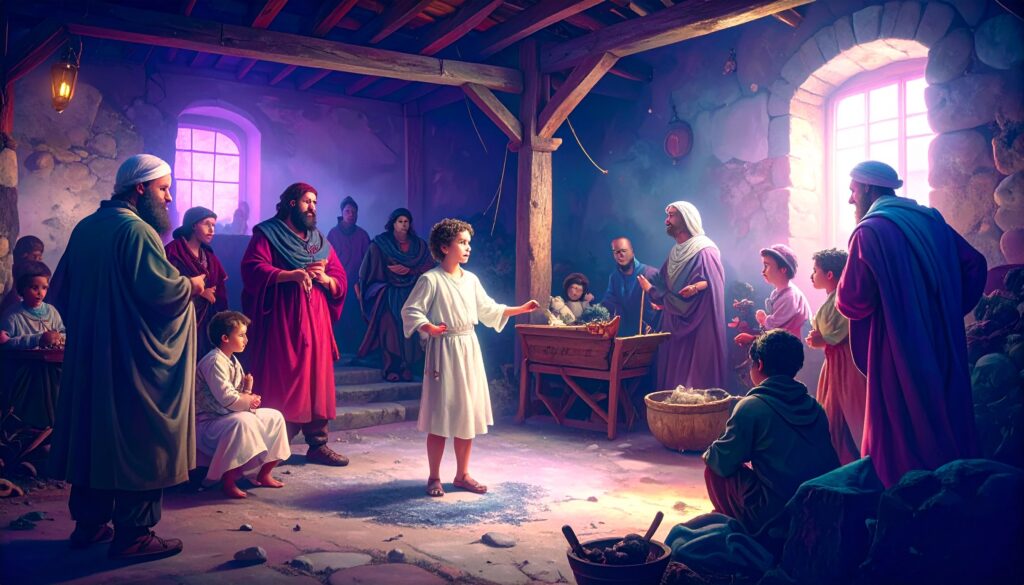
On the day before the Passover Sabbath, flood tides of spiritual illumination swept through the mortal mind of Jesus and filled his human heart to overflowing with affectionate pity for the spiritually blind and morally ignorant multitudes assembled for the celebration of the ancient Passover commemoration. This was one of the most extraordinary days that the Son of God spent in the flesh; and during the night, for the first time in his earth career, there appeared to him an assigned messenger from Salvington, commissioned by Immanuel, who said: “The hour has come. It is time that you began to be about your Father’s business.”
And so, even ere the heavy responsibilities of the Nazareth family descended upon his youthful shoulders, there now arrived the celestial messenger to remind this lad, not quite thirteen years of age, that the hour had come to begin the resumption of the responsibilities of a universe. This was the first act of a long succession of events which finally culminated in the completion of the Son’s bestowal on Urantia and the replacing of “the government of a universe on his human-divine shoulders.”
As time passed, the mystery of the incarnation became, to all of us, more and more unfathomable. We could hardly comprehend that this lad of Nazareth was the creator of all Nebadon. Neither do we nowadays understand how the spirit of this same Creator Son and the spirit of his Paradise Father are associated with the souls of mankind. With the passing of time, we could see that his human mind was increasingly discerning that, while he lived his life in the flesh, in spirit on his shoulders rested the responsibility of a universe.
Thus ends the career of the Nazareth lad, and begins the narrative of that adolescent youth—the increasingly self-conscious divine human—who now begins the contemplation of his world career as he strives to integrate his expanding life purpose with the desires of his parents and his obligations to his family and the society of his day and age.
SuomiEnglish
Kun Jeesus nyt oli astunut orastavan miehuuden kynnykselle ja päättänyt virallisesti opintonsa synagogakoulussa, hän oli kelvollinen menemään vanhempiensa seurassa Jerusalemiin osallistuakseen siellä heidän kanssaan ensimmäisen pääsiäisensä viettoon. Tuon vuoden pääsiäisjuhla osui lauantaiksi, eli se oli huhtikuun 9. päivänä vuonna 7 jKr. Suurehko (103-jäseninen) seurue laittautui valmiiksi lähteäkseen Nasaretista Jerusalemiin varhain maanantaiaamuna, huhtikuun 4. päivänä. He matkasivat etelään, kohti Samariaa, mutta Jisreeliin päästyään he kääntyivät itään niin, että he kiersivät Gilboavuoren taitse Jordaninlaaksoon välttyäkseen kulkemasta Samarian läpi. Joosef ja hänen perheensä olisivat mielellään kulkeneet Samarian läpi Jaakobin kaivon ja Betelin kautta, mutta koska juutalaisista oli epämieluisaa olla tekemisissä samarialaisten kanssa, hekin päättivät kulkea naapureidensa mukana Jordaninlaakson kautta.
Jesus, having now reached the threshold of young manhood and having been formally graduated from the synagogue schools, was qualified to proceed to Jerusalem with his parents to participate with them in the celebration of his first Passover. The Passover feast of this year fell on Saturday, April 9, a.d. 7. A considerable company (103) made ready to depart from Nazareth early Monday morning, April 4, for Jerusalem. They journeyed south toward Samaria, but on reaching Jezreel, they turned east, going around Mount Gilboa into the Jordan valley in order to avoid passing through Samaria. Joseph and his family would have enjoyed going down through Samaria by way of Jacob’s well and Bethel, but since the Jews disliked to deal with the Samaritans, they decided to go with their neighbors by way of the Jordan valley.
Suuresti pelätty Arkelaos oli syösty vallasta, eikä heidän tarvinnut olla suurestikaan peloissaan siitä, että he veivät Jeesuksen Jerusalemiin. Oli kulunut jo kaksitoista vuotta siitä, kun ensimmäinen Herodes oli yrittänyt surmauttaa Betlehemin lapsen, eikä kenenkään mieleen nyt enää juolahtanut yhdistää tuota tapausta tähän tuntemattomuudesta tulevaan nasaretilaisnuorukaiseen.
The much-dreaded Archelaus had been deposed, and they had little to fear in taking Jesus to Jerusalem. Twelve years had passed since the first Herod had sought to destroy the babe of Bethlehem, and no one would now think of associating that affair with this obscure lad of Nazareth.
Ennen kuin he saapuivat Jisreelin tienristeykseen, he matkaa jatkaessaan ohittivat kohta tien vasemmalla puolella muinaisen Suunemin kylän, ja Jeesus kuuli taas kerran tarinan siellä asuneesta koko Israelin kauneimmasta neidosta samoin kuin Elisan siellä suorittamista ihmeellisistä teoista. Jisreeliä ohitettaessa Jeesuksen vanhemmat kertoivat Ahabin ja Jesebelin tekemisistä ja Jehun urotöistä. Gilboavuoren ympäri kuljettaessa he puhuivat paljon Saulista, joka tämän vuoren rinteillä riisti hengen itseltään, sekä kuningas Daavidista ja siitä, mihin kaikkeen tämä historiallinen paikka liittyi.
Before reaching the Jezreel junction, and as they journeyed on, very soon, on the left, they passed the ancient village of Shunem, and Jesus heard again about the most beautiful maiden of all Israel who once lived there and also about the wonderful works Elisha performed there. In passing by Jezreel, Jesus’ parents recounted the doings of Ahab and Jezebel and the exploits of Jehu. In passing around Mount Gilboa, they talked much about Saul, who took his life on the slopes of this mountain, King David, and the associations of this historic spot.
Gilboan juurta kiertäessään pyhiinvaeltajat saattoivat oikealla puolella nähdä Skytopoliin kreikkalaiskaupungin. Matkan päästä he katselivat kaupungin marmorisia rakennelmia, mutteivät menneet lähellekään tätä ei-juutalaista kaupunkia, jotteivät vain olisi saastuttaneet itseään niin pahasti, että osallistuminen edessä oleviin juhlaviin ja pyhiin Jerusalemin pääsiäismenoihin olisi käynyt mahdottomaksi. Maria ei kyennyt ymmärtämään, miksei Joosef sen kummemmin kuin Jeesuskaan halunnut puhua Skytopoliista. Hän ei tiennyt heidän edellisvuotisesta kiistastaan, sillä he eivät olleet paljastaneet tätä välikohtausta hänelle.
As they rounded the base of Gilboa, the pilgrims could see the Greek city of Scythopolis on the right. They gazed upon the marble structures from a distance but went not near the gentile city lest they so defile themselves that they could not participate in the forthcoming solemn and sacred ceremonies of the Passover at Jerusalem. Mary could not understand why neither Joseph nor Jesus would speak of Scythopolis. She did not know about their controversy of the previous year as they had never revealed this episode to her.
Tie laskeutui välittömästi tämän jälkeen alas trooppiseen Jordaninlaaksoon, ja hetken päästä Jeesuksen ihmettelevän katseen edessä avautui mutkitteleva ja loputtomasti polveileva Jordan, jonka vesi kiilotti ja solisi virratessaan kohti Kuolluttamerta. He kuoriutuivat päällysvaatteistaan matkatessaan tässä trooppisessa laaksossa kohti etelää. He ihailivat vehreitä elopeltoja ja kauniita oleantereita, jotka taipuivat vaaleanpunaisten kukkien painosta. Kaukana pohjoisessa siinteli jyhkeä ja lumihuippuinen Hermonvuori katsellen majesteettisena alas historialliseen laaksoon. Laakson vastakkaisen laidan Skytopoliista runsaat kolme tuntia matkustettuaan he saapuivat pulppuavan lähteen partaalle, jonne he leiriytyivät tähtien valaiseman taivaan alla viettämänsä yön ajaksi.
The road now led immediately down into the tropical Jordan valley, and soon Jesus was to have exposed to his wondering gaze the crooked and ever-winding Jordan with its glistening and rippling waters as it flowed down toward the Dead Sea. They laid aside their outer garments as they journeyed south in this tropical valley, enjoying the luxurious fields of grain and the beautiful oleanders laden with their pink blossoms, while massive snow-capped Mount Hermon stood far to the north, in majesty looking down on the historic valley. A little over three hours’ travel from opposite Scythopolis they came upon a bubbling spring, and here they camped for the night, out under the starlit heavens.
Toisena matkapäivänään he ohittivat kohdan, jossa idästä virtaava Jabbok yhtyy Jordaniin, ja kun heidän katseensa kääntyi itään tätä jokilaaksoa seuraillen, he tarinoivat Gideonin ajoista, jolloin midianilaiset tulvehtivat näille seuduin tarkoituksenaan koko maan valloittaminen. Toisen matkapäivän lopulla he leiriytyivät likelle paikkaa, josta Sartabavuori, Jordaninlaakson ylle kohoavista vuorista korkein, alkaa kohotella rinteitään. Sartaban huipulla sijaitsi Aleksanterin rakennuttama linnoitus, jonne Herodes oli vanginnut yhden vaimoistaan ja haudannut kaksi kuoliaaksi kuristettua poikaansa.
On their second day’s journey they passed by where the Jabbok, from the east, flows into the Jordan, and looking east up this river valley, they recounted the days of Gideon, when the Midianites poured into this region to overrun the land. Toward the end of the second day’s journey they camped near the base of the highest mountain overlooking the Jordan valley, Mount Sartaba, whose summit was occupied by the Alexandrian fortress where Herod had imprisoned one of his wives and buried his two strangled sons.
Kolmantena päivänä he ohittivat kaksi kylää, jotka Herodes oli hiljattain rakennuttanut, ja he panivat merkille niiden suurenmoisen arkkitehtuurin ja kauniit palmutarhat. Iltahämärissä he saapuivat Jerikoon, jossa he viipyivät aamuun saakka. Tuona iltana Joosef, Maria ja Jeesus kävelivät kahden ja puolen kilometrin matkan muinaisen Jerikon sijaintipaikalle, jossa juutalaisen perimätiedon mukaan Joosua, jonka mukaan Jeesus oli saanut nimensä, oli suorittanut maineikkaat urotyönsä.
The third day they passed by two villages which had been recently built by Herod and noted their superior architecture and their beautiful palm gardens. By nightfall they reached Jericho, where they remained until the morrow. That evening Joseph, Mary, and Jesus walked a mile and a half to the site of the ancient Jericho, where Joshua, for whom Jesus was named, had performed his renowned exploits, according to Jewish tradition.
Kun päästiin neljänteen ja viimeiseen matkapäivään, tie alkoi olla yhtä loputonta pyhiinvaeltajien kulkuetta. He alkoivat nyt kiivetä mäkiä, jotka johtavat suoraan Jerusalemiin. Kukkulan lakea lähestyessään he saattoivat katsoa Jordanin ylitse ja nähdä siellä siintävät vuoret ja suunnata katseensa etelään, Kuolleenmeren liikkumattomien vetten taakse. Kun oltiin vielä noin puolen päivämatkan päässä Jerusalemista, Jeesus näki ensi kertaa Öljymäen (tienoon, josta oli niin paljossa tuleva osa hänen myöhempää elämäänsä), ja Joosef huomautti hänelle, että Pyhä kaupunki olisi heti tämän harjanteen takana, ja riemullinen odotus sai pojan sydämen pamppailemaan, olisihan hän kohta näkevä taivaallisen Isänsä huoneen ja kaupungin.
By the fourth and last day’s journey the road was a continuous procession of pilgrims. They now began to climb the hills leading up to Jerusalem. As they neared the top, they could look across the Jordan to the mountains beyond and south over the sluggish waters of the Dead Sea. About halfway up to Jerusalem, Jesus gained his first view of the Mount of Olives (the region to be so much a part of his subsequent life), and Joseph pointed out to him that the Holy City lay just beyond this ridge, and the lad’s heart beat fast with joyous anticipation of soon beholding the city and house of his heavenly Father.
Öljymäen itärinteillä he pysähtyivät lepäämään pienen Betania-nimisen kylän liepeille. Vieraanvaraiset kyläläiset tulivat sankoin joukoin tarjoamaan pyhiinvaeltajille apuaan, ja sattui, että Joosef oli perheineen pysähtynyt erään Simonin talon lähelle. Simonilla oli kolme suunnilleen Jeesuksen ikäistä lasta: Maria, Martta ja Lasarus. He kutsuivat nasaretilaisperheen sisälle virkistäytymään, ja tästä versoi näiden kahden perheen välille elinikäinen ystävyys. Vaiheikkaan elämänsä varrella Jeesus viivähti tässä talossa tämän jälkeen vielä monta kertaa.
On the eastern slopes of Olivet they paused for rest in the borders of a little village called Bethany. The hospitable villagers poured forth to minister to the pilgrims, and it happened that Joseph and his family had stopped near the house of one Simon, who had three children about the same age as Jesus—Mary, Martha, and Lazarus. They invited the Nazareth family in for refreshment, and a lifelong friendship sprang up between the two families. Many times afterward, in his eventful life, Jesus stopped in this home.
He riensivät eteenpäin, ja ennen pitkää he seisoivat Öljymäen harjalla, ja Jeesus näki (muistinsa mukaan) ensi kertaa Pyhän kaupungin, kerskailevat palatsit ja hänen Isänsä mieltäkiihottavan temppelin. Koskaan ei Jeesus enää tämän jälkeen kokenut sellaisia, puhtaasti inhimillisiä tunneväristyksiä, jotka nyt ottivat hänet läpikotaisin valtoihinsa, kun hän seisoi Öljymäellä tänä huhtikuisena iltapäivänä imemässä itseensä ensivaikutelmia Jerusalemista. Ja myöhempinä vuosina hän seisoi tällä samalla paikalla ja itki tämän kaupungin tähden, joka oli taas kerran hylkäämässä yhden profeetan, taivaallisista opettajistaan viimeisen ja suurimman.
They pressed on, soon standing on the brink of Olivet, and Jesus saw for the first time (in his memory) the Holy City, the pretentious palaces, and the inspiring temple of his Father. At no time in his life did Jesus ever experience such a purely human thrill as that which at this time so completely enthralled him as he stood there on this April afternoon on the Mount of Olives, drinking in his first view of Jerusalem. And in after years, on this same spot he stood and wept over the city which was about to reject another prophet, the last and the greatest of her heavenly teachers.
Mutta he kiiruhtivat Jerusalemiin. Nyt oli jo torstai-iltapäivä. Kaupunkiin saavuttuaan he kulkivat temppelin ohitse, eikä Jeesus ollut koskaan vielä nähnyt niin valtavia ihmisjoukkoja. Häntä askarrutti syvästi se, miten nämä juutalaiset olivat tunnetun maailman äärimmäisistäkin kolkista tänne kerääntyneet.
But they hurried on to Jerusalem. It was now Thursday afternoon. On reaching the city, they journeyed past the temple, and never had Jesus beheld such throngs of human beings. He meditated deeply on how these Jews had assembled here from the uttermost parts of the known world.
Kohta he saapuivat paikkaan, joka oli ennalta sovittu heidän majapaikakseen pääsiäisviikon ajaksi. Se oli Marian erään varakkaan sukulaisen avara koti. Tämä oli Sakariaan kautta saanut tietää jotakin sekä Johanneksen että Jeesuksen elämäntarinan varhaisvaiheista. Seuraavan päivän eli valmistuspäivän ajan he tekivät valmisteluja asianmukaista pääsiäissapatin viettoa varten.
Soon they reached the place prearranged for their accommodation during the Passover week, the large home of a well-to-do relative of Mary’s, one who knew something of the early history of both John and Jesus, through Zacharias. The following day, the day of preparation, they made ready for the appropriate celebration of the Passover Sabbath.
Vaikka koko Jerusalem oli pääsiäisvalmistelujen takia liikkeellä, Joosef ennätti kuitenkin viedä poikansa käymään akatemiassa, jonne tälle oli järjestetty tilaisuus jatkaa opintojaan kahden vuoden kuluttua, eli sitten kun hän olisi tullut vaadittuun viidentoista vuoden ikään. Joosef oli totisesti ymmällään huomatessaan, miten vähän kiinnostusta Jeesus osoitti kaikkia näitä huolellisesti laadittuja suunnitelmia kohtaan.
While all Jerusalem was astir in preparation for the Passover, Joseph found time to take his son around to visit the academy where it had been arranged for him to resume his education two years later, as soon as he reached the required age of fifteen. Joseph was truly puzzled when he observed how little interest Jesus evinced in all these carefully laid plans.
Temppeli siihen liittyvine palveluksineen ja toimituksineen teki Jeesukseen syvän vaikutuksen. Ensi kertaa, sen jälkeen kun hän oli nelivuotias, hän oli aivan liian syventynyt omiin mietteisiinsä montakaan kysymystä esittääkseen. Toki hän silti esitti isälleen useita hämmentäviä kysymyksiä (niin kuin hän oli tehnyt aikaisemmissakin tilanteissa) siitä, miksi taivaallinen Isä vaati teurastamaan niin monia viattomia ja avuttomia eläimiä. Ja nuorenmiehen kasvojen ilmeestä hänen isänsä tiesi hyvin, etteivät hänen vastauksensa ja selitysyrityksensä hänen syvämietteistä ja teräväjärkistä poikaansa tyydyttäneet.
Jesus was profoundly impressed by the temple and all the associated services and other activities. For the first time since he was four years old, he was too much preoccupied with his own meditations to ask many questions. He did, however, ask his father several embarrassing questions (as he had on previous occasions) as to why the heavenly Father required the slaughter of so many innocent and helpless animals. And his father well knew from the expression on the lad’s face that his answers and attempts at explanation were unsatisfactory to his deep-thinking and keen-reasoning son.
Pääsiäissapattia edeltävänä päivänä hengellisen valaistumisen vuoksiaallot vyöryivät Jeesuksen kuolevaismielen läpi ja täyttivät hänen ihmissydämensä ääriään myöten rakastavalla säälillä niitä hengellisesti sokeita ja moraalin suhteen tietämättömiä kansanjoukkoja kohtaan, jotka olivat kokoontuneet viettämään muinaista pääsiäisen muistojuhlaa. Tämä oli Jumalan Pojan lihallisessa hahmossa viettämistä päivistä eräs erikoisimmista. Ja yön aikana hänelle ilmestyi ensi kertaa hänen maisen elämänvaiheensa aikana Immanuelin valtuuttama ja Salvingtonista matkaan lähtenyt erityistehtävään asetettu sanansaattaja, joka sanoi: ”Hetki on tullut. On aika sinun ryhtyä toimittamaan Isäsi asioita.”
On the day before the Passover Sabbath, flood tides of spiritual illumination swept through the mortal mind of Jesus and filled his human heart to overflowing with affectionate pity for the spiritually blind and morally ignorant multitudes assembled for the celebration of the ancient Passover commemoration. This was one of the most extraordinary days that the Son of God spent in the flesh; and during the night, for the first time in his earth career, there appeared to him an assigned messenger from Salvington, commissioned by Immanuel, who said: “The hour has come. It is time that you began to be about your Father’s business.”
Ja tällä tavoin, jo ennen kuin hänen nuorille harteilleen laskeutui raskas vastuu nasaretilaisperheestä, taivaallinen viestintuoja saapui nyt muistuttamaan tätä nuorta poikaa, joka ei vielä ollut kolmeatoista täyttänyt, siitä, että oli tullut aika ryhtyä taas hoitamaan kokonaista universumia koskevia velvollisuuksia. Tämä oli ensimmäinen näytös pitkässä tapahtumaketjussa, joka lopulta huipentui Pojan Urantialla tapahtuneen lahjoittautumisen loppuunsaattamiseen ja siihen, että ”universumin hallintovastuu laskettiin taas hänen inhimillis-jumalallisille harteilleen.”
And so, even ere the heavy responsibilities of the Nazareth family descended upon his youthful shoulders, there now arrived the celestial messenger to remind this lad, not quite thirteen years of age, that the hour had come to begin the resumption of the responsibilities of a universe. This was the first act of a long succession of events which finally culminated in the completion of the Son’s bestowal on Urantia and the replacing of “the government of a universe on his human-divine shoulders.”
Ajan kuluessa tämä ruumiillistumisen mysteeri kävi meille kaikille aina vain käsittämättömämmäksi. Pystyimme tuskin käsittämään, että tämä nasaretilaispoikanen oli koko Nebadonin luoja. Emmekä me nykyisinkään käsitä, miten tämän saman Luoja-Pojan henki ja hänen Paratiisin-Isänsä henki liittyvät ihmiskunnan sieluihin. Sitä mukaa kun aika kului, pystyimme näkemään, miten hänen ihmismielensä teki yhä selvemmin sellaisen eron, että vaikka hän elikin elämäänsä lihallisessa hahmossa, hengessä hänen harteillaan lepäsi vastuu kokonaisesta universumista.
As time passed, the mystery of the incarnation became, to all of us, more and more unfathomable. We could hardly comprehend that this lad of Nazareth was the creator of all Nebadon. Neither do we nowadays understand how the spirit of this same Creator Son and the spirit of his Paradise Father are associated with the souls of mankind. With the passing of time, we could see that his human mind was increasingly discerning that, while he lived his life in the flesh, in spirit on his shoulders rested the responsibility of a universe.
Ja tähän päättyy nasaretilaisen pikkupojan elämänvaihe, ja tästä alkaa kertomus nuorukaisesta – yhä paremmin itsensä tiedostavasta jumalallisesta ihmisestä –, joka ryhtyy nyt pohtimaan, millainen on oleva hänen maailmassa viettämänsä elämänvaihe, kun hän pyrkii yhdistämään yhdeksi kokonaisuudeksi toisaalta elämänsä laajenevan tarkoituksen ja toisaalta vanhempiensa toiveet ja velvollisuutensa omaa perhettään ja oman aikansa ja aikakautensa yhteiskuntaa kohtaan.
Thus ends the career of the Nazareth lad, and begins the narrative of that adolescent youth—the increasingly self-conscious divine human—who now begins the contemplation of his world career as he strives to integrate his expanding life purpose with the desires of his parents and his obligations to his family and the society of his day and age.