
Teksti
Tausta
Näytä
Lisäasetukset
Kieli
Urantia Opas
Kysy kirjan sisällöstä. Opas vastaa Book Enginen omien lähdekohtien perusteella ja ohjaa sinut lukemaan ne.
Hei! 🙏
Olen sinun Urantia-oppaasi. Tehtäväni on auttaa sinua löytämään oikeat kohdat Urantia-kirjasta ja ymmärtämään sen opetuksia syvemmin. 😊❤️
Jeesus oli nyt seitsenvuotias eli iässä, jolloin juutalaislasten edellytettiin aloittavan virallinen opintiensä synagogakouluissa. Niinpä hän tämän vuoden elokuussa aloitti Nasaretissa vaiheikkaan koulunkäyntinsä. Pikkumiehemme osasi jo lukea, kirjoittaa ja puhua sujuvasti kahta kieltä: arameaa ja kreikkaa. Hänen oli nyt määrä ottaa tehtäväkseen oppia lukemaan, kirjoittamaan ja puhumaan heprean kieltä. Ja hän oli todella innoissaan edessään avautuvasta uudesta koululaisen maailmasta.
Kolmen vuoden ajan, kymmenvuotiaaksi asti, hän kävi Nasaretin synagogan alkeiskoulua. Näiden kolmen vuoden ajan hän opetteli lainkirjan alkeita, siinä muodossa kuin tämä teos oli heprean kielellä kirjaan pantu. Seuraavat kolme vuotta hän opiskeli ylemmän asteen koulussa ja painoi muistiinsa pyhän lain syvällisemmät opetukset niitä ääneen toistamalla. Hän valmistui tästä synagogakoulusta kolmantenatoista ikävuotenaan, ja synagogan johtajat luovuttivat hänet vanhemmilleen oppineena ”käskyn poikana”, joka siitä lähtien olisi Israelin yhteisön vastuunalainen kansalainen. Tämä kaikki oikeutti hänet osallistumaan pääsiäisenviettoon Jerusalemissa. Niinpä hän tuona vuonna osallistuikin isänsä ja äitinsä seurassa ensimmäistä kertaa pääsiäisjuhlille.
Nasaretin koulussa oppilaat istuivat puolikaaressa lattialla, kun hashen, muuan synagogan viranhaltija, heidän opettajansa, istui heitä vastapäätä. He aloittivat opiskelunsa Kolmannesta Mooseksen kirjasta eli Leviticuksesta, siirtyivät sitten opettelemaan muita lain kirjoja, minkä jälkeen vuorossa oli profeettojen ja psalmien opiskelu. Nasaretin synagoga omisti täydellisen kopion hepreankielisistä kirjoituksista. Ennen kahdettatoista ikävuotta ei opiskeltu mitään muuta kuin näitä kirjoituksia. Kesäkuukausien aikana koulutunteja vähennettiin huomattavasti.
Jeesuksesta tuli varsin lyhyessä ajassa loistava hepreantaitaja, ja hänen nuoruusvuosinaan, kun sattui, ettei Nasaretissa ollut käymässä ketään arvovierasta, häntä pyydettiin usein lukemaan heprealaiskirjoituksia synagogaan säännönmukaisiin sapattipalveluksiin kokoontuneille uskollisille.
Näillä synagogakouluilla ei tietenkään ollut mitään oppikirjoja. Hashenilla oli opettaessaan tapana sanoa lause ja oppilaat toistivat sen sitten hänen perässään yhteen ääneen. Jos oppilaalla oli käytettävissään kirjoitetut lain kirjat, hän opetteli läksynsä lukemalla kirjaa ääneen ja yhtä mittaa toistamalla.
Virallisemman koulunkäyntinsä ohella Jeesus alkoi seuraavaksi saada kosketusta maailman neljältä kulmalta kotoisin olevien ihmisluontoon, sillä hänen isänsä korjauspajassa kävi ihmisiä monista maista. Kun hänen ikänsä karttui, hän kuljeskeli vapaasti karavaanimatkustajien seassa näiden viivähtäessä kyläkaivon lähellä levähtämässä ja aterioimassa. Kreikkaa sujuvasti puhuvana hän keskusteli useimpien karavaanimatkustajien ja -ohjaajien kanssa vaivatta.
Nasaret oli karavaanitien asema ja matkanteon solmukohta, väestöltään suurelta osin ei-juutalainen. Samalla se oli laajalti tunnettu juutalaisten perinteisen lain vapaamielisen tulkinnan keskuksena. Galileassa juutalaiset menivät vapaammin ei-juutalaisten pariin kuin, mikä oli heidän käytäntönsä Juudeassa. Ja kaikkiin Galilean kaupunkeihin verrattuina Nasaretin juutalaiset olivat vapaamielisimpiä niiden sosiaalisten rajoitusten tulkinnoissaan, jotka perustuivat pelkoihin mahdollisesta itsensä saastuttamisesta, jos joutuisi kosketuksiin ei-juutalaisten kanssa. Ja näistä seikoista sai alkunsa Jerusalemissa yleisesti käytetty sanonta: ”Voiko Nasaretista muka tulla jotakin hyvää?”
Jeesus sai moraaliopetuksensa ja hengellisen sivistyksensä pääasiassa omassa kodissaan. Suuren osan älyllisestä ja teologisesta opetuksestaan hän sai hashenilta. Mutta todellisen sivistyksensä – sen mielen ja sydämen varustuksen, jota tarvitaan ihmisen joutuessa tositilanteessa koettelemaan itseään elämän asettamien ongelmien kanssa kamppailtaessa –, hän sai kanssaihmistensä keskuudessa liikkumalla. Juuri tämä läheinen yhdessäolo muiden ihmisten, nuorten ja vanhojen, juutalaisten ja ei-juutalaisten, kanssa tarjosi hänelle tilaisuuden päästä tuntemaan ihmisten sukukunta. Jeesus oli verrattoman sivistynyt sikäli, että hän ymmärsi ihmisiä perin pohjin ja rakasti heitä hartaasti.
Kaikki nämä synagogassa viettämänsä vuodet hän oli loistava oppilas, jolla oli paljon etua siitä, että hän osasi kolmea kieltä. Nasaretin hashen huomauttikin Joosefille tilanteessa, jolloin Jeesus päätti koulukurssinsa, että hän kukaties ”oli oppinut enemmän Jeesuksen syvälle käyvistä kysymyksistä” kuin, mitä hän oli ”kyennyt poikaselle opettamaan.”
Koko oppikurssinsa ajan Jeesus oppi paljon, ja synagogassa pidetyt säännölliset sapattisaarnat olivat hänelle suuri innoituksen lähde. Oli tavanmukaista, että Nasaretissa sapatin yli viipyviä merkittäviä vierailijoita pyydettiin puhumaan synagogassa. Varttuessaan Jeesus kuuli monien, kaikkialta juutalaisesta maailmasta tulevien, suurten ajattelijoiden esittävän näkemyksiään, samoin kuin monien sellaisten, jotka eivät olleet kovinkaan puhdasoppisia juutalaisia, sillä Nasaretin synagoga oli muuan heprealaisen ajattelun ja kulttuurin edistynyt ja vapaamielinen keskus.
Seitsemänikäisinä koulumaailmaan astuessaan (tuolloin juutalaiset olivat juuri saattaneet voimaan oppivelvollisuuslain) oppilailla oli tapana valita oma ”syntymäpäivätekstinsä”, eräänlainen kultainen sääntö, joka opastaisi heitä koko opiskeluajan ja jota he käyttivät usein lähtökohtana, kun he kolmentoistaikäisinä pitivät valmistumistilaisuudessa puheen. Jeesuksen valitseman tekstin oli kirjoittanut profeetta Jesaja: ”Herran Jumalan henki on minun päälläni, sillä Herra on minut voidellut; hän on lähettänyt minut viemään hyvää sanomaa nöyrille; sitomaan niitä, joiden sydän on särkynyt; julistamaan kahlituille vapautusta ja päästämään hengelliset vangit vapauteen.”
Nasaret oli yksi heprealaiskansakunnan kahdestakymmenestäneljästä pappiskeskuksesta. Mutta Galilean pappiskunta oli perinteisten lakien tulkinnassaan huomattavasti juudealaisia kirjanoppineita ja rabbeja vapaamielisempi. Ja Nasaretissa oltiin sapatin noudattamisenkin suhteen muita vapaamielisempiä. Siksi Joosefin tapana olikin viedä Jeesus sapatti-iltapäivinä kävelyretkille, ja yksi heidän mieluisimmista huvituksistaan oli kiivetä heidän kotinsa lähistöllä sijaitsevalle kukkulalle. Sieltä heille avautui esteetön näköala koko Galileaan. Luoteen suunnalla he voivat kirkkaina päivinä nähdä Karmelvuoren pitkän harjanteen, joka jatkui mereen saakka, ja monet kerrat Jeesus kuunteli isänsä esittämän tarinan Eliaasta. Tämä kuului ensimmäisten joukossa niiden heprealaispappien pitkään rivistöön, jotka arvostelivat Ahabia ja paljastivat Baalin papit. Pohjoisessa kohotti Hermonvuori lumisen huippunsa hohtaen majesteettisena ja halliten taivaanrantaa ylärinteiden kimallellessa lähes tuhannen metrin matkalta ikilumesta vitivalkoisina. Kaukana idässä he saattoivat erottaa Jordaninlaakson ja vieläkin kauempana Moabin kallioiset kukkulat. Samalla tavoin he etelässä ja idässä voivat nähdä Dekapoliin kreikkalais-roomalaiset kaupungit amfiteattereineen ja suurellisine temppeleineen, kun auringonsäteet osuivat niiden marmoriseiniin. Ja jos he viipyivät kukkulalla auringonlaskuun saakka, heidän oli lännen suunnalla mahdollista erottaa kaukaisella Välimerellä purjehtivat alukset.
Jeesus saattoi tarkkailla karavaaneja, kun ne tulivat neljältä suunnalta ja kulkivat reiteillään kohti Nasaretia ja sieltä pois, ja etelän suunnalla hänen katseensa kantoi avaran ja hedelmällisen Esdraelonin tasangon yli, joka levittäytyi Gilboavuoren suunnalle ja Samariaan.
Milloin he eivät kiivenneet kukkuloille kaukaisuuksiin ulottuvaa maisemaa katselemaan, he kuljeskelivat maaseudulla tutkimassa, miten luonnon ilmeet vaihtuivat kulloisenkin vuodenajan mukaan. Kotipiirissä saamansa opetuksen lisäksi Jeesuksen alkuopetuksessa tavoiteltiin kunnioittavaa ja myönteistä suhdetta luontoon.
Jo ennen kuin Jeesus oli täyttänyt kahdeksan vuotta, hän oli kaikkien Nasaretin äitien ja nuorten naisten tuntema. Nämä olivat tavanneet hänet ja keskustelleet hänen kanssaan kaivolla, joka ei ollut kaukana hänen kodistaan ja joka oli yksi koko kaupungin sosiaalisen kanssakäymisen ja kuulumistenvaihdon keskuksista. Puheena olevana vuonna Jeesus oppi lypsämään perheen lehmän ja hoitamaan muita eläimiä. Tämän ja seuraavan vuoden aikana hän oppi myös valmistamaan juustoa ja kutomaan. Kymmenvuotiaana hän oli jo taitava käsittelemään kangaspuita. Jotakuinkin näihin aikoihin Jeesus ja naapurinpoika Jaakob ystävystyivät savenvalajan kanssa, joka teki työtään virtaavan lähteen äärellä. Ja katsellessaan, miten Naatanin näppärät sormet muovailivat savea savenvalajan pyörällä, kumpainenkin heistä teki monta kertaa päätöksen ryhtyä savenvalajaksi, sitten kun olisi varttunut aikuiseksi. Naatan piti näistä pikkumiehistä kovasti ja antoi heille usein savea leikittäväksi. Hän nimittäin pyrki voimistamaan heidän luovaa mielikuvitustaan sillä, että innosti heitä kilpailemaan erilaisten esineiden ja eläinhahmojen luomisessa.
Jesus was now seven years old, the age when Jewish children were supposed to begin their formal education in the synagogue schools. Accordingly, in August of this year he entered upon his eventful school life at Nazareth. Already this lad was a fluent reader, writer, and speaker of two languages, Aramaic and Greek. He was now to acquaint himself with the task of learning to read, write, and speak the Hebrew language. And he was truly eager for the new school life which was ahead of him.
For three years—until he was ten—he attended the elementary school of the Nazareth synagogue. For these three years he studied the rudiments of the Book of the Law as it was recorded in the Hebrew tongue. For the following three years he studied in the advanced school and committed to memory, by the method of repeating aloud, the deeper teachings of the sacred law. He graduated from this school of the synagogue during his thirteenth year and was turned over to his parents by the synagogue rulers as an educated “son of the commandment”—henceforth a responsible citizen of the commonwealth of Israel, all of which entailed his attendance at the Passovers in Jerusalem; accordingly, he attended his first Passover that year in company with his father and mother.
At Nazareth the pupils sat on the floor in a semicircle, while their teacher, the chazan, an officer of the synagogue, sat facing them. Beginning with the Book of Leviticus, they passed on to the study of the other books of the law, followed by the study of the Prophets and the Psalms. The Nazareth synagogue possessed a complete copy of the Scriptures in Hebrew. Nothing but the Scriptures was studied prior to the twelfth year. In the summer months the hours for school were greatly shortened.
Jesus early became a master of Hebrew, and as a young man, when no visitor of prominence happened to be sojourning in Nazareth, he would often be asked to read the Hebrew scriptures to the faithful assembled in the synagogue at the regular Sabbath services.
These synagogue schools, of course, had no textbooks. In teaching, the chazan would utter a statement while the pupils would in unison repeat it after him. When having access to the written books of the law, the student learned his lesson by reading aloud and by constant repetition.
Next, in addition to his more formal schooling, Jesus began to make contact with human nature from the four quarters of the earth as men from many lands passed in and out of his father’s repair shop. When he grew older, he mingled freely with the caravans as they tarried near the spring for rest and nourishment. Being a fluent speaker of Greek, he had little trouble in conversing with the majority of the caravan travelers and conductors.
Nazareth was a caravan way station and crossroads of travel and largely gentile in population; at the same time it was widely known as a center of liberal interpretation of Jewish traditional law. In Galilee the Jews mingled more freely with the gentiles than was their practice in Judea. And of all the cities of Galilee, the Jews of Nazareth were most liberal in their interpretation of the social restrictions based on the fears of contamination as a result of contact with the gentiles. And these conditions gave rise to the common saying in Jerusalem, “Can any good thing come out of Nazareth?”
Jesus received his moral training and spiritual culture chiefly in his own home. He secured much of his intellectual and theological education from the chazan. But his real education—that equipment of mind and heart for the actual test of grappling with the difficult problems of life—he obtained by mingling with his fellow men. It was this close association with his fellow men, young and old, Jew and gentile, that afforded him the opportunity to know the human race. Jesus was highly educated in that he thoroughly understood men and devotedly loved them.
Throughout his years at the synagogue he was a brilliant student, possessing a great advantage since he was conversant with three languages. The Nazareth chazan, on the occasion of Jesus’ finishing the course in his school, remarked to Joseph that he feared he “had learned more from Jesus’ searching questions” than he had “been able to teach the lad.”
Throughout his course of study Jesus learned much and derived great inspiration from the regular Sabbath sermons in the synagogue. It was customary to ask distinguished visitors, stopping over the Sabbath in Nazareth, to address the synagogue. As Jesus grew up, he heard many great thinkers of the entire Jewish world expound their views, and many also who were hardly orthodox Jews since the synagogue of Nazareth was an advanced and liberal center of Hebrew thought and culture.
When entering school at seven years (at this time the Jews had just inaugurated a compulsory education law), it was customary for the pupils to choose their “birthday text,” a sort of golden rule to guide them throughout their studies, one upon which they often expatiated at their graduation when thirteen years old. The text which Jesus chose was from the Prophet Isaiah: “The spirit of the Lord God is upon me, for the Lord has anointed me; he has sent me to bring good news to the meek, to bind up the brokenhearted, to proclaim liberty to the captives, and to set the spiritual prisoners free.”
Nazareth was one of the twenty-four priest centers of the Hebrew nation. But the Galilean priesthood was more liberal in the interpretation of the traditional laws than were the Judean scribes and rabbis. And at Nazareth they were also more liberal regarding the observance of the Sabbath. It was therefore the custom for Joseph to take Jesus out for walks on Sabbath afternoons, one of their favorite jaunts being to climb the high hill near their home, from which they could obtain a panoramic view of all Galilee. To the northwest, on clear days, they could see the long ridge of Mount Carmel running down to the sea; and many times Jesus heard his father relate the story of Elijah, one of the first of that long line of Hebrew prophets, who reproved Ahab and exposed the priests of Baal. To the north Mount Hermon raised its snowy peak in majestic splendor and monopolized the skyline, almost 3,000 feet of the upper slopes glistening white with perpetual snow. Far to the east they could discern the Jordan valley and, far beyond, the rocky hills of Moab. Also to the south and the east, when the sun shone upon their marble walls, they could see the Greco-Roman cities of the Decapolis, with their amphitheaters and pretentious temples. And when they lingered toward the going down of the sun, to the west they could make out the sailing vessels on the distant Mediterranean.
From four directions Jesus could observe the caravan trains as they wended their way in and out of Nazareth, and to the south he could overlook the broad and fertile plain country of Esdraelon, stretching off toward Mount Gilboa and Samaria.
When they did not climb the heights to view the distant landscape, they strolled through the countryside and studied nature in her various moods in accordance with the seasons. Jesus’ earliest training, aside from that of the home hearth, had to do with a reverent and sympathetic contact with nature.
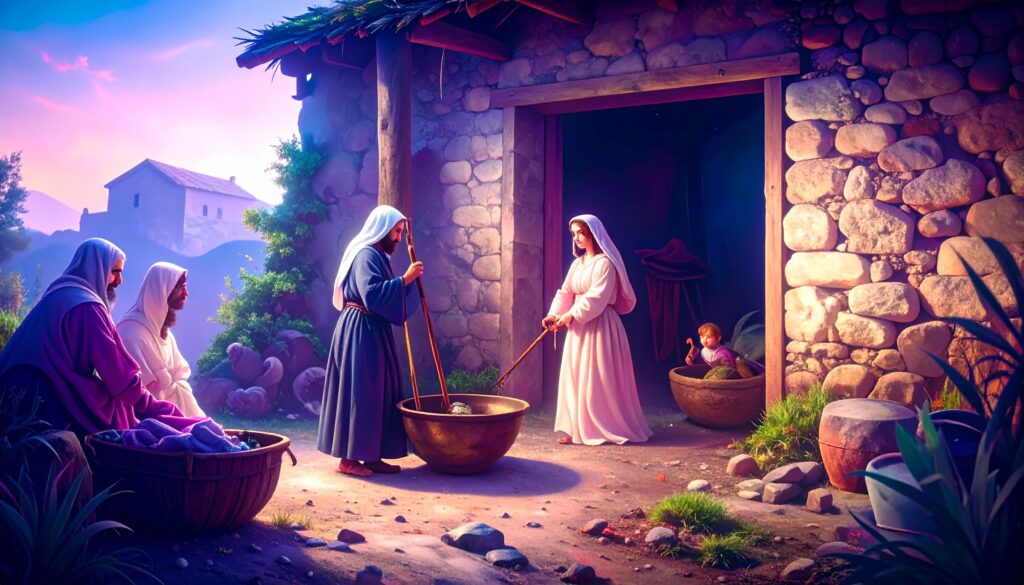
Before he was eight years of age, he was known to all the mothers and young women of Nazareth, who had met him and talked with him at the spring, which was not far from his home, and which was one of the social centers of contact and gossip for the entire town. This year Jesus learned to milk the family cow and care for the other animals. During this and the following year he also learned to make cheese and to weave. When he was ten years of age, he was an expert loom operator. It was about this time that Jesus and the neighbor boy Jacob became great friends of the potter who worked near the flowing spring; and as they watched Nathan’s deft fingers mold the clay on the potter’s wheel, many times both of them determined to be potters when they grew up. Nathan was very fond of the lads and often gave them clay to play with, seeking to stimulate their creative imaginations by suggesting competitive efforts in modeling various objects and animals.
SuomiEnglish
Jeesus oli nyt seitsenvuotias eli iässä, jolloin juutalaislasten edellytettiin aloittavan virallinen opintiensä synagogakouluissa. Niinpä hän tämän vuoden elokuussa aloitti Nasaretissa vaiheikkaan koulunkäyntinsä. Pikkumiehemme osasi jo lukea, kirjoittaa ja puhua sujuvasti kahta kieltä: arameaa ja kreikkaa. Hänen oli nyt määrä ottaa tehtäväkseen oppia lukemaan, kirjoittamaan ja puhumaan heprean kieltä. Ja hän oli todella innoissaan edessään avautuvasta uudesta koululaisen maailmasta.
Jesus was now seven years old, the age when Jewish children were supposed to begin their formal education in the synagogue schools. Accordingly, in August of this year he entered upon his eventful school life at Nazareth. Already this lad was a fluent reader, writer, and speaker of two languages, Aramaic and Greek. He was now to acquaint himself with the task of learning to read, write, and speak the Hebrew language. And he was truly eager for the new school life which was ahead of him.
Kolmen vuoden ajan, kymmenvuotiaaksi asti, hän kävi Nasaretin synagogan alkeiskoulua. Näiden kolmen vuoden ajan hän opetteli lainkirjan alkeita, siinä muodossa kuin tämä teos oli heprean kielellä kirjaan pantu. Seuraavat kolme vuotta hän opiskeli ylemmän asteen koulussa ja painoi muistiinsa pyhän lain syvällisemmät opetukset niitä ääneen toistamalla. Hän valmistui tästä synagogakoulusta kolmantenatoista ikävuotenaan, ja synagogan johtajat luovuttivat hänet vanhemmilleen oppineena ”käskyn poikana”, joka siitä lähtien olisi Israelin yhteisön vastuunalainen kansalainen. Tämä kaikki oikeutti hänet osallistumaan pääsiäisenviettoon Jerusalemissa. Niinpä hän tuona vuonna osallistuikin isänsä ja äitinsä seurassa ensimmäistä kertaa pääsiäisjuhlille.
For three years—until he was ten—he attended the elementary school of the Nazareth synagogue. For these three years he studied the rudiments of the Book of the Law as it was recorded in the Hebrew tongue. For the following three years he studied in the advanced school and committed to memory, by the method of repeating aloud, the deeper teachings of the sacred law. He graduated from this school of the synagogue during his thirteenth year and was turned over to his parents by the synagogue rulers as an educated “son of the commandment”—henceforth a responsible citizen of the commonwealth of Israel, all of which entailed his attendance at the Passovers in Jerusalem; accordingly, he attended his first Passover that year in company with his father and mother.
Nasaretin koulussa oppilaat istuivat puolikaaressa lattialla, kun hashen, muuan synagogan viranhaltija, heidän opettajansa, istui heitä vastapäätä. He aloittivat opiskelunsa Kolmannesta Mooseksen kirjasta eli Leviticuksesta, siirtyivät sitten opettelemaan muita lain kirjoja, minkä jälkeen vuorossa oli profeettojen ja psalmien opiskelu. Nasaretin synagoga omisti täydellisen kopion hepreankielisistä kirjoituksista. Ennen kahdettatoista ikävuotta ei opiskeltu mitään muuta kuin näitä kirjoituksia. Kesäkuukausien aikana koulutunteja vähennettiin huomattavasti.
At Nazareth the pupils sat on the floor in a semicircle, while their teacher, the chazan, an officer of the synagogue, sat facing them. Beginning with the Book of Leviticus, they passed on to the study of the other books of the law, followed by the study of the Prophets and the Psalms. The Nazareth synagogue possessed a complete copy of the Scriptures in Hebrew. Nothing but the Scriptures was studied prior to the twelfth year. In the summer months the hours for school were greatly shortened.
Jeesuksesta tuli varsin lyhyessä ajassa loistava hepreantaitaja, ja hänen nuoruusvuosinaan, kun sattui, ettei Nasaretissa ollut käymässä ketään arvovierasta, häntä pyydettiin usein lukemaan heprealaiskirjoituksia synagogaan säännönmukaisiin sapattipalveluksiin kokoontuneille uskollisille.
Jesus early became a master of Hebrew, and as a young man, when no visitor of prominence happened to be sojourning in Nazareth, he would often be asked to read the Hebrew scriptures to the faithful assembled in the synagogue at the regular Sabbath services.
Näillä synagogakouluilla ei tietenkään ollut mitään oppikirjoja. Hashenilla oli opettaessaan tapana sanoa lause ja oppilaat toistivat sen sitten hänen perässään yhteen ääneen. Jos oppilaalla oli käytettävissään kirjoitetut lain kirjat, hän opetteli läksynsä lukemalla kirjaa ääneen ja yhtä mittaa toistamalla.
These synagogue schools, of course, had no textbooks. In teaching, the chazan would utter a statement while the pupils would in unison repeat it after him. When having access to the written books of the law, the student learned his lesson by reading aloud and by constant repetition.
Virallisemman koulunkäyntinsä ohella Jeesus alkoi seuraavaksi saada kosketusta maailman neljältä kulmalta kotoisin olevien ihmisluontoon, sillä hänen isänsä korjauspajassa kävi ihmisiä monista maista. Kun hänen ikänsä karttui, hän kuljeskeli vapaasti karavaanimatkustajien seassa näiden viivähtäessä kyläkaivon lähellä levähtämässä ja aterioimassa. Kreikkaa sujuvasti puhuvana hän keskusteli useimpien karavaanimatkustajien ja -ohjaajien kanssa vaivatta.
Next, in addition to his more formal schooling, Jesus began to make contact with human nature from the four quarters of the earth as men from many lands passed in and out of his father’s repair shop. When he grew older, he mingled freely with the caravans as they tarried near the spring for rest and nourishment. Being a fluent speaker of Greek, he had little trouble in conversing with the majority of the caravan travelers and conductors.
Nasaret oli karavaanitien asema ja matkanteon solmukohta, väestöltään suurelta osin ei-juutalainen. Samalla se oli laajalti tunnettu juutalaisten perinteisen lain vapaamielisen tulkinnan keskuksena. Galileassa juutalaiset menivät vapaammin ei-juutalaisten pariin kuin, mikä oli heidän käytäntönsä Juudeassa. Ja kaikkiin Galilean kaupunkeihin verrattuina Nasaretin juutalaiset olivat vapaamielisimpiä niiden sosiaalisten rajoitusten tulkinnoissaan, jotka perustuivat pelkoihin mahdollisesta itsensä saastuttamisesta, jos joutuisi kosketuksiin ei-juutalaisten kanssa. Ja näistä seikoista sai alkunsa Jerusalemissa yleisesti käytetty sanonta: ”Voiko Nasaretista muka tulla jotakin hyvää?”
Nazareth was a caravan way station and crossroads of travel and largely gentile in population; at the same time it was widely known as a center of liberal interpretation of Jewish traditional law. In Galilee the Jews mingled more freely with the gentiles than was their practice in Judea. And of all the cities of Galilee, the Jews of Nazareth were most liberal in their interpretation of the social restrictions based on the fears of contamination as a result of contact with the gentiles. And these conditions gave rise to the common saying in Jerusalem, “Can any good thing come out of Nazareth?”
Jeesus sai moraaliopetuksensa ja hengellisen sivistyksensä pääasiassa omassa kodissaan. Suuren osan älyllisestä ja teologisesta opetuksestaan hän sai hashenilta. Mutta todellisen sivistyksensä – sen mielen ja sydämen varustuksen, jota tarvitaan ihmisen joutuessa tositilanteessa koettelemaan itseään elämän asettamien ongelmien kanssa kamppailtaessa –, hän sai kanssaihmistensä keskuudessa liikkumalla. Juuri tämä läheinen yhdessäolo muiden ihmisten, nuorten ja vanhojen, juutalaisten ja ei-juutalaisten, kanssa tarjosi hänelle tilaisuuden päästä tuntemaan ihmisten sukukunta. Jeesus oli verrattoman sivistynyt sikäli, että hän ymmärsi ihmisiä perin pohjin ja rakasti heitä hartaasti.
Jesus received his moral training and spiritual culture chiefly in his own home. He secured much of his intellectual and theological education from the chazan. But his real education—that equipment of mind and heart for the actual test of grappling with the difficult problems of life—he obtained by mingling with his fellow men. It was this close association with his fellow men, young and old, Jew and gentile, that afforded him the opportunity to know the human race. Jesus was highly educated in that he thoroughly understood men and devotedly loved them.
Kaikki nämä synagogassa viettämänsä vuodet hän oli loistava oppilas, jolla oli paljon etua siitä, että hän osasi kolmea kieltä. Nasaretin hashen huomauttikin Joosefille tilanteessa, jolloin Jeesus päätti koulukurssinsa, että hän kukaties ”oli oppinut enemmän Jeesuksen syvälle käyvistä kysymyksistä” kuin, mitä hän oli ”kyennyt poikaselle opettamaan.”
Throughout his years at the synagogue he was a brilliant student, possessing a great advantage since he was conversant with three languages. The Nazareth chazan, on the occasion of Jesus’ finishing the course in his school, remarked to Joseph that he feared he “had learned more from Jesus’ searching questions” than he had “been able to teach the lad.”
Koko oppikurssinsa ajan Jeesus oppi paljon, ja synagogassa pidetyt säännölliset sapattisaarnat olivat hänelle suuri innoituksen lähde. Oli tavanmukaista, että Nasaretissa sapatin yli viipyviä merkittäviä vierailijoita pyydettiin puhumaan synagogassa. Varttuessaan Jeesus kuuli monien, kaikkialta juutalaisesta maailmasta tulevien, suurten ajattelijoiden esittävän näkemyksiään, samoin kuin monien sellaisten, jotka eivät olleet kovinkaan puhdasoppisia juutalaisia, sillä Nasaretin synagoga oli muuan heprealaisen ajattelun ja kulttuurin edistynyt ja vapaamielinen keskus.
Throughout his course of study Jesus learned much and derived great inspiration from the regular Sabbath sermons in the synagogue. It was customary to ask distinguished visitors, stopping over the Sabbath in Nazareth, to address the synagogue. As Jesus grew up, he heard many great thinkers of the entire Jewish world expound their views, and many also who were hardly orthodox Jews since the synagogue of Nazareth was an advanced and liberal center of Hebrew thought and culture.
Seitsemänikäisinä koulumaailmaan astuessaan (tuolloin juutalaiset olivat juuri saattaneet voimaan oppivelvollisuuslain) oppilailla oli tapana valita oma ”syntymäpäivätekstinsä”, eräänlainen kultainen sääntö, joka opastaisi heitä koko opiskeluajan ja jota he käyttivät usein lähtökohtana, kun he kolmentoistaikäisinä pitivät valmistumistilaisuudessa puheen. Jeesuksen valitseman tekstin oli kirjoittanut profeetta Jesaja: ”Herran Jumalan henki on minun päälläni, sillä Herra on minut voidellut; hän on lähettänyt minut viemään hyvää sanomaa nöyrille; sitomaan niitä, joiden sydän on särkynyt; julistamaan kahlituille vapautusta ja päästämään hengelliset vangit vapauteen.”
When entering school at seven years (at this time the Jews had just inaugurated a compulsory education law), it was customary for the pupils to choose their “birthday text,” a sort of golden rule to guide them throughout their studies, one upon which they often expatiated at their graduation when thirteen years old. The text which Jesus chose was from the Prophet Isaiah: “The spirit of the Lord God is upon me, for the Lord has anointed me; he has sent me to bring good news to the meek, to bind up the brokenhearted, to proclaim liberty to the captives, and to set the spiritual prisoners free.”
Nasaret oli yksi heprealaiskansakunnan kahdestakymmenestäneljästä pappiskeskuksesta. Mutta Galilean pappiskunta oli perinteisten lakien tulkinnassaan huomattavasti juudealaisia kirjanoppineita ja rabbeja vapaamielisempi. Ja Nasaretissa oltiin sapatin noudattamisenkin suhteen muita vapaamielisempiä. Siksi Joosefin tapana olikin viedä Jeesus sapatti-iltapäivinä kävelyretkille, ja yksi heidän mieluisimmista huvituksistaan oli kiivetä heidän kotinsa lähistöllä sijaitsevalle kukkulalle. Sieltä heille avautui esteetön näköala koko Galileaan. Luoteen suunnalla he voivat kirkkaina päivinä nähdä Karmelvuoren pitkän harjanteen, joka jatkui mereen saakka, ja monet kerrat Jeesus kuunteli isänsä esittämän tarinan Eliaasta. Tämä kuului ensimmäisten joukossa niiden heprealaispappien pitkään rivistöön, jotka arvostelivat Ahabia ja paljastivat Baalin papit. Pohjoisessa kohotti Hermonvuori lumisen huippunsa hohtaen majesteettisena ja halliten taivaanrantaa ylärinteiden kimallellessa lähes tuhannen metrin matkalta ikilumesta vitivalkoisina. Kaukana idässä he saattoivat erottaa Jordaninlaakson ja vieläkin kauempana Moabin kallioiset kukkulat. Samalla tavoin he etelässä ja idässä voivat nähdä Dekapoliin kreikkalais-roomalaiset kaupungit amfiteattereineen ja suurellisine temppeleineen, kun auringonsäteet osuivat niiden marmoriseiniin. Ja jos he viipyivät kukkulalla auringonlaskuun saakka, heidän oli lännen suunnalla mahdollista erottaa kaukaisella Välimerellä purjehtivat alukset.
Nazareth was one of the twenty-four priest centers of the Hebrew nation. But the Galilean priesthood was more liberal in the interpretation of the traditional laws than were the Judean scribes and rabbis. And at Nazareth they were also more liberal regarding the observance of the Sabbath. It was therefore the custom for Joseph to take Jesus out for walks on Sabbath afternoons, one of their favorite jaunts being to climb the high hill near their home, from which they could obtain a panoramic view of all Galilee. To the northwest, on clear days, they could see the long ridge of Mount Carmel running down to the sea; and many times Jesus heard his father relate the story of Elijah, one of the first of that long line of Hebrew prophets, who reproved Ahab and exposed the priests of Baal. To the north Mount Hermon raised its snowy peak in majestic splendor and monopolized the skyline, almost 3,000 feet of the upper slopes glistening white with perpetual snow. Far to the east they could discern the Jordan valley and, far beyond, the rocky hills of Moab. Also to the south and the east, when the sun shone upon their marble walls, they could see the Greco-Roman cities of the Decapolis, with their amphitheaters and pretentious temples. And when they lingered toward the going down of the sun, to the west they could make out the sailing vessels on the distant Mediterranean.
Jeesus saattoi tarkkailla karavaaneja, kun ne tulivat neljältä suunnalta ja kulkivat reiteillään kohti Nasaretia ja sieltä pois, ja etelän suunnalla hänen katseensa kantoi avaran ja hedelmällisen Esdraelonin tasangon yli, joka levittäytyi Gilboavuoren suunnalle ja Samariaan.
From four directions Jesus could observe the caravan trains as they wended their way in and out of Nazareth, and to the south he could overlook the broad and fertile plain country of Esdraelon, stretching off toward Mount Gilboa and Samaria.
Milloin he eivät kiivenneet kukkuloille kaukaisuuksiin ulottuvaa maisemaa katselemaan, he kuljeskelivat maaseudulla tutkimassa, miten luonnon ilmeet vaihtuivat kulloisenkin vuodenajan mukaan. Kotipiirissä saamansa opetuksen lisäksi Jeesuksen alkuopetuksessa tavoiteltiin kunnioittavaa ja myönteistä suhdetta luontoon.
When they did not climb the heights to view the distant landscape, they strolled through the countryside and studied nature in her various moods in accordance with the seasons. Jesus’ earliest training, aside from that of the home hearth, had to do with a reverent and sympathetic contact with nature.
Jo ennen kuin Jeesus oli täyttänyt kahdeksan vuotta, hän oli kaikkien Nasaretin äitien ja nuorten naisten tuntema. Nämä olivat tavanneet hänet ja keskustelleet hänen kanssaan kaivolla, joka ei ollut kaukana hänen kodistaan ja joka oli yksi koko kaupungin sosiaalisen kanssakäymisen ja kuulumistenvaihdon keskuksista. Puheena olevana vuonna Jeesus oppi lypsämään perheen lehmän ja hoitamaan muita eläimiä. Tämän ja seuraavan vuoden aikana hän oppi myös valmistamaan juustoa ja kutomaan. Kymmenvuotiaana hän oli jo taitava käsittelemään kangaspuita. Jotakuinkin näihin aikoihin Jeesus ja naapurinpoika Jaakob ystävystyivät savenvalajan kanssa, joka teki työtään virtaavan lähteen äärellä. Ja katsellessaan, miten Naatanin näppärät sormet muovailivat savea savenvalajan pyörällä, kumpainenkin heistä teki monta kertaa päätöksen ryhtyä savenvalajaksi, sitten kun olisi varttunut aikuiseksi. Naatan piti näistä pikkumiehistä kovasti ja antoi heille usein savea leikittäväksi. Hän nimittäin pyrki voimistamaan heidän luovaa mielikuvitustaan sillä, että innosti heitä kilpailemaan erilaisten esineiden ja eläinhahmojen luomisessa.
Before he was eight years of age, he was known to all the mothers and young women of Nazareth, who had met him and talked with him at the spring, which was not far from his home, and which was one of the social centers of contact and gossip for the entire town. This year Jesus learned to milk the family cow and care for the other animals. During this and the following year he also learned to make cheese and to weave. When he was ten years of age, he was an expert loom operator. It was about this time that Jesus and the neighbor boy Jacob became great friends of the potter who worked near the flowing spring; and as they watched Nathan’s deft fingers mold the clay on the potter’s wheel, many times both of them determined to be potters when they grew up. Nathan was very fond of the lads and often gave them clay to play with, seeking to stimulate their creative imaginations by suggesting competitive efforts in modeling various objects and animals.