
Teksti
Tausta
Näytä
Lisäasetukset
Kieli
Urantia Opas
Kysy kirjan sisällöstä. Opas vastaa Book Enginen omien lähdekohtien perusteella ja ohjaa sinut lukemaan ne.
Hei! 🙏
Olen sinun Urantia-oppaasi. Tehtäväni on auttaa sinua löytämään oikeat kohdat Urantia-kirjasta ja ymmärtämään sen opetuksia syvemmin. 😊❤️
Golgatalle saapuessaan Joosef ja Nikodemus kohtasivat siellä sotilaat, jotka olivat ottamassa Jeesusta alas ristiltä, sekä sanhedrinin edustajat, jotka seisoivat vieressä vahtimassa, ettei kukaan Jeesuksen seuraajista estäisi hänen ruumistaan joutumasta rikollisille tarkoitettuun hautakuoppaan. Joosefin esittäessä sadanpäämiehelle Pilatuksen antaman, Mestarin ruumista koskevan määräyksen juutalaiset nostivat metelin ja vaativat suuriäänisesti ruumista haltuunsa. Siinä riehuessaan he koettivat saada väkivalloin ruumiin itselleen, ja heidän näin tehdessään sadanpäämies määräsi vierelleen neljä sotilastaan, ja nämä seisoivat miekat paljastettuina hajareisin Mestarin maassa lojuvan ruumiin yllä. Sadanpäämies antoi muille sotilaille määräyksen jättää molemmat varkaat siksi aikaa, kun he ajoivat tätä raivostuneiden juutalaisten vihaista joukkiota taaksepäin. Kun järjestys oli palautettu, sadanpäämies luki juutalaisille Pilatuksen antaman luvan, astui sivuun ja sanoi Joosefille: ”Tämä ruumis kuuluu teille tehdäksenne sille niin kuin katsotte hyväksi tehdä. Minä ja sotilaani pysyttelemme lähettyvillä pitääksemme huolen siitä, ettei kukaan tähän puutu.”
Ristiinnaulittua henkilöä ei voinut haudata juutalaiselle hautausmaalle; sellaista menettelyä vastaan oli olemassa ankara laki. Joosef ja Nikodemus olivat tästä laista tietoisia, ja matkallaan Golgatalle he olivat päättäneet haudata Jeesuksen Joosefin uuteen sukuhautaan. Lujaan kallioon hakattu hauta sijaitsi vähän matkan päässä Golgatasta pohjoiseen, Samariaan johtavan tien toisella puolella. Hauta oli vielä täysin käyttämätön, ja heistä tuntui sopivalta Mestarin levätä siellä. Joosef todellakin uskoi, että Jeesus nousisi kuolleista, mutta Nikodemus oli sangen epäileväinen. Nämä entiset sanhedrinin jäsenet olivat pitäneet uskonsa Jeesukseen enemmän tai vähemmän salaisuutena, jos kohta heidän sanhedristitoverinsa olivat jo kauan heitä epäilleet, itse asiassa jo ennen kuin he jättäytyivät pois neuvostosta. Tästä lähtien he olivat koko Jerusalemissa Jeesuksen suorapuheisimmat opetuslapset.
Noin kello puoli viideltä Jeesus Nasaretilaisen hautajaissaatto lähti liikkeelle Golgatalta kohti Joosefin hautakammiota tien toisella puolella. Ruumis oli kääritty pellavakankaaseen, ja sitä kantoi neljä miestä, joiden perässä astelivat uskolliset ruumiinvalvojaisnaiset Galileasta. Jeesuksen aineellisen ruumiin hautaan kantaneet kuolevaiset olivat Joosef, Nikodemus, Johannes ja roomalainen sadanpäämies.
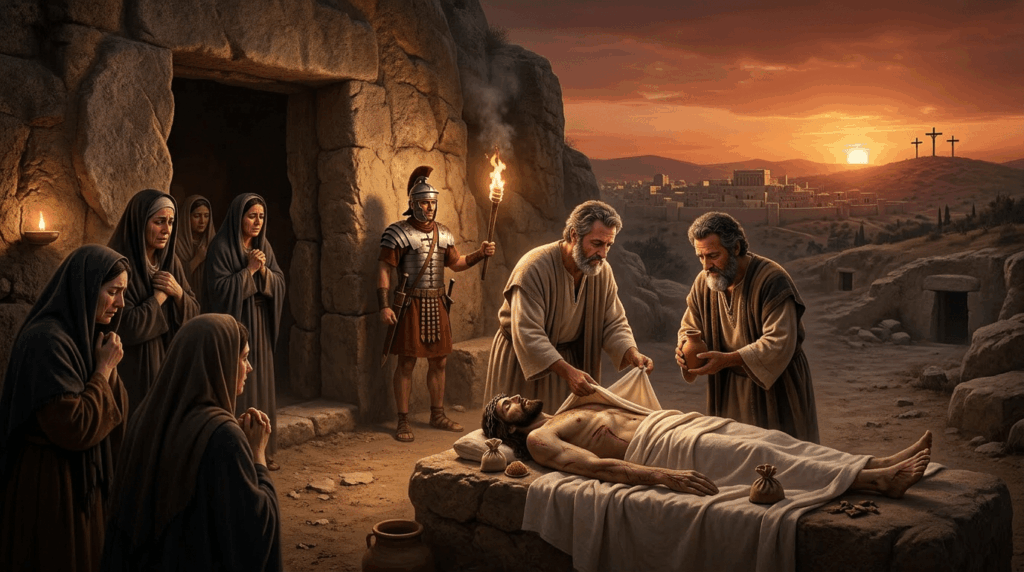
He kantoivat ruumiin hautaan, kammioon, joka oli pinta-alaltaan noin yhdeksän neliömetriä, ja siellä he nopeasti valmistivat ruumiin hautaan jätettäväksi. Juutalaiset eivät todellisuudessa haudanneet vainajiaan, vaan he itse asiassa palsamoivat ne. Joosef ja Nikodemus olivat tuoneet mukanaan suuret määrät mirhamia ja aaloeita, ja nyt he käärivät ruumiin näillä liuoksilla kyllästettyihin liinoihin. Kun palsamointi oli suoritettu, he sitoivat hikiliinan kasvojen ympärille, kietoivat ruumiin pellavakankaaseen ja asettivat sen kunnioittavasti yhdelle hautakammion ruumishyllyistä.
Laskettuaan ruumiin paikalleen hautakammiossa sadanpäämies antoi sotilailleen merkin näiden tulla auttamaan ovikiven vierittämisessä haudan suuaukon eteen. Sotilaat lähtivät sen jälkeen varkaiden ruumiit mukanaan Gehennaan, kun muut sen sijaan palasivat surun vallassa Jerusalemiin viettämään Mooseksen lakien mukaista pääsiäisjuhlaa.
Jeesuksen hautaamiseen liittyi melkoinen kiire ja hoppu siksi, että se suoritettiin valmistuspäivänä, ja sapatti oli aivan kohta alkamassa. Miehet riensivät takaisin kaupunkiin, mutta naiset viipyivät haudan lähellä sysipimeään saakka.
Sen aikaa kun kaikki edellä kerrottu tapahtui, naiset piileskelivät lähettyvillä, joten he näkivät kaiken ja panivat merkille, minne Mestari oli laskettu. He lymyilivät näin siksi, että naisten ei ollut lupa tällaisena hetkenä esiintyä miesten seurassa. Nämä naiset eivät olleet sitä mieltä, että Jeesusta olisi asianmukaisesti valmistettu hautaanpanoa varten, ja he sopivat keskenään menevänsä takaisin Joosefin kotiin, lepäävänsä sapattipäivän yli, laittavansa valmiiksi yrttejä ja voiteita ja palaavansa paikalle sunnuntaiaamuna valmistamaan Mestarin ruumiin asianmukaisesti kuolonunta varten. Haudan äärellä tuona perjantai-iltana viipyneet naiset olivat Magdalan Maria, Klopaksen vaimo Maria, Jeesuksen äidin toinen sisar Martta ja Sepforiin Rebekka.
Daavid Sebedeusta ja Joosef Arimatealaista lukuun ottamatta vain muutamat Jeesuksen opetuslapset todellakin uskoivat tai ymmärsivät, että hänen oli määrä nousta kolmantena päivänä haudasta.
When Joseph and Nicodemus arrived at Golgotha, they found the soldiers taking Jesus down from the cross and the representatives of the Sanhedrin standing by to see that none of Jesus’ followers prevented his body from going to the criminal burial pits. When Joseph presented Pilate’s order for the Master’s body to the centurion, the Jews raised a tumult and clamored for its possession. In their raving they sought violently to take possession of the body, and when they did this, the centurion ordered four of his soldiers to his side, and with drawn swords they stood astride the Master’s body as it lay there on the ground. The centurion ordered the other soldiers to leave the two thieves while they drove back this angry mob of infuriated Jews. When order had been restored, the centurion read the permit from Pilate to the Jews and, stepping aside, said to Joseph: “This body is yours to do with as you see fit. I and my soldiers will stand by to see that no man interferes.”
A crucified person could not be buried in a Jewish cemetery; there was a strict law against such a procedure. Joseph and Nicodemus knew this law, and on the way out to Golgotha they had decided to bury Jesus in Joseph’s new family tomb, hewn out of solid rock, located a short distance north of Golgotha and across the road leading to Samaria. No one had ever lain in this tomb, and they thought it appropriate that the Master should rest there. Joseph really believed that Jesus would rise from the dead, but Nicodemus was very doubtful. These former members of the Sanhedrin had kept their faith in Jesus more or less of a secret, although their fellow Sanhedrists had long suspected them, even before they withdrew from the council. From now on they were the most outspoken disciples of Jesus in all Jerusalem.
At about half past four o’clock the burial procession of Jesus of Nazareth started from Golgotha for Joseph’s tomb across the way. The body was wrapped in a linen sheet as the four men carried it, followed by the faithful women watchers from Galilee. The mortals who bore the material body of Jesus to the tomb were: Joseph, Nicodemus, John, and the Roman centurion.
They carried the body into the tomb, a chamber about ten feet square, where they hurriedly prepared it for burial. The Jews did not really bury their dead; they actually embalmed them. Joseph and Nicodemus had brought with them large quantities of myrrh and aloes, and they now wrapped the body with bandages saturated with these solutions. When the embalming was completed, they tied a napkin about the face, wrapped the body in a linen sheet, and reverently placed it on a shelf in the tomb.
After placing the body in the tomb, the centurion signaled for his soldiers to help roll the doorstone up before the entrance to the tomb. The soldiers then departed for Gehenna with the bodies of the thieves while the others returned to Jerusalem, in sorrow, to observe the Passover feast according to the laws of Moses.
There was considerable hurry and haste about the burial of Jesus because this was preparation day and the Sabbath was drawing on apace. The men hurried back to the city, but the women lingered near the tomb until it was very dark.
While all this was going on, the women were hiding near at hand so that they saw it all and observed where the Master had been laid. They thus secreted themselves because it was not permissible for women to associate with men at such a time. These women did not think Jesus had been properly prepared for burial, and they agreed among themselves to go back to the home of Joseph, rest over the Sabbath, make ready spices and ointments, and return on Sunday morning properly to prepare the Master’s body for the death rest. The women who thus tarried by the tomb on this Friday evening were: Mary Magdalene, Mary the wife of Clopas, Martha another sister of Jesus’ mother, and Rebecca of Sepphoris.
Aside from David Zebedee and Joseph of Arimathea, very few of Jesus’ disciples really believed or understood that he was due to arise from the tomb on the third day.
SuomiEnglish
Golgatalle saapuessaan Joosef ja Nikodemus kohtasivat siellä sotilaat, jotka olivat ottamassa Jeesusta alas ristiltä, sekä sanhedrinin edustajat, jotka seisoivat vieressä vahtimassa, ettei kukaan Jeesuksen seuraajista estäisi hänen ruumistaan joutumasta rikollisille tarkoitettuun hautakuoppaan. Joosefin esittäessä sadanpäämiehelle Pilatuksen antaman, Mestarin ruumista koskevan määräyksen juutalaiset nostivat metelin ja vaativat suuriäänisesti ruumista haltuunsa. Siinä riehuessaan he koettivat saada väkivalloin ruumiin itselleen, ja heidän näin tehdessään sadanpäämies määräsi vierelleen neljä sotilastaan, ja nämä seisoivat miekat paljastettuina hajareisin Mestarin maassa lojuvan ruumiin yllä. Sadanpäämies antoi muille sotilaille määräyksen jättää molemmat varkaat siksi aikaa, kun he ajoivat tätä raivostuneiden juutalaisten vihaista joukkiota taaksepäin. Kun järjestys oli palautettu, sadanpäämies luki juutalaisille Pilatuksen antaman luvan, astui sivuun ja sanoi Joosefille: ”Tämä ruumis kuuluu teille tehdäksenne sille niin kuin katsotte hyväksi tehdä. Minä ja sotilaani pysyttelemme lähettyvillä pitääksemme huolen siitä, ettei kukaan tähän puutu.”
When Joseph and Nicodemus arrived at Golgotha, they found the soldiers taking Jesus down from the cross and the representatives of the Sanhedrin standing by to see that none of Jesus’ followers prevented his body from going to the criminal burial pits. When Joseph presented Pilate’s order for the Master’s body to the centurion, the Jews raised a tumult and clamored for its possession. In their raving they sought violently to take possession of the body, and when they did this, the centurion ordered four of his soldiers to his side, and with drawn swords they stood astride the Master’s body as it lay there on the ground. The centurion ordered the other soldiers to leave the two thieves while they drove back this angry mob of infuriated Jews. When order had been restored, the centurion read the permit from Pilate to the Jews and, stepping aside, said to Joseph: “This body is yours to do with as you see fit. I and my soldiers will stand by to see that no man interferes.”
Ristiinnaulittua henkilöä ei voinut haudata juutalaiselle hautausmaalle; sellaista menettelyä vastaan oli olemassa ankara laki. Joosef ja Nikodemus olivat tästä laista tietoisia, ja matkallaan Golgatalle he olivat päättäneet haudata Jeesuksen Joosefin uuteen sukuhautaan. Lujaan kallioon hakattu hauta sijaitsi vähän matkan päässä Golgatasta pohjoiseen, Samariaan johtavan tien toisella puolella. Hauta oli vielä täysin käyttämätön, ja heistä tuntui sopivalta Mestarin levätä siellä. Joosef todellakin uskoi, että Jeesus nousisi kuolleista, mutta Nikodemus oli sangen epäileväinen. Nämä entiset sanhedrinin jäsenet olivat pitäneet uskonsa Jeesukseen enemmän tai vähemmän salaisuutena, jos kohta heidän sanhedristitoverinsa olivat jo kauan heitä epäilleet, itse asiassa jo ennen kuin he jättäytyivät pois neuvostosta. Tästä lähtien he olivat koko Jerusalemissa Jeesuksen suorapuheisimmat opetuslapset.
A crucified person could not be buried in a Jewish cemetery; there was a strict law against such a procedure. Joseph and Nicodemus knew this law, and on the way out to Golgotha they had decided to bury Jesus in Joseph’s new family tomb, hewn out of solid rock, located a short distance north of Golgotha and across the road leading to Samaria. No one had ever lain in this tomb, and they thought it appropriate that the Master should rest there. Joseph really believed that Jesus would rise from the dead, but Nicodemus was very doubtful. These former members of the Sanhedrin had kept their faith in Jesus more or less of a secret, although their fellow Sanhedrists had long suspected them, even before they withdrew from the council. From now on they were the most outspoken disciples of Jesus in all Jerusalem.
Noin kello puoli viideltä Jeesus Nasaretilaisen hautajaissaatto lähti liikkeelle Golgatalta kohti Joosefin hautakammiota tien toisella puolella. Ruumis oli kääritty pellavakankaaseen, ja sitä kantoi neljä miestä, joiden perässä astelivat uskolliset ruumiinvalvojaisnaiset Galileasta. Jeesuksen aineellisen ruumiin hautaan kantaneet kuolevaiset olivat Joosef, Nikodemus, Johannes ja roomalainen sadanpäämies.
At about half past four o’clock the burial procession of Jesus of Nazareth started from Golgotha for Joseph’s tomb across the way. The body was wrapped in a linen sheet as the four men carried it, followed by the faithful women watchers from Galilee. The mortals who bore the material body of Jesus to the tomb were: Joseph, Nicodemus, John, and the Roman centurion.
He kantoivat ruumiin hautaan, kammioon, joka oli pinta-alaltaan noin yhdeksän neliömetriä, ja siellä he nopeasti valmistivat ruumiin hautaan jätettäväksi. Juutalaiset eivät todellisuudessa haudanneet vainajiaan, vaan he itse asiassa palsamoivat ne. Joosef ja Nikodemus olivat tuoneet mukanaan suuret määrät mirhamia ja aaloeita, ja nyt he käärivät ruumiin näillä liuoksilla kyllästettyihin liinoihin. Kun palsamointi oli suoritettu, he sitoivat hikiliinan kasvojen ympärille, kietoivat ruumiin pellavakankaaseen ja asettivat sen kunnioittavasti yhdelle hautakammion ruumishyllyistä.
They carried the body into the tomb, a chamber about ten feet square, where they hurriedly prepared it for burial. The Jews did not really bury their dead; they actually embalmed them. Joseph and Nicodemus had brought with them large quantities of myrrh and aloes, and they now wrapped the body with bandages saturated with these solutions. When the embalming was completed, they tied a napkin about the face, wrapped the body in a linen sheet, and reverently placed it on a shelf in the tomb.
Laskettuaan ruumiin paikalleen hautakammiossa sadanpäämies antoi sotilailleen merkin näiden tulla auttamaan ovikiven vierittämisessä haudan suuaukon eteen. Sotilaat lähtivät sen jälkeen varkaiden ruumiit mukanaan Gehennaan, kun muut sen sijaan palasivat surun vallassa Jerusalemiin viettämään Mooseksen lakien mukaista pääsiäisjuhlaa.
After placing the body in the tomb, the centurion signaled for his soldiers to help roll the doorstone up before the entrance to the tomb. The soldiers then departed for Gehenna with the bodies of the thieves while the others returned to Jerusalem, in sorrow, to observe the Passover feast according to the laws of Moses.
Jeesuksen hautaamiseen liittyi melkoinen kiire ja hoppu siksi, että se suoritettiin valmistuspäivänä, ja sapatti oli aivan kohta alkamassa. Miehet riensivät takaisin kaupunkiin, mutta naiset viipyivät haudan lähellä sysipimeään saakka.
There was considerable hurry and haste about the burial of Jesus because this was preparation day and the Sabbath was drawing on apace. The men hurried back to the city, but the women lingered near the tomb until it was very dark.
Sen aikaa kun kaikki edellä kerrottu tapahtui, naiset piileskelivät lähettyvillä, joten he näkivät kaiken ja panivat merkille, minne Mestari oli laskettu. He lymyilivät näin siksi, että naisten ei ollut lupa tällaisena hetkenä esiintyä miesten seurassa. Nämä naiset eivät olleet sitä mieltä, että Jeesusta olisi asianmukaisesti valmistettu hautaanpanoa varten, ja he sopivat keskenään menevänsä takaisin Joosefin kotiin, lepäävänsä sapattipäivän yli, laittavansa valmiiksi yrttejä ja voiteita ja palaavansa paikalle sunnuntaiaamuna valmistamaan Mestarin ruumiin asianmukaisesti kuolonunta varten. Haudan äärellä tuona perjantai-iltana viipyneet naiset olivat Magdalan Maria, Klopaksen vaimo Maria, Jeesuksen äidin toinen sisar Martta ja Sepforiin Rebekka.
While all this was going on, the women were hiding near at hand so that they saw it all and observed where the Master had been laid. They thus secreted themselves because it was not permissible for women to associate with men at such a time. These women did not think Jesus had been properly prepared for burial, and they agreed among themselves to go back to the home of Joseph, rest over the Sabbath, make ready spices and ointments, and return on Sunday morning properly to prepare the Master’s body for the death rest. The women who thus tarried by the tomb on this Friday evening were: Mary Magdalene, Mary the wife of Clopas, Martha another sister of Jesus’ mother, and Rebecca of Sepphoris.
Daavid Sebedeusta ja Joosef Arimatealaista lukuun ottamatta vain muutamat Jeesuksen opetuslapset todellakin uskoivat tai ymmärsivät, että hänen oli määrä nousta kolmantena päivänä haudasta.
Aside from David Zebedee and Joseph of Arimathea, very few of Jesus’ disciples really believed or understood that he was due to arise from the tomb on the third day.