
Teksti
Tausta
Näytä
Lisäasetukset
Kieli
Urantia Opas
Kysy kirjan sisällöstä. Opas vastaa Book Enginen omien lähdekohtien perusteella ja ohjaa sinut lukemaan ne.
Hei! 🙏
Olen sinun Urantia-oppaasi. Tehtäväni on auttaa sinua löytämään oikeat kohdat Urantia-kirjasta ja ymmärtämään sen opetuksia syvemmin. 😊❤️
Ennen kuin lähdettiin praetoriumin pihalta, sotilaat asettivat ristin poikkipuun Jeesuksen harteille. Tapana oli, että tuomittu pakotettiin kantamaan poikkipuu ristiinnaulitsemispaikalle. Tuomittu ei kantanut koko ristiä, vaan ainoastaan tämän lyhyemmän poikkihirren. Kolmen ristin pitemmät, pystyyn asetettavat hirret oli jo kuljetettu Golgatalle, ja siihen hetkeen, kun sotilaat ja heidän vankinsa saapuivat paikalle, ne oli jo lyöty lujasti maahan.
Vakiintuneen tavan mukaisesti kapteeni asteli kulkueen edellä kantaen pieniä valkoisia puutauluja, joihin oli hiilellä kirjoitettu rikollisten nimet sekä minkälaatuisista rikoksista nämä oli tuomittu. Kahta varasta varten sadanpäämiehellä oli taulut, joissa mainittiin näiden nimi, ja sen alle oli kirjoitettu yksi ainoa sana: ”Rosvo”. Sen jälkeen kun uhri oli naulittu poikkipuuhun ja nostettu paikalleen ristin pystysuoraan puuhun, tapana oli naulata tämä taulu ristin yläosaan, heti rikollisen pään yläpuolelle, jotta kaikki silminnäkijät tietäisivät, mistä rikoksesta tuomittu oli ristille pantu. Pilatus oli itse kirjoittanut latinaksi, kreikaksi ja arameaksi tekstin siihen sadanpäämiehen kantamaan tauluun, joka oli tarkoitettu kiinnitettäväksi Jeesuksen ristiin, ja se kuului: ”Jeesus Nasaretilainen – juutalaisten kuningas.”
Muutamat niistä juutalaisviranomaisista, jotka olivat paikalla, vielä silloin kun Pilatus kirjoitti tämän tekstin, protestoivat voimakkaasti sellaista vastaan, että Jeesusta kutsuttiin ”juutalaisten kuninkaaksi”. Mutta Pilatus muistutti heitä, että tällainen syytöshän sisältyi kanteeseen, joka johti hänen tuomitsemiseensa. Huomatessaan, etteivät saisi Pilatusta muuttamaan mieltään, juutalaiset anoivat, että tekstiä ainakin muutettaisiin sen verran, että se kuuluisi: ”Hän sanoi: ’Minä olen juutalaisten kuningas.’” Mutta Pilatus oli taipumaton; hän ei suostuisi muuttamaan kirjoitusta. Kaikkiin vielä esitettyihin hartaisiin pyyntöihin hän vastasi ainoastaan: ”Minkä olen kirjoittanut, sen olen kirjoittanut.”
Tavallisissa oloissa oli käytäntönä, että Golgatalle mentiin pisintä tietä, jotta mahdollisimman suuri määrä ihmisiä saisi nähdä tuomitun rikollisen, mutta käsillä olevana päivänä he menivät suorinta reittiä Damaskoksenportille, joka johti kaupungista pohjoiseen, ja tätä tietä kulkien he saapuivat kohta Golgatalle, Jerusalemin viralliselle ristiinnaulitsemispaikalle. Golgatan takana olivat rikkaiden villat, ja tien toisella puolella sijaitsivat monien varakkaiden juutalaisten haudat.
Ristiinnaulitseminen ei ollut juutalainen rangaistusmuoto. Sekä kreikkalaiset että roomalaiset oppivat tämän teloitusmenetelmän foinikialaisilta. Edes Herodes kaikessa julmuudessaan ei käyttänyt ristiinnaulitsemista. Roomalaiset eivät koskaan ristiinnaulinneet Rooman kansalaista; tätä kunniatonta hengiltäottotapaa sovellettiin vain orjiin ja alamaiskansoihin. Jerusalemin piirityksen aikana, vain neljäkymmentä vuotta Jeesuksen ristiinnaulitsemisen jälkeen, Golgata peittyi tuhansista ja taas tuhansista risteistä, joilla päivä päivän jälkeen menehtyi juutalaisrodun kukkein nuoriso. Se oli toden totta kaamea sato käsillä olevan päivän kylvöksestä.
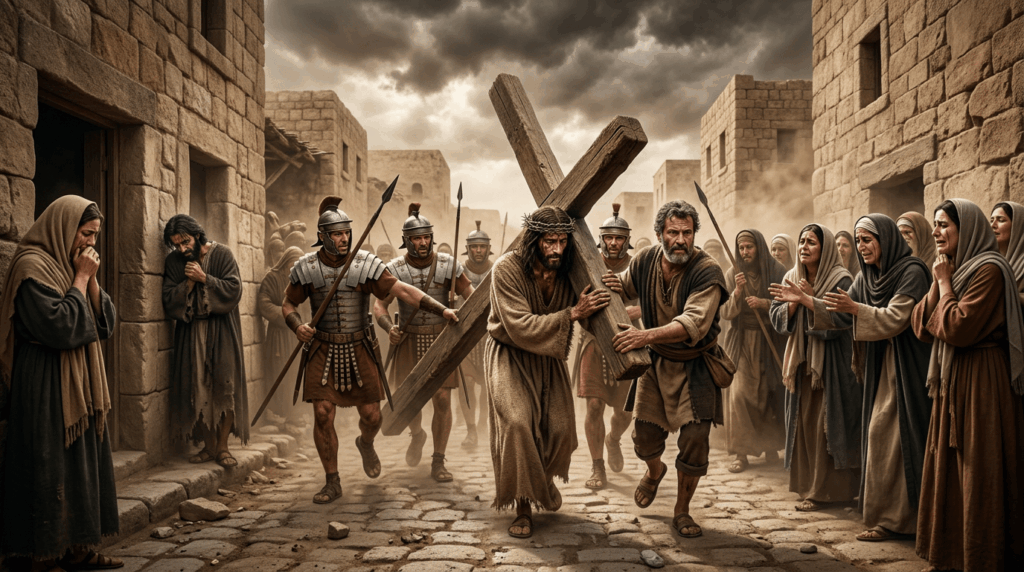
Kuolemankulkueen edetessä pitkin Jerusalemin kapeita katuja monet helläsydämisistä juutalaisnaisista, jotka olivat kuunnelleet Jeesuksen lausumia rohkaisun ja myötätunnon sanoja ja jotka tiesivät hänen eläneen elämänsä rakastavasti palvellen, eivät kyenneet pidättämään itkuaan nähdessään häntä vietävän tällaiseen kunniattomaan kuolemaan. Kun hän kulki ohi, monet näistä naisista valittivat ja vaikeroivat. Ja kun jotkut heistä rohkenivat jopa kulkea hänen rinnallaan, Mestari käänsi päänsä heihin päin ja sanoi: ”Jerusalemin tyttäret, älkää minun takiani itkekö, vaan itkekää paremminkin itsenne ja lastenne tähden. Minun työni on lähes tehty – menen kohta Isäni tykö –, mutta Jerusalemille ovat hirvittävän vaivan ajat vasta alkamassa. Katso, ne päivät ovat kohta, jolloin te sanotte: Siunattuja ovat hedelmättömät ja ne, joiden rinnat eivät ole koskaan lasta imettäneet. Niinä päivinä rukoilette, että vuorten kivenjärkäleet lankeaisivat päällenne, jotta välttyisitte vaivojenne kauheuksilta.”
Nämä jerusalemilaisnaiset olivat totisesti rohkeita osoittaessaan myötätuntoa Jeesukselle, sillä ystävällisten tunteiden osoittaminen ristiinnaulittavaksi talutettua kohtaan oli laissa ankarasti kielletty. Roskaväki sai vapaasti herjata, pilkata ja irvailla tuomittua, mutta minkäänlaisen myötätunnon julkituominen ei ollut sallittua. Vaikka Jeesus arvosti hänelle osoitettua myötätuntoa tänä synkkänä hetkenä, jolloin hänen ystävänsä piileskelivät, hän ei halunnut näiden hyväsydämisten naisten joutuvan viranomaisten tyytymättömyyden kohteiksi siksi, että he uskalsivat osoittaa hänelle myötätuntoa. Edes tällaisena hetkenä Jeesus ei juurikaan ajatellut itseään vaan vain niitä kauheita murhenäytelmän päiviä, jotka olivat Jerusalemin ja koko juutalaiskansakunnan edessä.
Kun Mestari laahusti eteenpäin matkalla kohti ristiinnaulitsemista, hän oli hyvin väsynyt; hän oli lähes näännyksissä. Elia Markuksen kodissa nautitun viimeisen ehtoollisen jälkeen hän ei ollut saanut ruokaa eikä vettä; eikä hänelle liioin ollut suotu hetkeäkään unta. Tämän lisäksi häntä oli hänen tuomitsemiseensa saakka käytetty kuulustelussa kuulustelun perään, puhumattakaan pahoinpitelytarkoituksessa suoritetuista ruoskimisista ja niihin liittyvistä fyysisestä kivusta ja verenhukasta. Kaiken tämän lisäksi tilannetta pahensivat vielä hänen äärimmäinen mentaalinen ahdistuksensa, hänen ankara hengellinen jännittyneisyytensä ja hirvittävä inhimillisen yksinäisyyden tunne.
Kohta sen jälkeen kun matkalla kaupungin ulkopuolelle oli kuljettu portin läpi Jeesuksen huojuessa poikkihirren painon alla, hänen fyysiset voimansa hetkeksi pettivät, ja hän kaatui raskaan taakkansa alle. Sotilaat huusivat hänelle ja potkivat häntä, mutta hän ei kyennyt nousemaan. Tämän nähdessään kapteeni, tietoisena siitä, mitä Jeesus jo oli kestänyt, käski sotilaiden lopettaa. Sitten hän määräsi yhden ohikulkijan, Simon Kyreneläisen, ottamaan poikkihirren Jeesuksen harteilta ja pakotti tämän kantamaan sitä loppumatkan Golgatalle.
Tämä mies, Simon, oli tullut aina Pohjois-Afrikan Kyrenestä asti ollakseen mukana pääsiäisjuhlilla. Hän oli muutamien muiden kyreneläisten kanssa majoittunut heti kaupunginmuurien ulkopuolelle, ja hän oli matkalla kaupungissa pidettäviin temppelipalveluksiin, kun roomalaiskapteeni komensi hänet kantamaan Jeesuksen ristin poikkipuuta. Simon viipyi paikalla kaikki ne tunnit, jotka Mestari teki kuolemaa ristillä, ja hän keskusteli monien tämän ystävien ja vihollisten kanssa. Kuolleistaheräämisen jälkeen ja ennen Jerusalemista-lähtöään hänestä tuli urhea valtakunnan evankeliumiin uskova, ja kotiin palattuaan hän johdatti perheensä taivaan valtakuntaan. Hänen molemmista pojistaan, Alexanderista ja Rufuksesta, tuli erittäin aikaansaavia uuden evankeliumin opettajia Afrikassa. Mutta Simon ei koskaan tullut tietämään, että Jeesus, jonka taakkaa hän kantoi, ja se juutalainen opettaja, joka oli aikanaan osoittanut ystävällisyyttä hänen vahingoittuneelle pojalleen, olivat sama henkilö.
Kello oli vähän yli yhdeksän, kun tämä kuolemankulkue saapui Golgatalle, ja roomalaissotilaat kävivät käsiksi tehtäväänsä naulata kumpikin ryöväri ja Ihmisen Poika kukin omalle ristilleen.
Before leaving the courtyard of the praetorium, the soldiers placed the crossbeam on Jesus’ shoulders. It was the custom to compel the condemned man to carry the crossbeam to the site of the crucifixion. Such a condemned man did not carry the whole cross, only this shorter timber. The longer and upright pieces of timber for the three crosses had already been transported to Golgotha and, by the time of the arrival of the soldiers and their prisoners, had been firmly implanted in the ground.
According to custom the captain led the procession, carrying small white boards on which had been written with charcoal the names of the criminals and the nature of the crimes for which they had been condemned. For the two thieves the centurion had notices which gave their names, underneath which was written the one word, “Brigand.” It was the custom, after the victim had been nailed to the crossbeam and hoisted to his place on the upright timber, to nail this notice to the top of the cross, just above the head of the criminal, that all witnesses might know for what crime the condemned man was being crucified. The legend which the centurion carried to put on the cross of Jesus had been written by Pilate himself in Latin, Greek, and Aramaic, and it read: “Jesus of Nazareth—the King of the Jews.”
Some of the Jewish authorities who were yet present when Pilate wrote this legend made vigorous protest against calling Jesus the “king of the Jews.” But Pilate reminded them that such an accusation was part of the charge which led to his condemnation. When the Jews saw they could not prevail upon Pilate to change his mind, they pleaded that at least it be modified to read, “He said, ‘I am the king of the Jews.’” But Pilate was adamant; he would not alter the writing. To all further supplication he only replied, “What I have written, I have written.”
Ordinarily, it was the custom to journey to Golgotha by the longest road in order that a large number of persons might view the condemned criminal, but on this day they went by the most direct route to the Damascus gate, which led out of the city to the north, and following this road, they soon arrived at Golgotha, the official crucifixion site of Jerusalem. Beyond Golgotha were the villas of the wealthy, and on the other side of the road were the tombs of many well-to-do Jews.
Crucifixion was not a Jewish mode of punishment. Both the Greeks and the Romans learned this method of execution from the Phoenicians. Even Herod, with all his cruelty, did not resort to crucifixion. The Romans never crucified a Roman citizen; only slaves and subject peoples were subjected to this dishonorable mode of death. During the siege of Jerusalem, just forty years after the crucifixion of Jesus, all of Golgotha was covered by thousands upon thousands of crosses upon which, from day to day, there perished the flower of the Jewish race. A terrible harvest, indeed, of the seed-sowing of this day.
As the death procession passed along the narrow streets of Jerusalem, many of the tenderhearted Jewish women who had heard Jesus’ words of good cheer and compassion, and who knew of his life of loving ministry, could not refrain from weeping when they saw him being led forth to such an ignoble death. As he passed by, many of these women bewailed and lamented. And when some of them even dared to follow along by his side, the Master turned his head toward them and said: “Daughters of Jerusalem, weep not for me, but rather weep for yourselves and for your children. My work is about done—soon I go to my Father—but the times of terrible trouble for Jerusalem are just beginning. Behold, the days are coming in which you shall say: Blessed are the barren and those whose breasts have never suckled their young. In those days will you pray the rocks of the hills to fall on you in order that you may be delivered from the terrors of your troubles.”
These women of Jerusalem were indeed courageous to manifest sympathy for Jesus, for it was strictly against the law to show friendly feelings for one who was being led forth to crucifixion. It was permitted the rabble to jeer, mock, and ridicule the condemned, but it was not allowed that any sympathy should be expressed. Though Jesus appreciated the manifestation of sympathy in this dark hour when his friends were in hiding, he did not want these kindhearted women to incur the displeasure of the authorities by daring to show compassion in his behalf. Even at such a time as this Jesus thought little about himself, only of the terrible days of tragedy ahead for Jerusalem and the whole Jewish nation.
As the Master trudged along on the way to the crucifixion, he was very weary; he was nearly exhausted. He had had neither food nor water since the Last Supper at the home of Elijah Mark; neither had he been permitted to enjoy one moment of sleep. In addition, there had been one hearing right after another up to the hour of his condemnation, not to mention the abusive scourgings with their accompanying physical suffering and loss of blood. Superimposed upon all this was his extreme mental anguish, his acute spiritual tension, and a terrible feeling of human loneliness.
Shortly after passing through the gate on the way out of the city, as Jesus staggered on bearing the crossbeam, his physical strength momentarily gave way, and he fell beneath the weight of his heavy burden. The soldiers shouted at him and kicked him, but he could not arise. When the captain saw this, knowing what Jesus had already endured, he commanded the soldiers to desist. Then he ordered a passerby, one Simon from Cyrene, to take the crossbeam from Jesus’ shoulders and compelled him to carry it the rest of the way to Golgotha.
This man Simon had come all the way from Cyrene, in northern Africa, to attend the Passover. He was stopping with other Cyrenians just outside the city walls and was on his way to the temple services in the city when the Roman captain commanded him to carry Jesus’ crossbeam. Simon lingered all through the hours of the Master’s death on the cross, talking with many of his friends and with his enemies. After the resurrection and before leaving Jerusalem, he became a valiant believer in the gospel of the kingdom, and when he returned home, he led his family into the heavenly kingdom. His two sons, Alexander and Rufus, became very effective teachers of the new gospel in Africa. But Simon never knew that Jesus, whose burden he bore, and the Jewish tutor who once befriended his injured son, were the same person.
It was shortly after nine o’clock when this procession of death arrived at Golgotha, and the Roman soldiers set themselves about the task of nailing the two brigands and the Son of Man to their respective crosses.
SuomiEnglish
Ennen kuin lähdettiin praetoriumin pihalta, sotilaat asettivat ristin poikkipuun Jeesuksen harteille. Tapana oli, että tuomittu pakotettiin kantamaan poikkipuu ristiinnaulitsemispaikalle. Tuomittu ei kantanut koko ristiä, vaan ainoastaan tämän lyhyemmän poikkihirren. Kolmen ristin pitemmät, pystyyn asetettavat hirret oli jo kuljetettu Golgatalle, ja siihen hetkeen, kun sotilaat ja heidän vankinsa saapuivat paikalle, ne oli jo lyöty lujasti maahan.
Before leaving the courtyard of the praetorium, the soldiers placed the crossbeam on Jesus’ shoulders. It was the custom to compel the condemned man to carry the crossbeam to the site of the crucifixion. Such a condemned man did not carry the whole cross, only this shorter timber. The longer and upright pieces of timber for the three crosses had already been transported to Golgotha and, by the time of the arrival of the soldiers and their prisoners, had been firmly implanted in the ground.
Vakiintuneen tavan mukaisesti kapteeni asteli kulkueen edellä kantaen pieniä valkoisia puutauluja, joihin oli hiilellä kirjoitettu rikollisten nimet sekä minkälaatuisista rikoksista nämä oli tuomittu. Kahta varasta varten sadanpäämiehellä oli taulut, joissa mainittiin näiden nimi, ja sen alle oli kirjoitettu yksi ainoa sana: ”Rosvo”. Sen jälkeen kun uhri oli naulittu poikkipuuhun ja nostettu paikalleen ristin pystysuoraan puuhun, tapana oli naulata tämä taulu ristin yläosaan, heti rikollisen pään yläpuolelle, jotta kaikki silminnäkijät tietäisivät, mistä rikoksesta tuomittu oli ristille pantu. Pilatus oli itse kirjoittanut latinaksi, kreikaksi ja arameaksi tekstin siihen sadanpäämiehen kantamaan tauluun, joka oli tarkoitettu kiinnitettäväksi Jeesuksen ristiin, ja se kuului: ”Jeesus Nasaretilainen – juutalaisten kuningas.”
According to custom the captain led the procession, carrying small white boards on which had been written with charcoal the names of the criminals and the nature of the crimes for which they had been condemned. For the two thieves the centurion had notices which gave their names, underneath which was written the one word, “Brigand.” It was the custom, after the victim had been nailed to the crossbeam and hoisted to his place on the upright timber, to nail this notice to the top of the cross, just above the head of the criminal, that all witnesses might know for what crime the condemned man was being crucified. The legend which the centurion carried to put on the cross of Jesus had been written by Pilate himself in Latin, Greek, and Aramaic, and it read: “Jesus of Nazareth—the King of the Jews.”
Muutamat niistä juutalaisviranomaisista, jotka olivat paikalla, vielä silloin kun Pilatus kirjoitti tämän tekstin, protestoivat voimakkaasti sellaista vastaan, että Jeesusta kutsuttiin ”juutalaisten kuninkaaksi”. Mutta Pilatus muistutti heitä, että tällainen syytöshän sisältyi kanteeseen, joka johti hänen tuomitsemiseensa. Huomatessaan, etteivät saisi Pilatusta muuttamaan mieltään, juutalaiset anoivat, että tekstiä ainakin muutettaisiin sen verran, että se kuuluisi: ”Hän sanoi: ’Minä olen juutalaisten kuningas.’” Mutta Pilatus oli taipumaton; hän ei suostuisi muuttamaan kirjoitusta. Kaikkiin vielä esitettyihin hartaisiin pyyntöihin hän vastasi ainoastaan: ”Minkä olen kirjoittanut, sen olen kirjoittanut.”
Some of the Jewish authorities who were yet present when Pilate wrote this legend made vigorous protest against calling Jesus the “king of the Jews.” But Pilate reminded them that such an accusation was part of the charge which led to his condemnation. When the Jews saw they could not prevail upon Pilate to change his mind, they pleaded that at least it be modified to read, “He said, ‘I am the king of the Jews.’” But Pilate was adamant; he would not alter the writing. To all further supplication he only replied, “What I have written, I have written.”
Tavallisissa oloissa oli käytäntönä, että Golgatalle mentiin pisintä tietä, jotta mahdollisimman suuri määrä ihmisiä saisi nähdä tuomitun rikollisen, mutta käsillä olevana päivänä he menivät suorinta reittiä Damaskoksenportille, joka johti kaupungista pohjoiseen, ja tätä tietä kulkien he saapuivat kohta Golgatalle, Jerusalemin viralliselle ristiinnaulitsemispaikalle. Golgatan takana olivat rikkaiden villat, ja tien toisella puolella sijaitsivat monien varakkaiden juutalaisten haudat.
Ordinarily, it was the custom to journey to Golgotha by the longest road in order that a large number of persons might view the condemned criminal, but on this day they went by the most direct route to the Damascus gate, which led out of the city to the north, and following this road, they soon arrived at Golgotha, the official crucifixion site of Jerusalem. Beyond Golgotha were the villas of the wealthy, and on the other side of the road were the tombs of many well-to-do Jews.
Ristiinnaulitseminen ei ollut juutalainen rangaistusmuoto. Sekä kreikkalaiset että roomalaiset oppivat tämän teloitusmenetelmän foinikialaisilta. Edes Herodes kaikessa julmuudessaan ei käyttänyt ristiinnaulitsemista. Roomalaiset eivät koskaan ristiinnaulinneet Rooman kansalaista; tätä kunniatonta hengiltäottotapaa sovellettiin vain orjiin ja alamaiskansoihin. Jerusalemin piirityksen aikana, vain neljäkymmentä vuotta Jeesuksen ristiinnaulitsemisen jälkeen, Golgata peittyi tuhansista ja taas tuhansista risteistä, joilla päivä päivän jälkeen menehtyi juutalaisrodun kukkein nuoriso. Se oli toden totta kaamea sato käsillä olevan päivän kylvöksestä.
Crucifixion was not a Jewish mode of punishment. Both the Greeks and the Romans learned this method of execution from the Phoenicians. Even Herod, with all his cruelty, did not resort to crucifixion. The Romans never crucified a Roman citizen; only slaves and subject peoples were subjected to this dishonorable mode of death. During the siege of Jerusalem, just forty years after the crucifixion of Jesus, all of Golgotha was covered by thousands upon thousands of crosses upon which, from day to day, there perished the flower of the Jewish race. A terrible harvest, indeed, of the seed-sowing of this day.
Kuolemankulkueen edetessä pitkin Jerusalemin kapeita katuja monet helläsydämisistä juutalaisnaisista, jotka olivat kuunnelleet Jeesuksen lausumia rohkaisun ja myötätunnon sanoja ja jotka tiesivät hänen eläneen elämänsä rakastavasti palvellen, eivät kyenneet pidättämään itkuaan nähdessään häntä vietävän tällaiseen kunniattomaan kuolemaan. Kun hän kulki ohi, monet näistä naisista valittivat ja vaikeroivat. Ja kun jotkut heistä rohkenivat jopa kulkea hänen rinnallaan, Mestari käänsi päänsä heihin päin ja sanoi: ”Jerusalemin tyttäret, älkää minun takiani itkekö, vaan itkekää paremminkin itsenne ja lastenne tähden. Minun työni on lähes tehty – menen kohta Isäni tykö –, mutta Jerusalemille ovat hirvittävän vaivan ajat vasta alkamassa. Katso, ne päivät ovat kohta, jolloin te sanotte: Siunattuja ovat hedelmättömät ja ne, joiden rinnat eivät ole koskaan lasta imettäneet. Niinä päivinä rukoilette, että vuorten kivenjärkäleet lankeaisivat päällenne, jotta välttyisitte vaivojenne kauheuksilta.”
As the death procession passed along the narrow streets of Jerusalem, many of the tenderhearted Jewish women who had heard Jesus’ words of good cheer and compassion, and who knew of his life of loving ministry, could not refrain from weeping when they saw him being led forth to such an ignoble death. As he passed by, many of these women bewailed and lamented. And when some of them even dared to follow along by his side, the Master turned his head toward them and said: “Daughters of Jerusalem, weep not for me, but rather weep for yourselves and for your children. My work is about done—soon I go to my Father—but the times of terrible trouble for Jerusalem are just beginning. Behold, the days are coming in which you shall say: Blessed are the barren and those whose breasts have never suckled their young. In those days will you pray the rocks of the hills to fall on you in order that you may be delivered from the terrors of your troubles.”
Nämä jerusalemilaisnaiset olivat totisesti rohkeita osoittaessaan myötätuntoa Jeesukselle, sillä ystävällisten tunteiden osoittaminen ristiinnaulittavaksi talutettua kohtaan oli laissa ankarasti kielletty. Roskaväki sai vapaasti herjata, pilkata ja irvailla tuomittua, mutta minkäänlaisen myötätunnon julkituominen ei ollut sallittua. Vaikka Jeesus arvosti hänelle osoitettua myötätuntoa tänä synkkänä hetkenä, jolloin hänen ystävänsä piileskelivät, hän ei halunnut näiden hyväsydämisten naisten joutuvan viranomaisten tyytymättömyyden kohteiksi siksi, että he uskalsivat osoittaa hänelle myötätuntoa. Edes tällaisena hetkenä Jeesus ei juurikaan ajatellut itseään vaan vain niitä kauheita murhenäytelmän päiviä, jotka olivat Jerusalemin ja koko juutalaiskansakunnan edessä.
These women of Jerusalem were indeed courageous to manifest sympathy for Jesus, for it was strictly against the law to show friendly feelings for one who was being led forth to crucifixion. It was permitted the rabble to jeer, mock, and ridicule the condemned, but it was not allowed that any sympathy should be expressed. Though Jesus appreciated the manifestation of sympathy in this dark hour when his friends were in hiding, he did not want these kindhearted women to incur the displeasure of the authorities by daring to show compassion in his behalf. Even at such a time as this Jesus thought little about himself, only of the terrible days of tragedy ahead for Jerusalem and the whole Jewish nation.
Kun Mestari laahusti eteenpäin matkalla kohti ristiinnaulitsemista, hän oli hyvin väsynyt; hän oli lähes näännyksissä. Elia Markuksen kodissa nautitun viimeisen ehtoollisen jälkeen hän ei ollut saanut ruokaa eikä vettä; eikä hänelle liioin ollut suotu hetkeäkään unta. Tämän lisäksi häntä oli hänen tuomitsemiseensa saakka käytetty kuulustelussa kuulustelun perään, puhumattakaan pahoinpitelytarkoituksessa suoritetuista ruoskimisista ja niihin liittyvistä fyysisestä kivusta ja verenhukasta. Kaiken tämän lisäksi tilannetta pahensivat vielä hänen äärimmäinen mentaalinen ahdistuksensa, hänen ankara hengellinen jännittyneisyytensä ja hirvittävä inhimillisen yksinäisyyden tunne.
As the Master trudged along on the way to the crucifixion, he was very weary; he was nearly exhausted. He had had neither food nor water since the Last Supper at the home of Elijah Mark; neither had he been permitted to enjoy one moment of sleep. In addition, there had been one hearing right after another up to the hour of his condemnation, not to mention the abusive scourgings with their accompanying physical suffering and loss of blood. Superimposed upon all this was his extreme mental anguish, his acute spiritual tension, and a terrible feeling of human loneliness.
Kohta sen jälkeen kun matkalla kaupungin ulkopuolelle oli kuljettu portin läpi Jeesuksen huojuessa poikkihirren painon alla, hänen fyysiset voimansa hetkeksi pettivät, ja hän kaatui raskaan taakkansa alle. Sotilaat huusivat hänelle ja potkivat häntä, mutta hän ei kyennyt nousemaan. Tämän nähdessään kapteeni, tietoisena siitä, mitä Jeesus jo oli kestänyt, käski sotilaiden lopettaa. Sitten hän määräsi yhden ohikulkijan, Simon Kyreneläisen, ottamaan poikkihirren Jeesuksen harteilta ja pakotti tämän kantamaan sitä loppumatkan Golgatalle.
Shortly after passing through the gate on the way out of the city, as Jesus staggered on bearing the crossbeam, his physical strength momentarily gave way, and he fell beneath the weight of his heavy burden. The soldiers shouted at him and kicked him, but he could not arise. When the captain saw this, knowing what Jesus had already endured, he commanded the soldiers to desist. Then he ordered a passerby, one Simon from Cyrene, to take the crossbeam from Jesus’ shoulders and compelled him to carry it the rest of the way to Golgotha.
Tämä mies, Simon, oli tullut aina Pohjois-Afrikan Kyrenestä asti ollakseen mukana pääsiäisjuhlilla. Hän oli muutamien muiden kyreneläisten kanssa majoittunut heti kaupunginmuurien ulkopuolelle, ja hän oli matkalla kaupungissa pidettäviin temppelipalveluksiin, kun roomalaiskapteeni komensi hänet kantamaan Jeesuksen ristin poikkipuuta. Simon viipyi paikalla kaikki ne tunnit, jotka Mestari teki kuolemaa ristillä, ja hän keskusteli monien tämän ystävien ja vihollisten kanssa. Kuolleistaheräämisen jälkeen ja ennen Jerusalemista-lähtöään hänestä tuli urhea valtakunnan evankeliumiin uskova, ja kotiin palattuaan hän johdatti perheensä taivaan valtakuntaan. Hänen molemmista pojistaan, Alexanderista ja Rufuksesta, tuli erittäin aikaansaavia uuden evankeliumin opettajia Afrikassa. Mutta Simon ei koskaan tullut tietämään, että Jeesus, jonka taakkaa hän kantoi, ja se juutalainen opettaja, joka oli aikanaan osoittanut ystävällisyyttä hänen vahingoittuneelle pojalleen, olivat sama henkilö.
This man Simon had come all the way from Cyrene, in northern Africa, to attend the Passover. He was stopping with other Cyrenians just outside the city walls and was on his way to the temple services in the city when the Roman captain commanded him to carry Jesus’ crossbeam. Simon lingered all through the hours of the Master’s death on the cross, talking with many of his friends and with his enemies. After the resurrection and before leaving Jerusalem, he became a valiant believer in the gospel of the kingdom, and when he returned home, he led his family into the heavenly kingdom. His two sons, Alexander and Rufus, became very effective teachers of the new gospel in Africa. But Simon never knew that Jesus, whose burden he bore, and the Jewish tutor who once befriended his injured son, were the same person.
Kello oli vähän yli yhdeksän, kun tämä kuolemankulkue saapui Golgatalle, ja roomalaissotilaat kävivät käsiksi tehtäväänsä naulata kumpikin ryöväri ja Ihmisen Poika kukin omalle ristilleen.
It was shortly after nine o’clock when this procession of death arrived at Golgotha, and the Roman soldiers set themselves about the task of nailing the two brigands and the Son of Man to their respective crosses.